


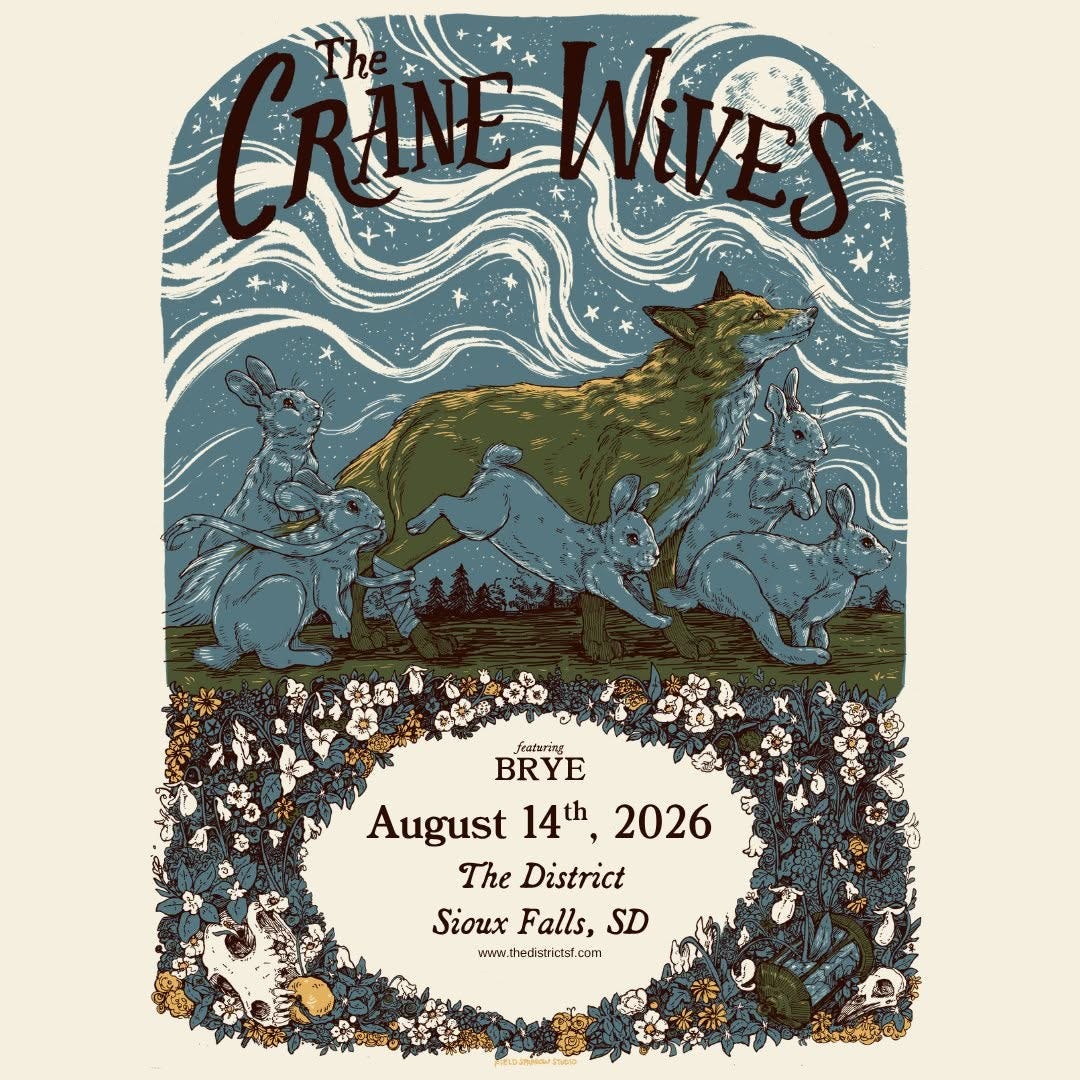
The Crane Wives Built Their Own Myth, Then Learned to Outgrow It
Ahead of their August 14 performance at The District in Sioux Falls, South Dakota, Emilee Petersmark and Dan Rickabus revisit the band’s hostile restaurant beginnings, slow-burning rise, unexpected internet rebirth and the courage required to keep changing.
The first review The Crane Wives ever received was brutal, during the girls early restaurant days.
Emilee Petersmark and Kate Pillsbury had convinced the manager of the Chinese buffet where they worked to let them perform on Friday nights instead of cleaning tables. It was the recession. Money was thin, neither of them wanted to spend another evening clearing discarded crab legs and playing music offered at least a temporary escape from waitressing.
The customers did not share their enthusiasm.
“It was a nightmare,” Petersmark said. “Everyone hated it.”
After their first performance, one coworker approached Petersmark with a concise verdict: “When you play, it annoying.”
Sixteen years later, the sentence still makes her laugh. More importantly, it clarified something. The music did not have to belong to the customers who wanted to eat quietly. It belonged to Petersmark and Pillsbury.
“That’s fine. They don’t have to like it,” Petersmark remembers realizing. “This was for me and for Kate and not really for the people who came to eat their Chinese food in quiet.”
That stubborn little revelation has survived every version of The Crane Wives: the acoustic group born during the folk boom, the bar band learning to overpower breweries at midnight, the independent road crew repairing its own van and the internet phenomenon whose older songs were suddenly adopted by animators, role-playing communities and a generation of listeners who had not been present for the lean years.
The audience eventually arrived.
The band was already moving without it.

Please consider Donating to Sponsor an article even $1 helps!


Cleaning up crab legs
Petersmark and Pillsbury knew each other through overlapping college circles and local performance spaces, but working together gave them enough time to recognize the shared hunger underneath their separate songwriting.
They had similar influences, complementary voices and a mutual desire to be almost anywhere other than the restaurant.
“We both hated waitressing,” Petersmark said. “It was one of the first times that I’ve ever had a job with somebody where we could commiserate together about wanting to be somewhere else, and we both had the same vision of what the other thing we wanted to do was, which was play music.”
Pillsbury’s songwriting gave Petersmark a kind of creative permission she had not experienced before. Here was another person willing to share the vulnerable material usually kept behind bedroom doors. Their voices settled together naturally. Their styles did not compete for space.
Asked whether there was a particular restaurant performance when the project began to feel serious, Petersmark did not need to search for one.
“I think night one, honestly.”
The rest of the original lineup assembled through a tangle of college friendships, open mics and recording-room keys. Drummer Dan Rickabus had grown up with banjo player Tom Gunnels. He had already noticed Pillsbury at a campus open mic before Gunnels invited him to start a project with a musician named Kate. Rickabus arrived at the basement rehearsal and discovered it was the same songwriter who had caught his attention onstage.
Pillsbury brought Petersmark into that developing circle. Rickabus, meanwhile, knew Ben Zito through a college audio club and admired his engineering knowledge. Rickabus had recently lost a job at a recording studio when the business could no longer afford to keep him, but the owner allowed him to retain a key and use the empty studio on Sundays.
Zito initially entered the orbit as an engineer. He was also, inconveniently for any plan that did not place him onstage, an excellent bassist.
“He always jokes that he used to just kind of look at us with the side eye, like, ‘You guys know you need a bass player, right?’” Rickabus said.
Zito eventually became much more than that. He now engineers the band’s records, manages the business and helps hold together the practical structure around the music. What began with a borrowed studio key became a working ecosystem.
The name was already taking shape before the full lineup arrived. Petersmark and the others were devoted fans of The Decemberists, whose album The Crane Wife drew from the Japanese folktale of the same name. Its story of love, sacrifice, secrecy and loss carried the emotional weight they wanted their own music to hold.
There was a brief discussion about whether a band containing men should keep such a feminine name.
“The boys decided that they could be wives,” Petersmark said.
The name remained. Its meaning did not.
Rickabus no longer instinctively thinks of the old folktale when he hears The Crane Wives. After sixteen years, the phrase has become shorthand for the people, records and accumulated history surrounding them. He thinks of the discography as a canon, an evolving narrative whose characters keep being revised.
For Petersmark, the name now describes a job, a business and a machine built through years of shared labor.
That machine was once four musicians wearing every possible hat. Sometimes it looked like Zito underneath a van in Colorado, using a piece of mattress spring to keep the exhaust system in place. Now it includes a larger touring crew and people trusted with responsibilities the four members once carried alone.
“The Crane Wives is the machine,” Petersmark said. “It’s everyone who makes the machine work, and it’s more than just the four of us now.”
Learning to play louder
The early version of The Crane Wives fit comfortably inside the West Michigan folk scene. Petersmark and Pillsbury played acoustic guitars. Gunnels picked up the banjo. Their arrangements leaned into songwriting and three-part harmony at a moment when the stomp-and-shout sound of The Lumineers and Mumford & Sons had moved folk music into the commercial center.
The band’s lyrics were rarely as cheerful as the melodies carrying them.
Petersmark had grown up listening to ska, a genre she loved for placing bright, buoyant arrangements against darker writing. The Crane Wives developed a similar tension. Their harmonies could sound inviting while the words underneath wrestled with anger, religious pressure, economic fear and the exhausting work of making oneself acceptable.
The region’s brewery boom sharpened the other half of their sound. Before concertgoers arrived eager to sing every word, The Crane Wives played loud bars filled with people who had been drinking since early evening and were not necessarily interested in stopping their conversations for an acoustic band.
They learned to meet the room where it was.
“You kind of have to bring the energy up,” Petersmark said. “We had a lot of practice doing that, and now I feel like it’s just kind of second nature for us.”
Those shows also stripped away romantic ideas about immediate success. The band played pizza shops, outdoor events and indoor rooms where almost no one listened. Rickabus believes those years gave them the legs to withstand the much faster growth that eventually came.
“We have the humility to just be like, this is a miracle, what we’re experiencing right now,” he said. “We know how much of a miracle it is, and we’re not entitled to it.”
Longevity became more important than appearing successful from the outside. Every member held other jobs at different points. Rickabus worked construction before the recording of Coyote Stories and Foxlore. Petersmark remembers the fear of surrendering the predictable income of an office job. The band invested heavily in those sister albums without any guarantee the effort would return to them financially.
“There’s a little bit of blind confidence you have to have,” Rickabus said. “A little bit of almost magical thinking to be a dreamer enough to be like, this is going to work for us. We’re just going to keep doing it.”
They kept digging into the arrangements whenever a song seemed to demand more. More layers. More instrumental color. More time in a studio they could not be certain would pay for itself.
The records cost them stability.
A decade later, they helped make stability possible.
The sound changed along the way. When Gunnels left the band in 2015, Petersmark and Pillsbury did not search for a new banjo player to preserve the previous arrangement. They bought electric guitars.
Petersmark briefly played banjo on a few tours, but recreating someone else’s parts felt hollow. It was easier to write something new. Older material from Safe Ship, Harbored and The Fool in Her Wedding Gown began acquiring sharper guitar lines and a different physical force onstage.
Coyote Stories and Foxlore became laboratories for expansion, filled with guest guitarists, strings, clarinet and arrangements that could not immediately be duplicated by four people at a concert. On Beyond Beyond Beyond, the scale remained, but much of the guitar interplay returned to Petersmark and Pillsbury.
The band had not abandoned folk music. It had stopped treating its original form as a fence.
The moon reflecting on a lake
Petersmark’s lyrics often arrive populated by bones, forests, animals, monsters and burning houses. These are not decorations hung around otherwise straightforward confessions. They are the vocabulary she uses when a feeling refuses to accept an ordinary name.
“I feel like when I write lyrics, I’m trying to evoke a vibe, and it’s hard to put into words,” she said. “I feel like it helps me put into words a feeling that doesn’t really have a name.”
Growing up in Michigan gave her a familiar landscape of woods and natural symbolism. Her visual art gave those images another place to take root. A song could begin alone in Petersmark’s or Pillsbury’s bedroom with chords, lyrics and a melody, then become a collective act once it reached the band.
Zito built bass lines underneath it. The other guitarist found a lead part. Each member constructed a harmony. Rickabus listened to the world described in the lyrics and searched for the correct texture on the drums.
The imagery could become an arrangement instruction. While their friend and tour manager Steve Leaf worked on the ambient guitar part in “The Moon Will Sing,” Pillsbury told him she wanted it to sound like moonlight reflecting on a lake.
“He did it,” Petersmark said.
That distance created by metaphor has also allowed Petersmark to approach her experience as a Korean adoptee in stages. “Never Love an Anchor” imagined love through absence, separation and the belief that releasing someone might be the only way to avoid hurting them. “Scars,” from Beyond Beyond Beyond, moved closer to the wound itself.
Asked what allowed her to write more directly, Petersmark’s answer was immediate.
“Therapy. Lots and lots of adoption-informed therapy.”
She had spent years keeping emotional distance between herself and the adoption. Her relationship with her adoptive family was complicated, and she lacked the language needed to explain feelings that were already difficult for adults to understand, much less a child.
The work involved therapists trained in transracial adoption and complex family dynamics. It also brought Petersmark back to South Korea for the first time since her adoption. She walked through the city where she was born and where she believes her birth mother may have lived.
There was no neat ending waiting for her there.
“It’s still a work in progress,” she said. “There’s no end destination.”
There was, however, a new capacity to speak and to recognize other adoptees through the music. Touring brought The Crane Wives into communities more diverse than the largely homogenous part of Michigan where Petersmark grew up. Looking into those crowds and finding people who understood the emotional core of the songs became its own form of repair.
“It feels very healing and unifying,” she said.
The audience finds the lore
Before the pandemic, The Crane Wives had already spent roughly a decade constructing a regional career. The first major online surge arrived through a South Park fan animation posted by a YouTube creator called Extra Ballz. The video used “Curses,” a track Petersmark considered something of a B-side on Foxlore.
The animation reached a million views. YouTube began recommending the band to adjacent fandoms and other animators. The numbers for “Curses” started climbing while the musicians tried to determine where the listeners were coming from.
“We couldn’t figure out why for the longest time until we found this video,” Petersmark said. “I think this is why, but I don’t understand any of the things that are happening in this video.”
The Crane Wives remained outside many of the fandoms adopting their work, but they were not dismissive of them.
“I support it,” Petersmark said. “I don’t necessarily get it, but I definitely support it.”
In some ways, the audience had found exactly the right band. Petersmark had once made playlists for her own Dungeons & Dragons characters. Watching listeners carry Crane Wives songs into campaigns, animations, queer narratives and fantasy worlds felt less like misuse than fulfillment.
“It was my dream, dude,” she said. “I think it’s such an honor to be used as the background music for your D&D campaign.”
The band does not insist on controlling what its songs mean once they leave the studio. Listeners have interpreted the early track “The Crooked, the Cradle” as everything from an oil-spill narrative to a Harry Potter story. Those readings may have little connection to the circumstances behind the song, but Rickabus sees no reason they cannot coexist.
“It’s yours now,” he said. “If that’s what it is to you, that’s what it is to you.”
The new audience also returned older music to the band in altered form. By the time “Curses” surged online, Petersmark had performed it for years in breweries where much of the room did not care. The fan art and animations reignited her own interest in a song she had begun to regard as exhausted.
That younger following has brought another responsibility. For many attendees, a Crane Wives performance is their first concert. The band knows that a first show can remain vivid for years, whether the memory is joyful or damaging.
They cannot control every element of a venue, but they ask about accessibility and safety plans and try to cultivate a crowd that feels friendly rather than predatory.
“We want to make sure that it’s a good and safe experience above everything else,” Petersmark said.

Staying true by refusing to stay still
Beyond Beyond Beyond arrived eight years after the band’s previous studio album and after its older catalog had been consumed by an audience the members never anticipated.
The obvious temptation would have been to reverse-engineer the qualities listeners loved in “Curses,” “The Moon Will Sing” and “Never Love an Anchor.” Instead, The Crane Wives returned to the same instinct that carried Petersmark and Pillsbury through the bad reviews at the Chinese buffet.
Make the thing that excites the people making it.
Rickabus remembers the band discussing what it meant to create a record now that people were waiting to hear it. Their answer was to preserve the raw emotion and collaborative spirit of the early work, not its specific sound.
“Staying true to what we’ve always done as artists meant specifically not staying the same sonically,” he said.
The band had briefly experimented with commissioned songs early in its career. The experience taught Petersmark that guaranteed payment could not replace ownership or pride. The lasting reward was not the promise of success but the process of building something that had not existed before.
“Making it, that’s just play,” she said. “Every other part is kind of work.”
That sense of play is now scattering into new projects. Rickabus released Ache in the Blooming, a layered solo record built with longtime collaborators and ideas gathered across different periods of his life. Petersmark is preparing DESTROY EVERYTHING, her debut album as Lee Emi, for an October 2 release. The name draws from Lee Sang-Eun, the Korean name she was given before her adoption. Zito produced the record, allowing Petersmark to enter a different musical space without severing it from the trust built inside The Crane Wives.
Rickabus believes those departures create fertile ground for whatever the band makes next. Individual expression does not drain the machine. It returns each member to it with unfamiliar tools.
That future is tied to the idea of radical hope running through Beyond Beyond Beyond. Petersmark does not define hope as larger rooms, stronger numbers or endless expansion. She sees it in the young artists arriving at concerts wearing costumes they sewed themselves and carrying fan art created from the band’s songs.
“Radical hope for The Crane Wives looks like inspiring a generation of younger musicians and creatives to make their own shit,” she said. “I know that these kids are going to make such cool stuff.”
For Rickabus, hope means growth of a more private kind: artistic movement, personal courage and a willingness to enter change without requiring proof of a happy ending.
“Change is just the natural flow of being alive,” he said. “Meeting that change with courage is what I hope we can continue to do.”
Afterglow
On Friday, August 14, The Crane Wives’ tour reaches The District in Sioux Falls with Brye. Doors open at 7 p.m. for the all-ages show, with music beginning at 8.
The room will not resemble that Chinese buffet.
People will arrive already knowing the lyrics. Some will be attending their first concert. Others may carry handmade art, elaborate costumes or private interpretations of songs the band released before those listeners were old enough to find them. A track once ignored in breweries may return from hundreds of voices at once.
The first audience wanted The Crane Wives to stop interrupting dinner.
The band kept playing long enough to find the people who came specifically to hear the interruption.
Please consider Donating to Sponsor an article even $1 helps!




