



Driving I-90 into the La Crosse area almost makes you forget what everyone keeps threatening about Wisconsin winter. The Mississippi River caught a clear blue sky as we crossed the Dresbach Bridge, white clouds and green trees reflected across the water. Barns started appearing beyond the highway, their weathered red boards cutting through fields and rolling hills while silos rose behind them. Traffic thinned. The farther we drove, the quieter everything looked.
Beautiful country. Still slightly terrifying to imagine all of that frozen solid.
The road eventually brought us east of La Crosse to Newberg Corners and Leo & Leona’s, the kind of roadhouse that does not need somebody to manufacture nostalgia for it. The place has been here since 1951, and its history is not hanging neatly behind glass. It is in the wood, the old tavern memorabilia, the strange collections on the walls and the little imperfections that have survived generations of people walking through the doors.
Leo & Leona’s
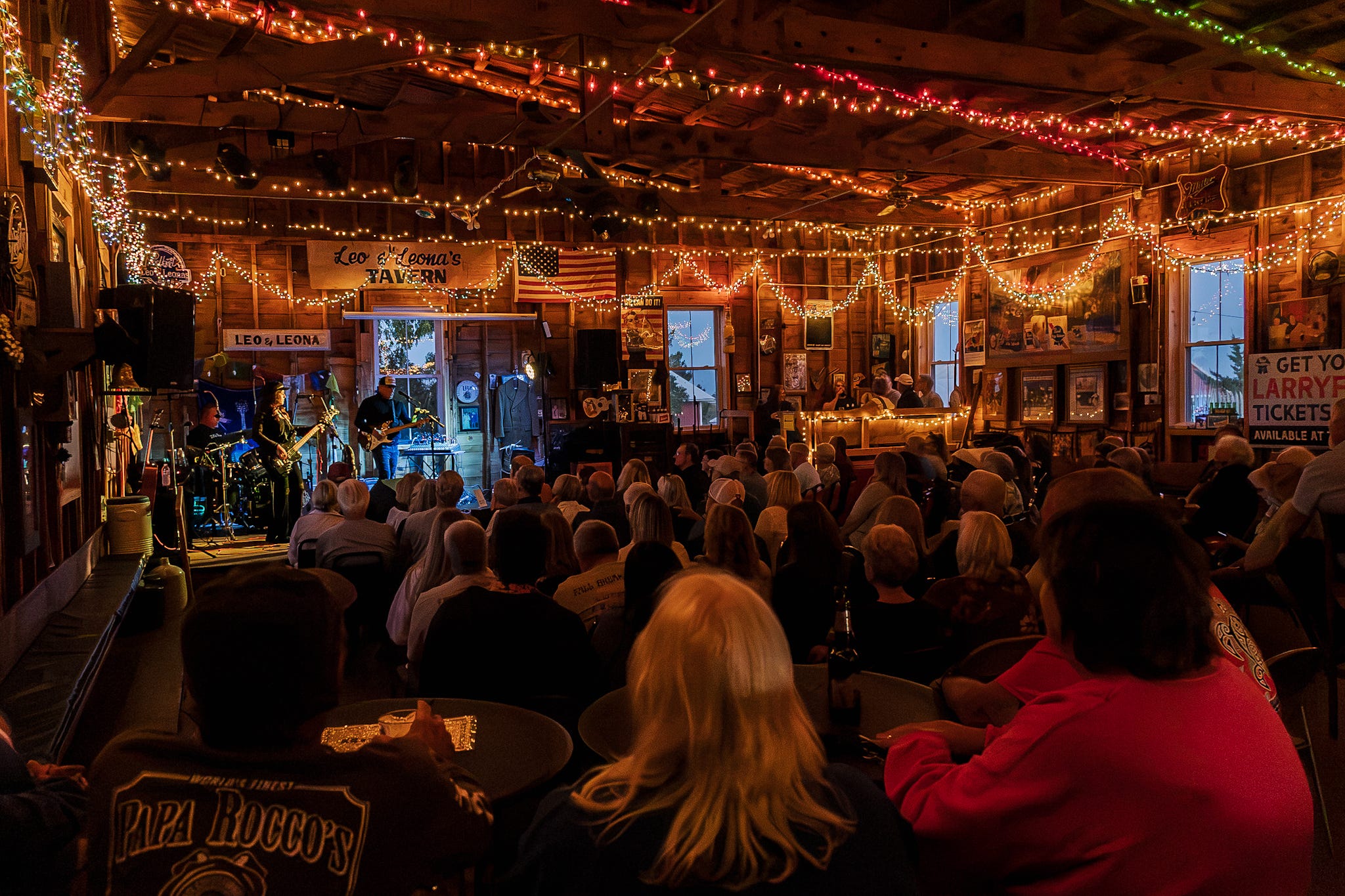
Terry Sebranek was sitting at the bar in a LarryFest sweatshirt when we arrived, smiling like someone who had been expecting company. He took me back into the dance hall before the room filled, and the first impression landed immediately: now this was storybook.
Unpainted wood covers much of the room. Christmas lights run around the hall and across the ceiling. Old band stickers are slapped across the load-in door, little fossils from whoever hauled an amp through there before us. Beer cases are stacked overhead in one section because apparently somebody once looked at an empty ceiling and thought it needed more beer boxes.


There is a raised side booth with benches wrapped around a single table, close enough to the stage that it immediately reminded me of one of those tucked-away booths in the Flora-Bama main room. The hall itself can hold around 150 people, but with the wooden floor, low ceiling and stage sitting right in front of you, it feels much more intimate once you are standing inside it.
The smell was part of the place too. Fresh-cut grass drifting in from outside mixed with stale beer, aged wood, dust and the faint old-house smell that comes with a building that has actually lived a little. It was not unpleasant. It made the room feel more honest. Nothing had been scrubbed into some artificial version of “vintage.” The place simply was old, warm and worn-in.
Around 1 p.m., the Veronica Jean Trio pulled in. The room was still empty, but not for long.
Soundcheckin’
Load-in might be one of the least glamorous parts of playing music, which also makes it one of the funniest to watch when you are lucky enough not to be the one carrying anything. The Mercedes Sprinter was packed like a game of high-stakes Tetris. Dewey, Smokey’s son, handled a lot of the heavy lifting, but nobody really escapes load-in. Someone inevitably decides that carrying two guitars, a cymbal bag and a backpack in one trip is somehow preferable to walking back to the van. Cables come out of a bucket labeled as organized, which of course means pulling out something resembling a dead sci-fi creature before finding the cable you actually need.
Drums emerged from what felt like 47 separate cases. Cymbal stands. Hardware. Pedalboards. Merch tubs. A kick drum large enough to rent as temporary housing. Then there is the soundtrack to all of it: the Dad Grunt, Hrrggh-ungh; the exhausted exhale, Pfffffhhh; cymbals going Clang-whang-clatter-shshsh; and eventually the inevitable moment when somebody catches a shin on something expensive and lets out a high-pitched Yyyyyoooooaaaawwwww.
From a distance, it looked mildly ridiculous. It also felt strangely calm because everyone knew what came next.
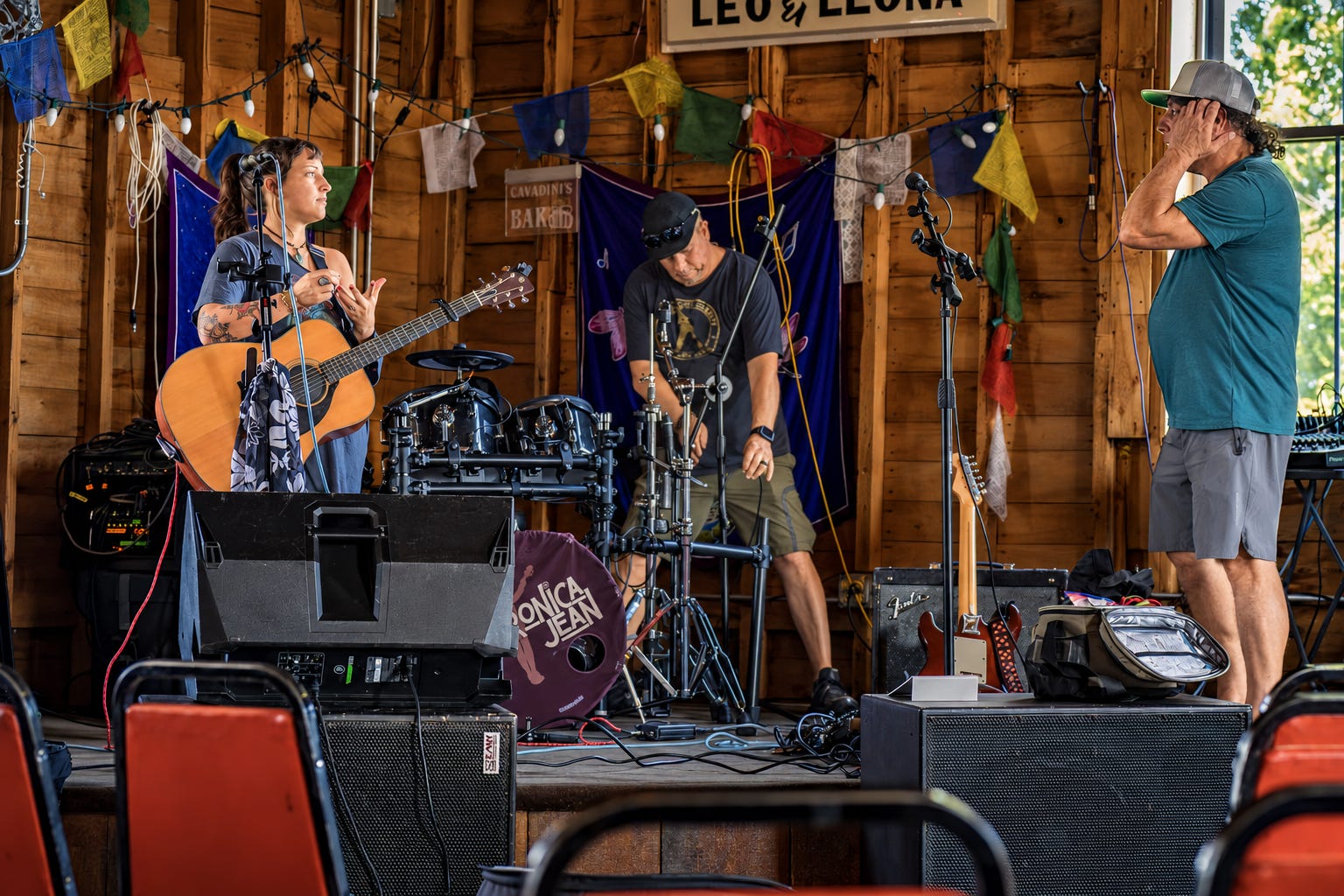
After being folded inside a van for hours, Veronica claimed a section of floor and started stretching, untangling herself until her muscles seemed to remember they belonged to a human body. At one point she attempted a handstand, because apparently normal stretching was not entertaining enough.
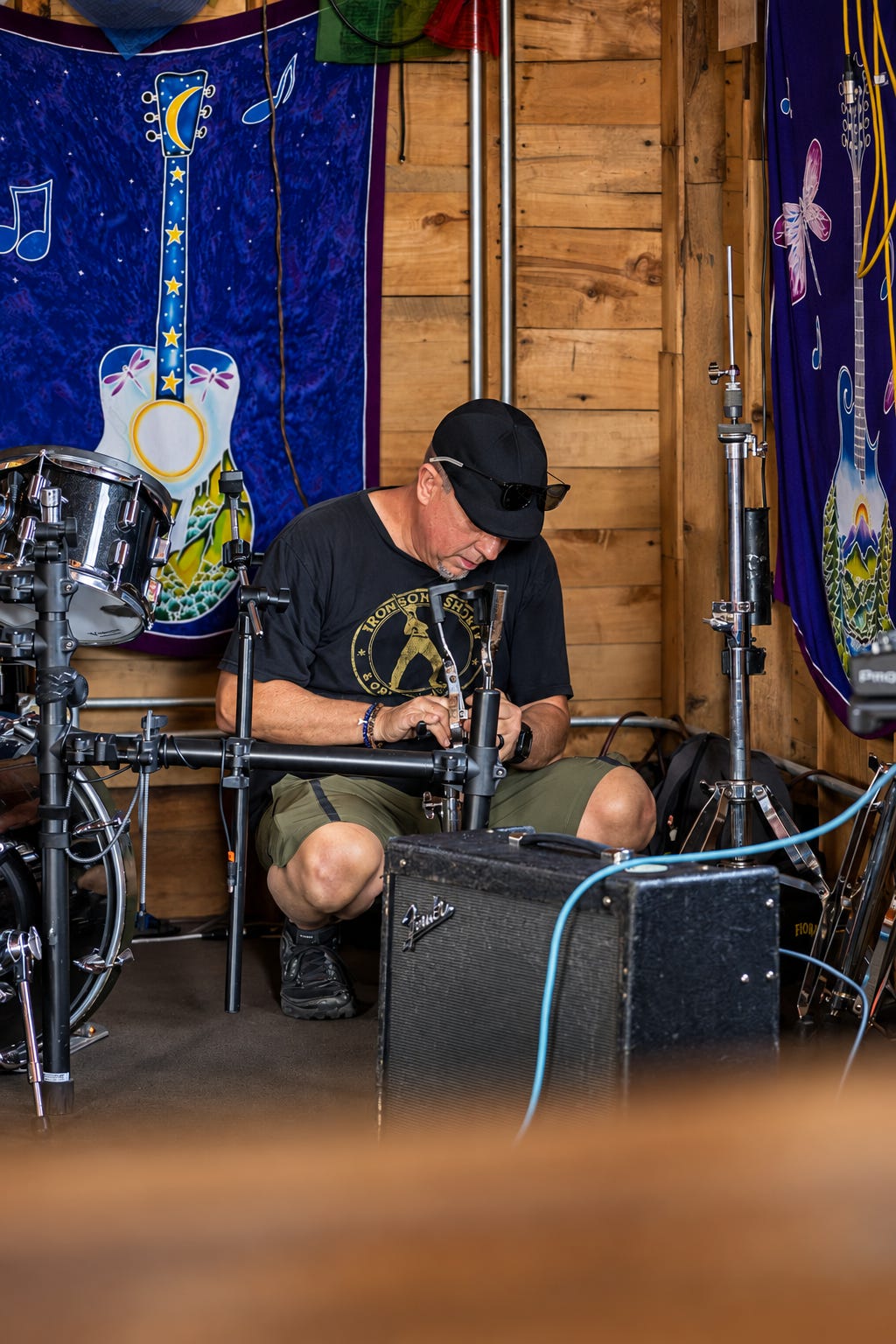
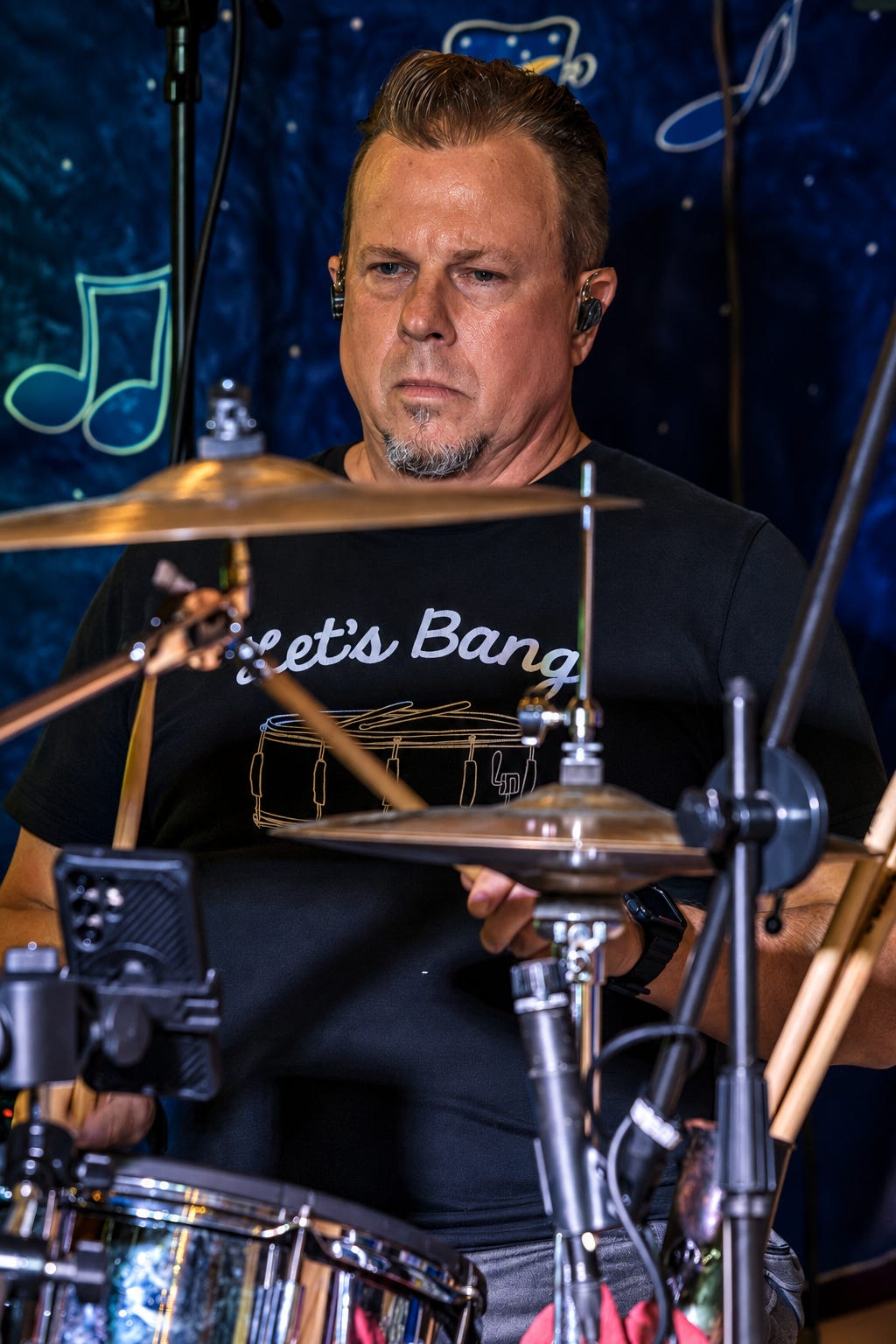
Meanwhile, Uncle Bob was working his way around the drum kit, striking each piece individually before settling on the kick. Again. Again. Again. For what felt like five straight minutes, while everybody else stared into the tired abyss.
More vocal in the monitor. A little more guitar. Less of that. More me. More you.
Soundcheck.
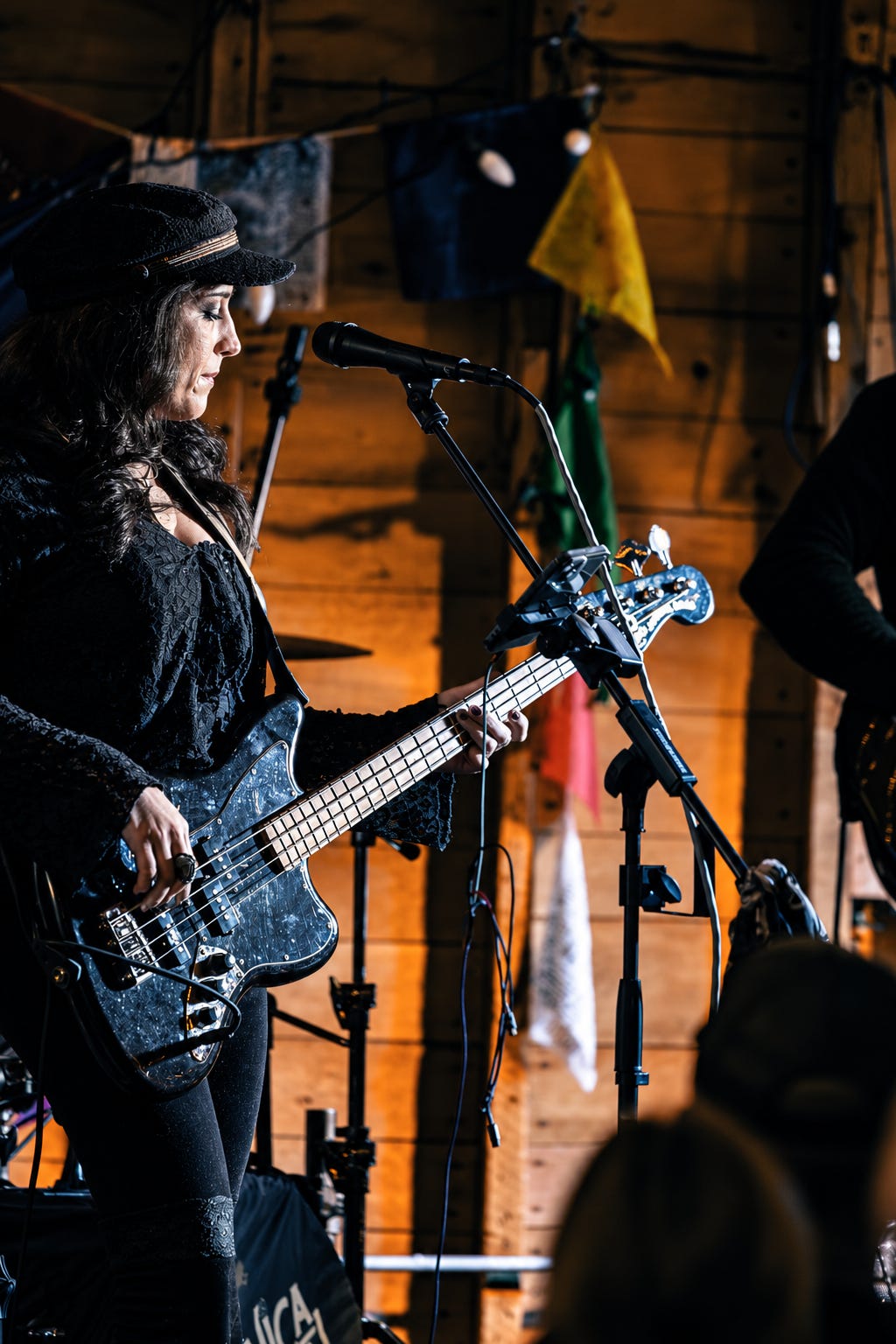
Then the bass came out.
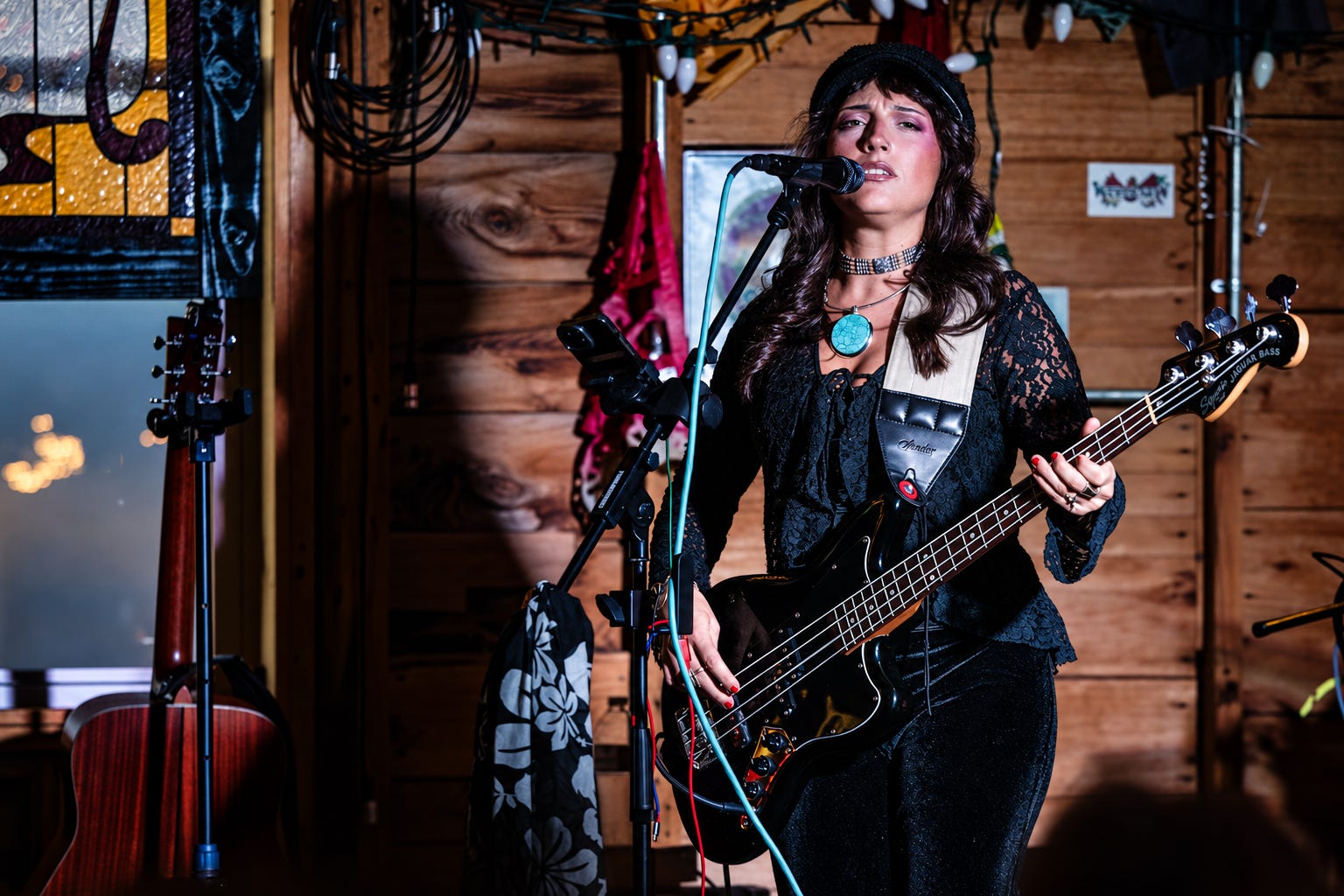
Playing bass while singing is already a fine way to ask your brain to run two operating systems at once, and Veronica moved through both without making it look especially complicated. She eventually switched to acoustic guitar and began warming up with Paramore’s “The Only Exception”, a choice that made sense after she mentioned Hayley Williams as one of her biggest musical influences.
There is some of that influence in the way Veronica approaches a vocal, not imitation so much as a willingness to let a pretty note get a little ugly when the lyric needs teeth.
“Am I good?” Veronica asked.
“your good,” Smokey answered.
She kept playing for another moment, then sarcastically tossed out “because none of it was ever worth the risk” while putting the guitar away.
Meanwhile, actual soundcheck problems had begun multiplying. Smokey stared down at the board trying to figure out why the power supply had apparently decided to leave this mortal plane. Cases needed new places to live. Cables migrated. Everybody asked for tiny changes that sounded meaningless until the right combination suddenly made everything work.
Dewey began working the room while the trio played. He is a musician himself under the name Shleem Pink, but for the afternoon his instrument was everything happening between the stage and the back of the hall. Smokey hit a note and let it hang. The low end rolled through the empty room longer than it needed to. Dewey listened, made an adjustment and had him hit it again.
He moved with his phone in hand, then toward the board, then onto the stage and back into the empty seats. A hand signal to Smokey. Another tweak. He was listening for the places where the lows collected too heavily, where a vocal might disappear once bodies filled the room and where enough volume could become too much volume.
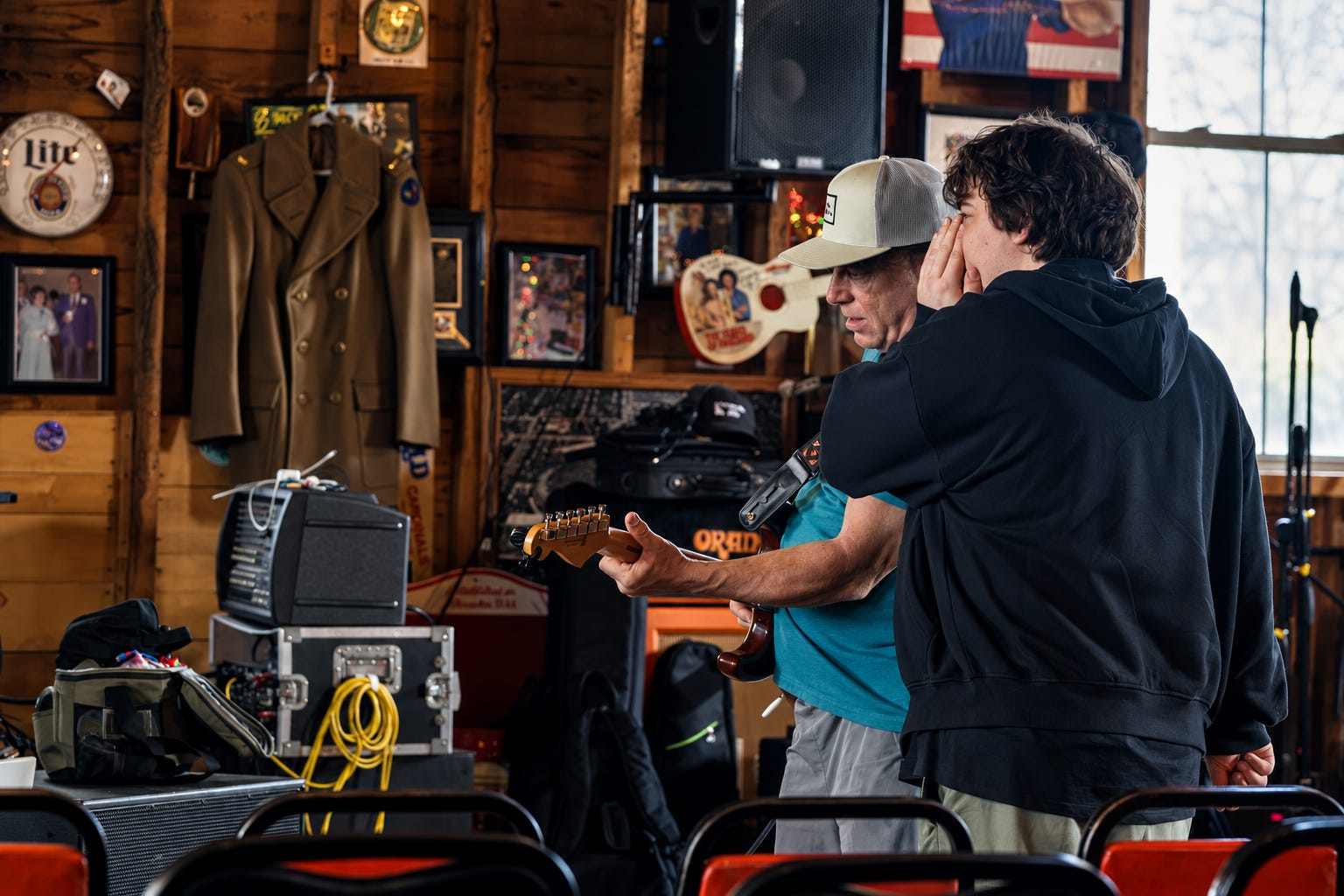
The hall made the process easy to hear. Empty, it has a warm hollowness. A guitar note carries beyond the stage and comes back at you. Kick drum hangs in the wood for a beat. Vocals reveal every little imbalance because there is nowhere for bad sound to hide.
Gradually, the boominess disappeared. The instruments stopped stepping on one another. Veronica’s vocal sat above the mix without becoming detached from it. Smokey’s guitar still had weight but no longer swallowed the room. Bob’s kick hit without hanging around three seconds after being invited.
Then everything clicked.
There was still plenty of time before showtime, but the hall already felt awake.
Please consider Donating to Sponsor an article even $1 helps!

Newberg Corners
By evening, those empty chairs were gone. Flocks reunited with flocks again as people who knew one another from winters down in Gulf Shores hugged after months apart. The Fall Break Tour merch table became its own congregation point while people crowded around for shirts. Seats filled. Then the back of the room filled too.
Standing room only.
There was a little nervousness onstage, or at least something resembling nervousness underneath the excitement. This was not a typical Veronica Jean Trio bar gig where people are immediately dancing, getting rowdy and occasionally appearing in an animal mask for reasons best left unexplained. Leo & Leona’s had more of a concert feel, almost a listening room. People were sitting there waiting, and that kind of attention can be more intimidating than chaos.
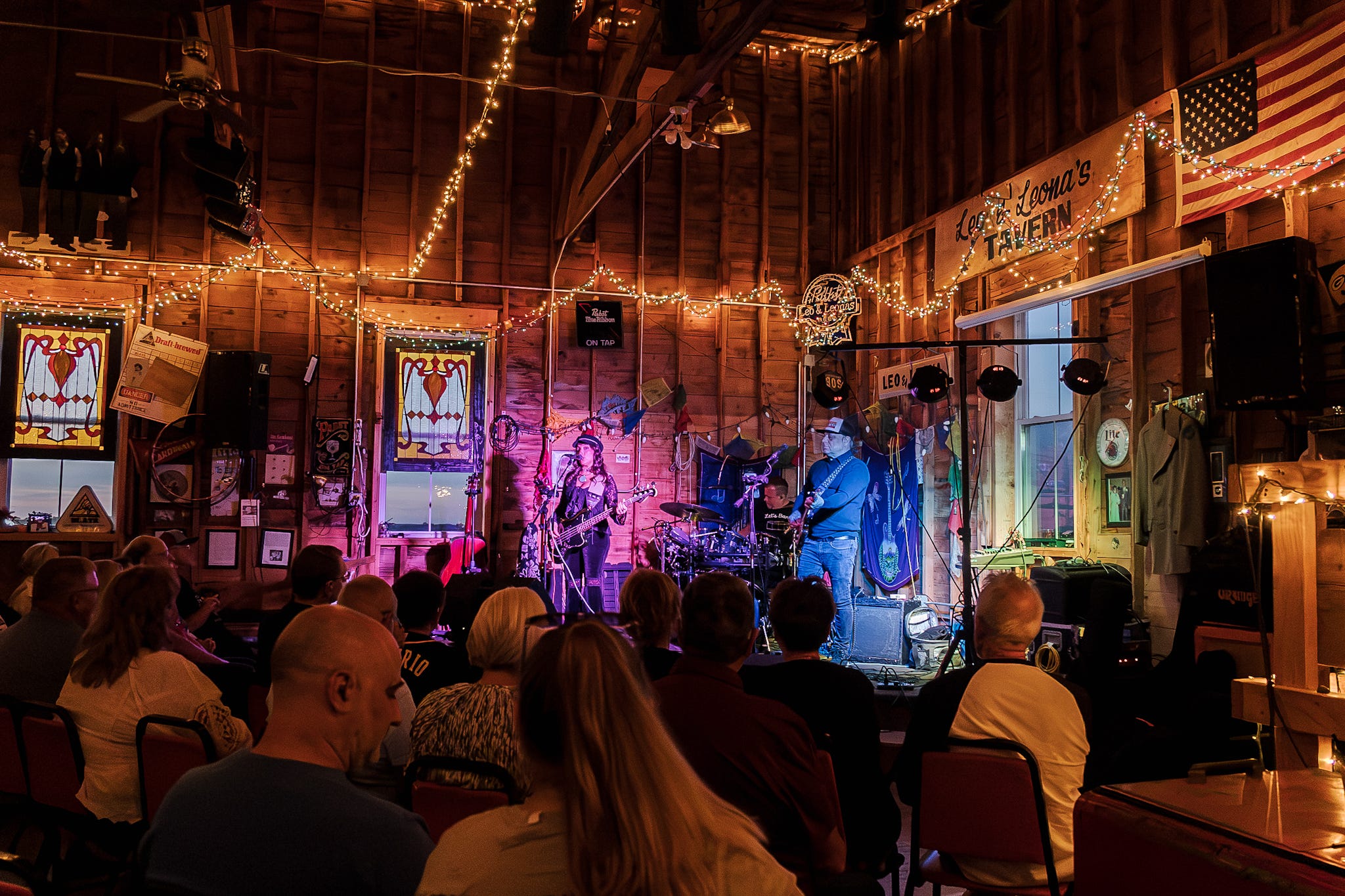
The first song took care of most of that. The room listened first, really listened, then gradually loosened. People started singing along. A few got up. Someone hollered. Another person answered. By the first set, those neatly seated rows had lost some discipline.
Maybe the Spotted Cow helped. Possibly just mine.
What became striking was how large the trio sounded without actually overplaying. Three musicians can expose one another quickly. There is no fourth or fifth player available to smear over an empty space. Bob has to hold the rhythmic center. Smokey has to decide when guitar should fill the room and when it should leave it alone. Veronica has to carry bass while keeping her voice free enough to move above it. At Leo & Leona’s, those parts sat together without turning muddy or crowded.
During Tracy Chapman’s “Fast Car,” Veronica and Smokey also demonstrated another part of their musical relationship: neither seems especially interested in remaining serious for too long. Veronica reached “See, my old man’s got a problem,” and Smokey, standing there with his acoustic guitar, suddenly started acting decrepit. He stumbled, shuffled and physically played out the lyric while Veronica tried to keep singing. She laughed. He laughed. The crowd caught it immediately.
There are little interactions between a father and daughter that cannot be rehearsed convincingly. This was one of them.
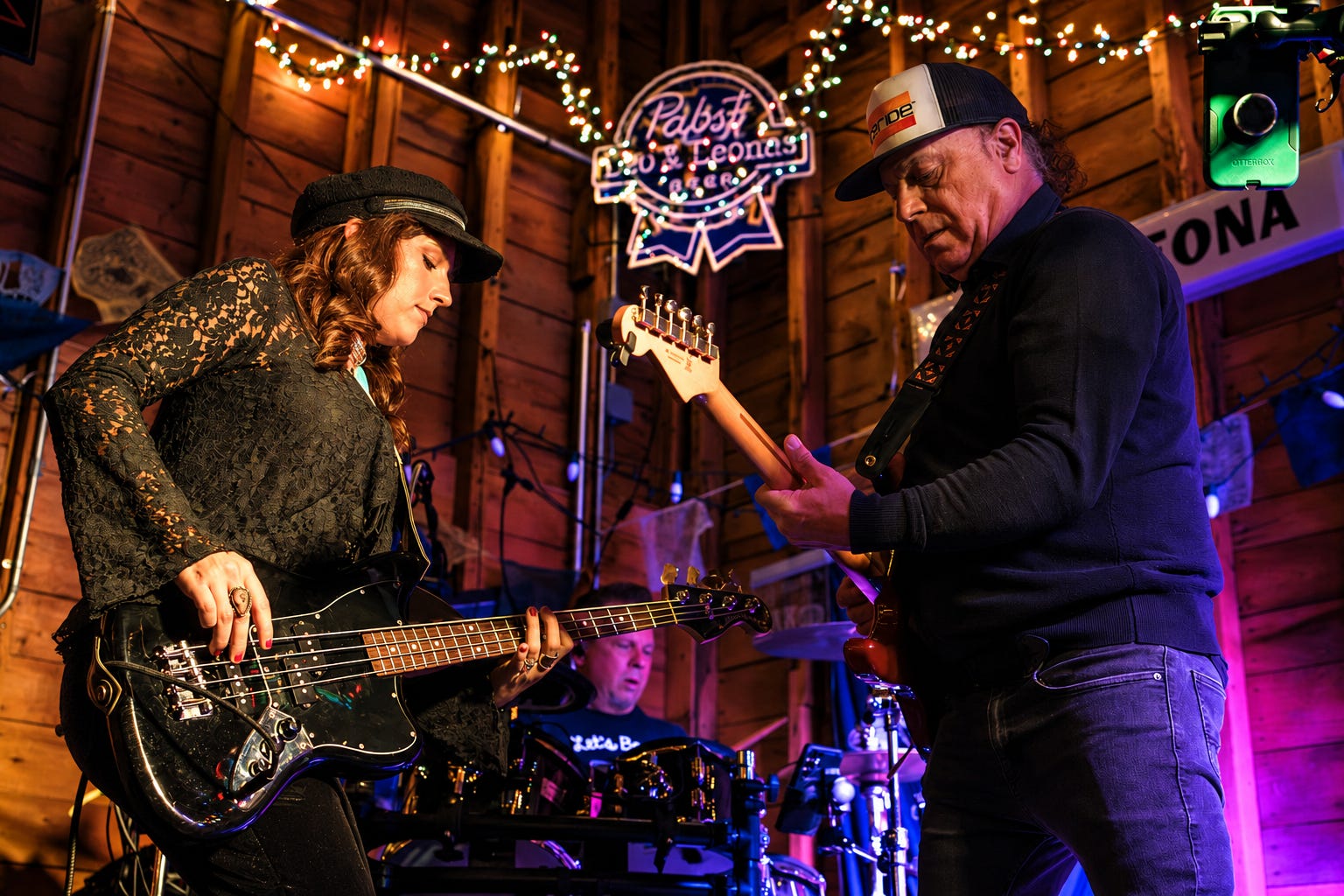
Veronica followed with Adele’s “Rolling in the Deep,” and the performance gave her room to show how much more controlled her voice has become. The verses sat low and dark, letting the grain in her tone carry the weight rather than forcing every phrase into a huge vocal moment. When she climbed into the chorus, the cleaner upper notes still had a slight rasp around the edges. Not enough to damage the pitch, just enough abrasion to keep the song from getting polished smooth.
Bob built underneath her with toms before snapping into a harder backbeat. His harmony arrived without pulling attention from the lead vocal. Bass, drums and voice kept tightening around one another until the song had more muscle than three people should reasonably have been producing.
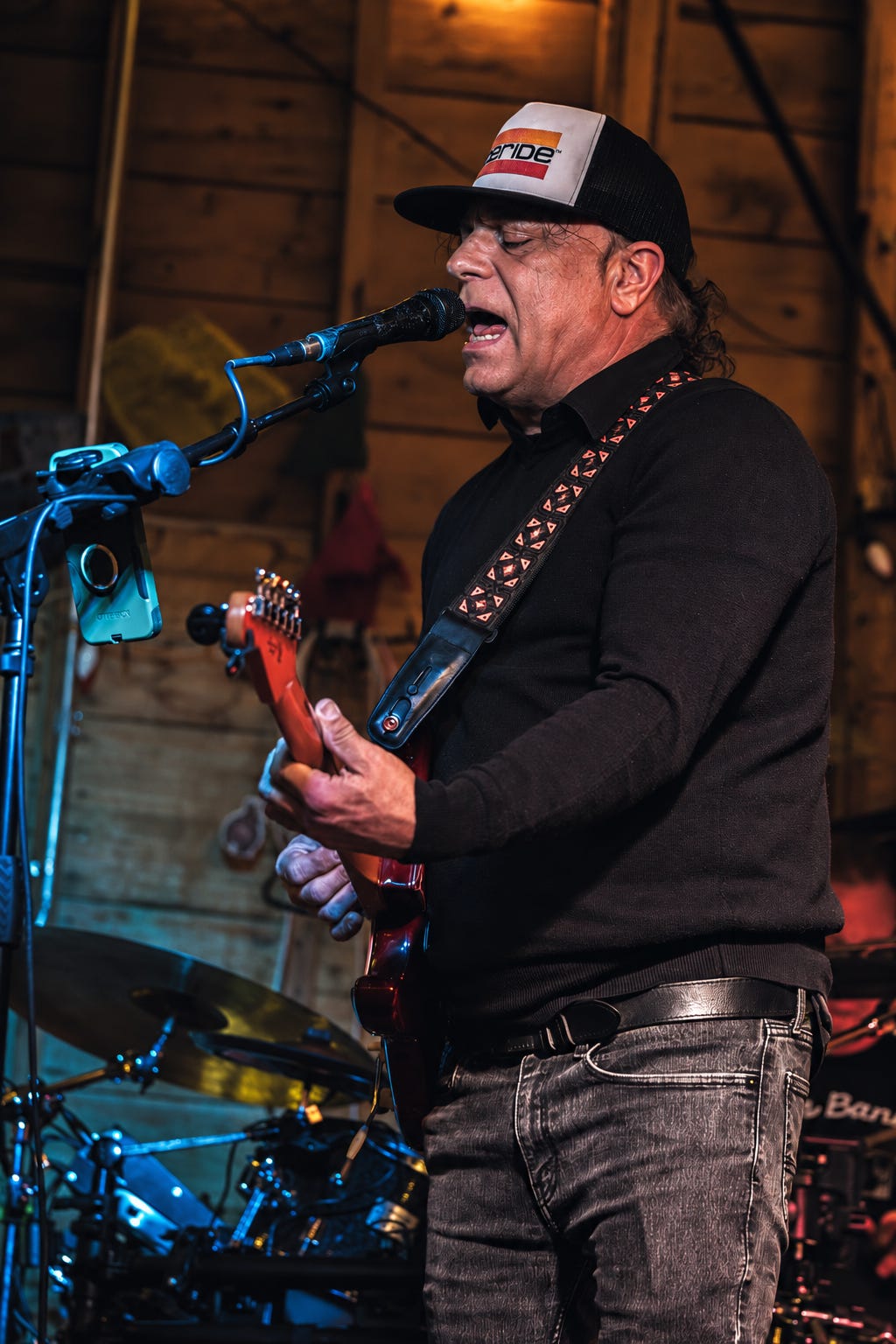
Smokey got his own moment when Prince’s “Purple Rain” entered the set. With Minneapolis sitting just over the state line, the dedication felt right for the room. Smokey changed the vocal treatment, adding reverb and delay, then leaned into the song with the gravel that defines so much of his singing.
Phones came up. Flashlights started waving. I am fairly certain an actual lighter appeared somewhere.
Smokey’s voice does not clean itself up for a song like this. The rough lower register stayed rough. The higher notes strained just enough to make the song feel lived-in instead of polished. Then his guitar took over. One note held steady while another string bent upward toward it, the pitch tightening until the two almost met. Conversation disappeared.
When Smokey sings, people stop and listen.
Then, because emotional consistency is apparently overrated, the trio broke into “La Bamba” and a conga line formed. Not a cute little five-person conga line either. Thirty-plus people started circling Leo & Leona’s, making one pass, then another, then another, picking up accomplices while onlookers filmed the evidence and encouraged increasingly poor behavior.
For a few minutes, we might as well have been back at the Beach House in Gulf Shores on a Monday.
Veronica kept flipping the set again. Meredith Brooks’ “Bitch” gave way to Joan Jett’s “I Love Rock ’n’ Roll,” and then came Elvis Presley’s “Can’t Help Falling in Love.”
Pardon me, but I now have whiplash from this musical freight train.
The song arrived with almost none of the force of what had come before it, which was exactly why it worked. Couples started moving toward the dance floor, some holding each other with the easy familiarity of people who had probably danced together more times than anybody could count. The trio let the arrangement breathe. Smokey softened the guitar and tucked his harmony behind Veronica instead of beside her. Bob settled into a restrained groove and resisted decorating every open space.
Veronica opened the first line softly, letting the phrase come out warm and breathy before a darker color settled into the rest of the verse. The song carries decades of other people’s memories with it, but she did not fight that history or try to overpower it. She also did not disappear inside it. The phrasing remained hers, and so did the tone.
After Meredith Brooks, Joan Jett and a thirty-person conga line, she had somehow quieted the room.
That was a much harder trick.
Afterglow
Two nights earlier at Peer’s Bar, the Sandbirds-coming-to-the-Snowbirds idea had mostly been funny. Gulf Shores musicians flying north to the people who usually migrate south. A reversal of the winter pattern. An excuse for bird jokes, Spotted Cow and a 95-year-old man dancing to Johnny Cash.
Leo & Leona’s gave the idea another layer.
The people in that room were not simply fans waiting for a band to play recognizable songs. They had relationships with these musicians. They knew one another from another state, another season, another bar. Hugs happened before the show. People bought tour shirts. They sang lyrics back. They formed a thirty-person conga line because apparently dignity had already left Newberg Corners for the evening.
In the middle of all of it stood Veronica Jean.
Back home, Smokey carries a reputation into nearly every room before he plays a note. He is the larger-than-life singer, the guy who seems to know a thousand songs, the voice people recognize. For years, the easiest introduction for Veronica has been obvious: Smokey’s daughter.
There is nothing negative about that shadow, and watching them together makes that clear. She learned around music. She plays beside her father. They laugh through songs. They trade instruments, harmonies and jokes. Smokey does not look like someone worried that his daughter might become too good.
Near the end of the night, he spoke about her over the microphone and told the room how proud he was. The emotion underneath it did not need polishing. Veronica has only been seriously giving this music thing a go for about three years, and her father sounded like someone who had been close enough to see all the parts an audience does not: the first attempts, the rough gigs, the nerves, the little improvements that happen one show at a time until suddenly there is a night like this one.
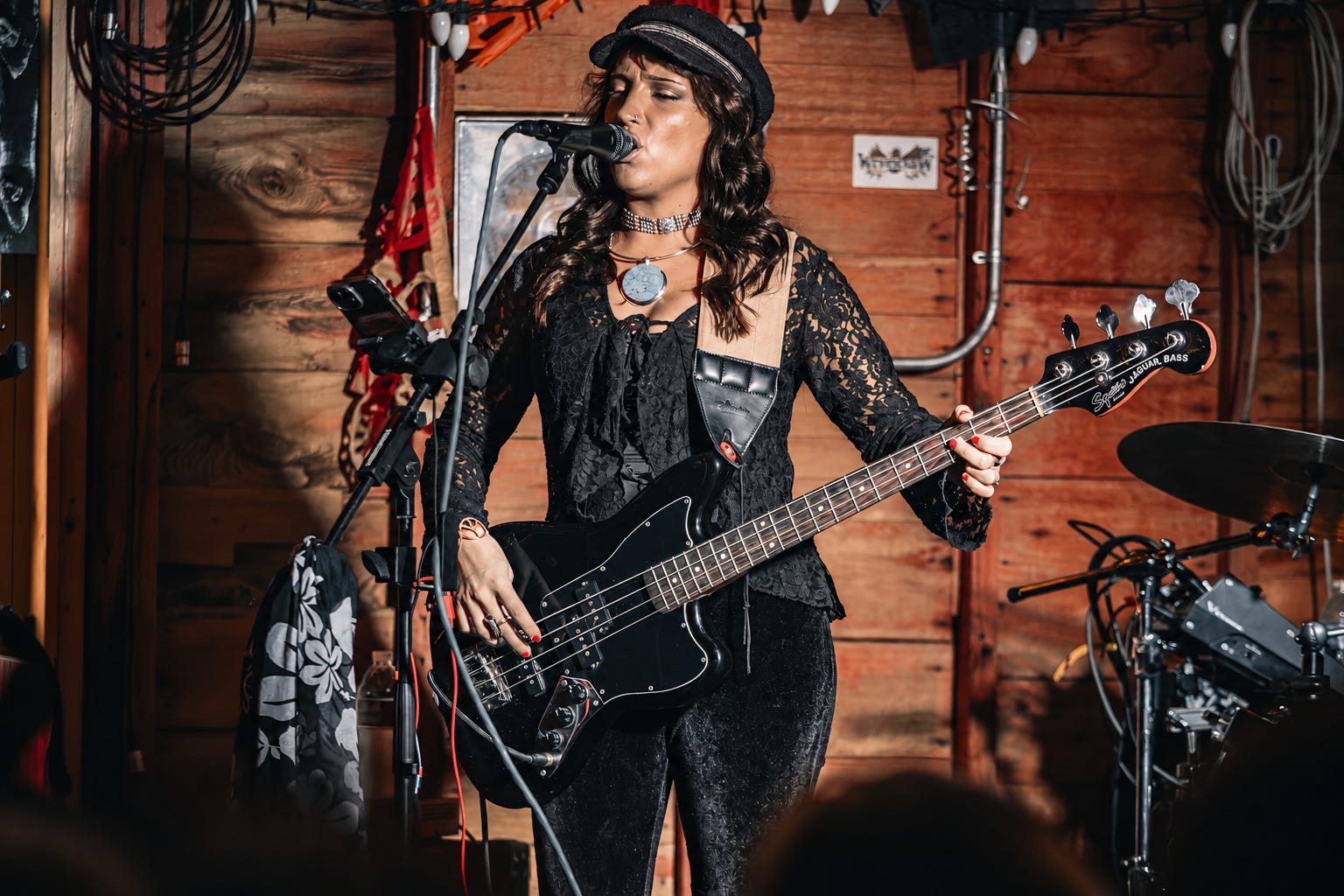
At Leo & Leona’s, being Smokey’s daughter felt less like a definition and more like where the story started. She did not need him to step aside for her to step forward. You could hear it in “Rolling in the Deep,” where she trusted the grit in her own voice instead of chasing somebody else’s. You could see it during “Can’t Help Falling in Love,” when couples moved together and she held the room without trying to overpower it. Somewhere in that first set, the early nervousness disappeared.
She started owning the room, not loudly and not by trying to outdo her father, but by sounding increasingly like herself.
The family around her made that possible without making it easy. Uncle Bob stayed locked behind the kit. Smokey pushed and backed off when the songs asked him to. Dewey had spent the afternoon making sure what they were doing onstage could actually reach everybody correctly. Bob is not related by blood, but after enough miles, load-ins, soundchecks and gigs together, that technicality starts feeling pretty useless.
Family was all over this show. It was in Smokey clowning around during “Fast Car,” in Dewey chasing a bad low frequency through an empty hall hours before anybody else would ever notice the difference, in Bob holding the groove while Veronica stretched a vocal and in a father telling a room full of people how proud he was of his daughter.
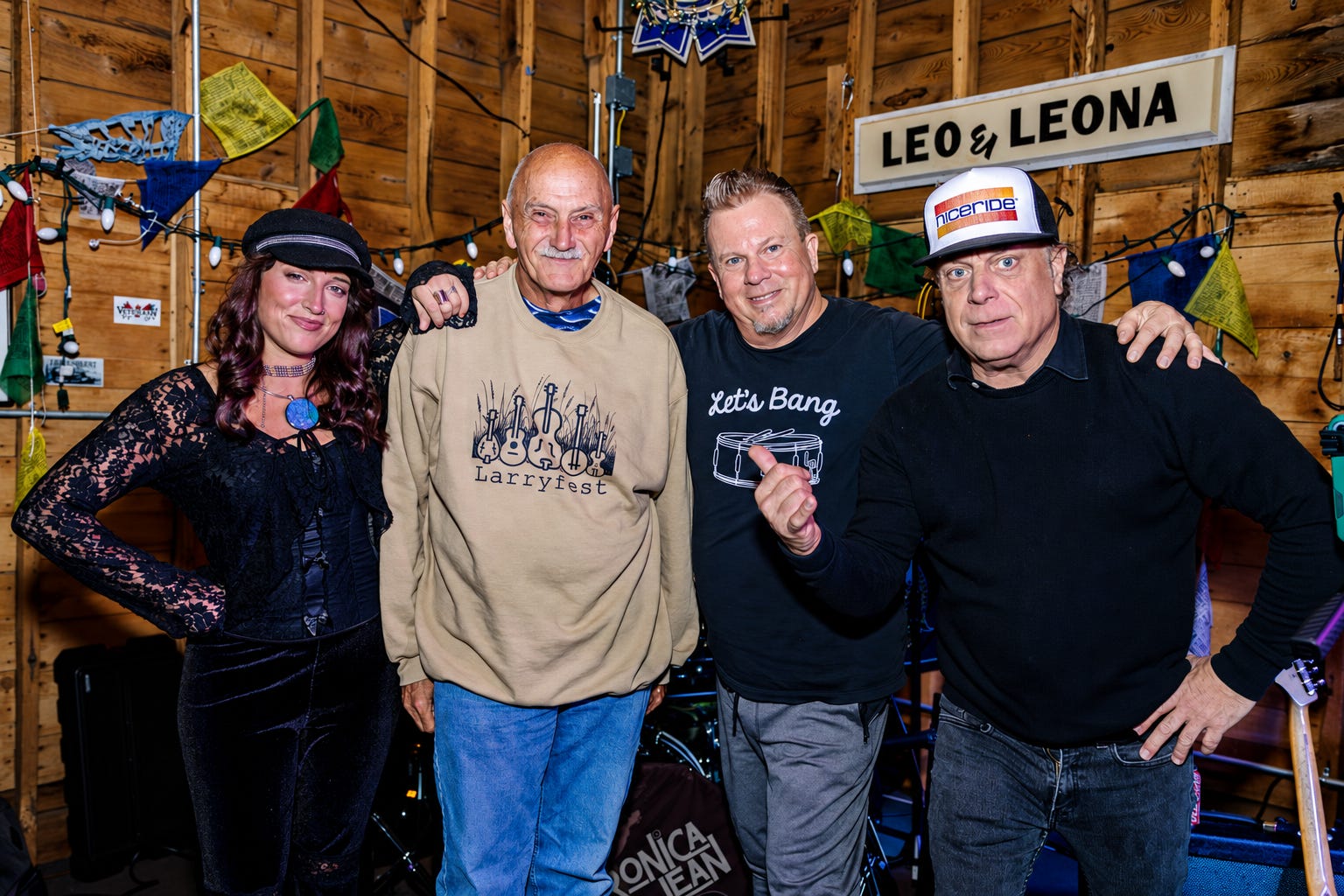
Sometimes applause almost felt secondary, not because the crowd was quiet or unimpressed, but because there were moments when the appreciation already seemed to be sitting between the stage and the chairs before anybody put their hands together.
Leo & Leona’s was built for that kind of night. The old boards, Christmas lights, beer boxes overhead, stickers on the load-in door and all those years of music already absorbed into the place did not make the show good. The three people onstage did that. But the room knew exactly what to do with them.
Peer’s Bar had started this Wisconsin run with dancing under the pines and Snowbirds welcoming the Sandbirds north. Leo & Leona’s brought everybody closer. For three hours, the world outside Newberg Corners became extremely easy to ignore.
Then the lights came up, and the ordinary work started again. Cases had to be closed. Cables had to return to the alien-creature bucket. The Mercedes Sprinter waited outside for another round of high-stakes Tetris.
West Allis was next, with the Fall Break Tour finale at Reunions Restaurant on September 13.
All aboard the freight train. YEEEEEEHHHAAAWWWWW!
Please consider Donating to Sponsor an article even $1 helps!
