


Technical Analysis contained in this post was performed manually by Andrew Jodice of Markets, Liberty, & Discipline. He’s studied and blends Al Brooks’ theory, Richard D. Wyckoff’s theory, and Charles H. Dow’s theory to conduct his analysis, and implements Al Brooks’ strategy to execute trades.

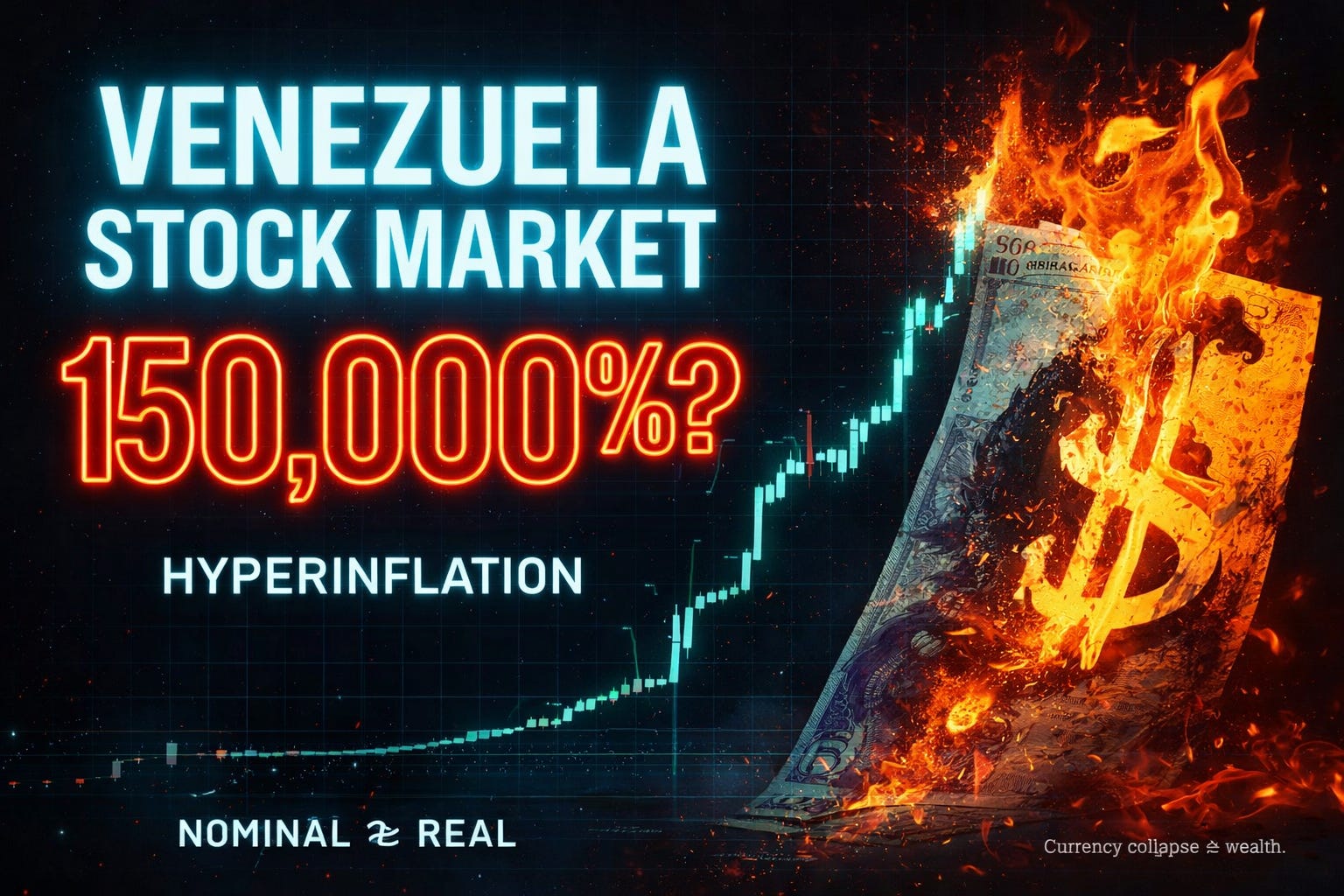
A 150,000% increase in the Venezuelan stock market is a number so big, that it stops investors skepticism mid stride. It feels like Venezuela used a cheat code for their stock market.
However, any investor who’s worth his weight in gold, first verifies the math. Followed by interpreting what the math does and doesn’t mean. The reason for doing so in the macro sense, is it is the fastest way to get conned. We never want to start with the story, only to later find ourselves asking whether the numbers even existed.
Lets start with two published endpoints to gain a better understanding of the Venezuelan market
On Jan. 5, 2021, the Caracas Stock Exchange’s main index (IBC) closed at 1,381,986.75. (Datosmacro.com)
On Jan. 5, 2026, the Bolsa de Valores de Caracas reports the IBC closed at 2,597.68. (Bolsa de Valores de Caracas)
Those numbers look incompatible until investors remember a key mechanical detail, Venezuela redenominated its currency on Oct. 1, 2021 by cutting six zeros off of the Bolívar (a 1,000,000:1 conversion). Reuters described it as the country’s second monetary overhaul in three years. (Reuters)
A currency redenomination does not create wealth. In simple terms it is just an accounting operation that moves the decimal point. That way prices and ledgers stop looking like astrophysics calculations scrawled across Einstein's chalkboard.
It doesn't mean investors cannot compare “old-Bolívar” stock index points to “new-Bolívar” stock index points, without first finding out what the real value of the Bolívar is when compared against the US dollar or gold.
Investors can’t compute a return until both endpoints are expressed in the same ratio. The October 1, 2021 redenomination removed 6 zeros, so the January 2021 index level must be converted into post-redenominated Bolívar before investors can understand what the real value of Venezuelan assets are.

Quick Math Check on the numbers
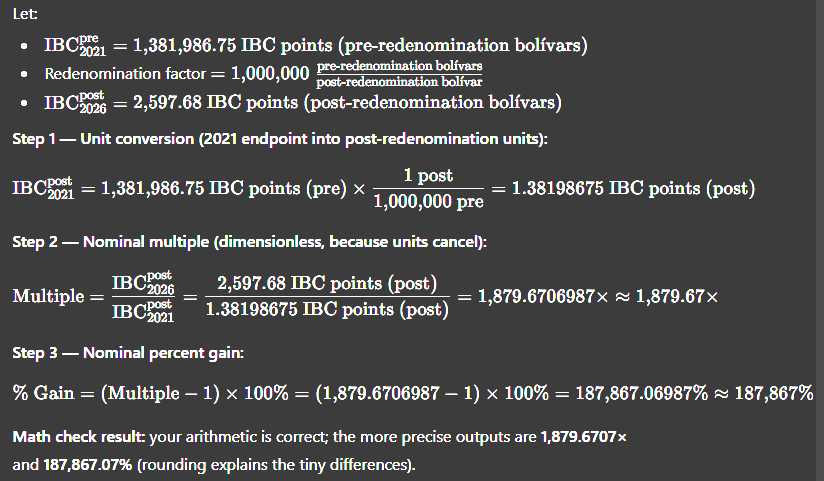


The Venezuela stock market is up over 150,000% is not only plausible, it’s actually a conservative number depending on the exact start & end dates investors use for the calculations. The chart is telling the truth although in a narrow arithmetic sense.
Let's explore where financial “news” tries to mislead investors with a technically correct number by smuggling in a false intuition.
Venezuela’s inflation history has been full of news articles from around the globe supporting the “hyperinflation optics” framing of the Venezuelan economy.
If investors are staring at a near vertical stock index, located in a country that has experienced devastating currency destruction, the first hypothesis should be, that the Venezuelan Bolivar has melted down ever since the now ex President Maduro took power.
The Venezuelan central bank reported inflation numbers for 2021 were 686.4% (down from a massive 2,959.8%!!!! in 2020), per Reuters reporting. (Reuters)
Reuters also reported inflation of 234% in 2022. (Reuters)
For 2023, Reuters reported central bank data showing 189.8% inflation. (Reuters)
And for 2024, Reuters reported President Maduro telling lawmakers inflation was 48% year-on-year. (Reuters)
Those are still ugly numbers even after the deceleration. More crucially is the act of redenominating the Bolívar itself, is a giant red flashing neon sign that the currency has been abused so badly that daily life in Venezuela needs a reset button.
When a countries currency is comparable to a meme coin in cryptocurrency, the story is always one of central banks abusing the currency, rather than a story of prosperity for the Venezuelans.
When money fails, history has shown that it typically fails in three critical roles simultaneously.
First, money is supposed to be a medium of exchange, a store of value, and a unit that one can count on remaining stable. Under hyperinflation conditions the Bolívar function became especially cursed. Prices still move in the market, but the measuring stick investors are trying to use to analyze the market are shrinking as they use it.
When a stock index is quoted in the broken measuring stick, the market can still go vertical while the real economy is stagnant, or where the average household is getting poorer as
the underlying businesseses aren't innovating or expanding. The economy is propped up by government printing.
This is why investors keep two definitions on their desk for a return, nominal and real returns.
A “nominal” return is measured in Bolivars, before adjusting for inflation. (Investopedia has a clean explainer on the nominal rate of return.)
A “real” return adjusted for inflation to reflect purchasing power. (Investopedia’s definition of real rate of return.)
In a collapsing currency, nominal returns can become loud, theatrical, and emotionally persuasive… meanwhile the real returns are the quiet truth hiding out in the back of the report on a tiny little spreadsheet hiding a dirty secret.
From an Austrian economics angle, this isn’t a side note, it’s literally the point. When central planning & fiscal monetary abuse finally destroy the Bolivar, it will also destroy the price signals in the Venezuelan market. When price signals become corrupted, capital allocation becomes a game of “guess what the government will break next” instead of “ what will the government fund that consumers actually value.”
That’s why the market can look like it’s “booming” in charts while society looks like it’s grinding down in real time. The chart is reporting nominal repricing under monetary decay, not broad-based wealth creation.
The main take away is that stocks can still outperform cash during currency breakdown.
This should all sound quite familiar to the Americans who have been paying attention to politics and markets on the global stage, in conjunction with the monetary policy in the United States since the creation of the Federal Reserve.
Americans were moving towards Venezuela’s fate at a lightning speed with all the printing, fraud and abuse under the Biden Administration that has come to light. Factor in the globalist sympathizers in the Democrat and Republican parties who printed and then dumped 5x the number of dollars ever created into circulation in 4 short years than all the years going back to the creation of the federal reserve in 1913. I hope that gets investors attention and they start seeing the bigger picture. The USA is the last country standing in the way of an unelected, and unregulated, one world government.
The real battle of our generation isn't a Democrat or Republican fight, but rather a pro-Globalist and pro-Freedom of individual rights.
Once investors start looking at politicians in terms of those who push policies to bring about a one world global government or policies and politicians who support individualistic ideologues.
Investors can easily discern who the players are on each team by using those two simple rules.
Back to Venezuela. Hyperinflation means people didn't get rich, but it also does not imply that the stocks were useless.
In hyperinflationary conditions, holding local currency cash is often financial suicide. Scarce assets become “less bad” stores of value as more and more paper is printed. Venezuelan equities, especially companies tied to real assets with hard goods or the ability to export with dollar-linked revenue, act as partial shelters or stores of value compared to the Bolivar.
That’s not a bull case for the country. It’s an indictment of the Bolívar.

A viral chart is a single slice of a complicated reality.
Here’s what this chart doesn’t answer on its own.
What was the real (inflation-adjusted) return?
To know that, investors need a consistent CPI series over the same dates and investors need to compute the real return explicitly.What was the USD return? Investors need a reliable bolívar per USD exchange rate series that matches what investors could actually access. In countries with multiple exchange rates and restrictions, this gets messy fast. However, this is where many of the big investment firms really make their money exploiting these inefficiencies.
Could an investor actually realize the gains?
Frontier markets can have thin liquidity, wide spreads, limited access, and meaningful institutional risk. Add in capital and exchange controls, government restrictions on moving money and converting currency, and the gap between “paper gains” and “realizable gains” can become near impossible. Investopedia’s primers on capital controls and exchange controls are useful for framing that risk.
None of this is Venezuela specific doom saying. It’s basic market structure hygiene. A nominal chart is the beginning of analysis, not the end.
Sound money is not a vibe, it’s infrastructure. Ron Paul made “sound money” feel like a political slogan. It isn’t. It’s the plumbing of successful civilizations.
When the state monopolizes money and then over issues it to fund deficit spending, while subsidizing allies, and postponing hard reforms, investors don’t just get higher prices. Investors get crushed when the economy loses its ability to be effectively measured with any kind reliability.
Free markets are decentralized discovery machines. Prices are how they talk. Break the currency and the language becomes jumbled and impossible to discern.
Once the language has been scrambled, people don’t just stop making decisions they're forced to make them in a fog of fear, and coercion. That’s how investors end up with charts that scream “record highs” while households barely have enough food to feed themselves nevermind the family pet.
The practical takeaway is to not get hypnotized by nominal fireworks. Here’s the discipline I use when looking at a chart from Venezuela or similar to a market.
Check for currency redenominations and index rebasing before I trust longterm percentage moves.(Reuters)
Re-measure performance in a stable currency or commodity such as USD or gold. If investors can’t do that, investors don’t know what they actually own.
Treat huge nominal returns as a signal to investigate monetary conditions first, not as an invitation to be a new poster boy for Wallstreet Bets over at Reddit.
In short, nominal returns are what the earlier chart shows investors. Real returns are what an investors life feels like.
Educational Disclaimer
This article is for educational and informational purposes only and does not constitute investment advice or a recommendation to buy or sell any security. Investing and trading involve risk, including the possible loss of principal. Trading leveraged instruments (including futures and derivatives) can result in losses that exceed your initial investment. Many short-term and active traders lose money over time. Consider your financial situation, objectives, and risk tolerance, and consult a qualified, licensed financial professional before making investment decisions.
Glossary and Further Reading
Caracas Stock Exchange / Bolsa de Valores de Caracas (BVC) — BVC official site
IBC Index — BVC market update example
Hyperinflation — Investopedia: Hyperinflation
Nominal Return — Investopedia: Nominal Rate of Return
Real Rate of Return — Investopedia: Real Rate of Return
Capital Controls — Investopedia: Capital Controls
Exchange Controls — Investopedia: Exchange Controls
Crack-Up Boom — Investopedia: Crack-Up Boom

