


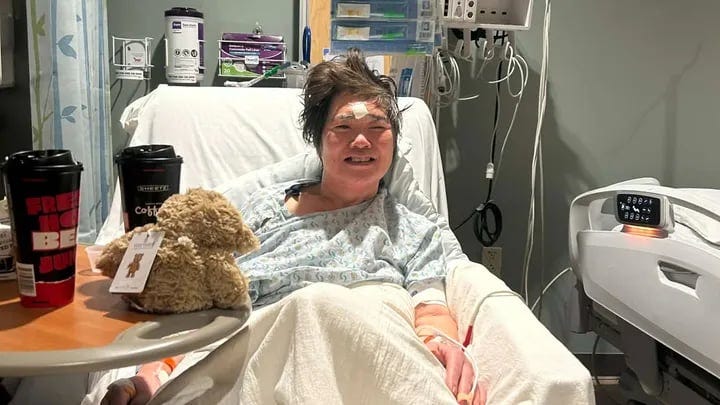
Not being any type of medical professional myself, only having a masters degree in psychology (Addictions counseling)—I list, in retrospect, some of my wife's past medical history that may well have been “road signs” indicating the growth of her now-known glioblastoma.
My wife is 56 years old now, and over the last ten years she has experienced a series of seemingly unrelated medical issues that, when viewed together in the context of her current diagnosis, paint a clear picture of an emerging tumor in the left cerebral hemisphere. The pathology report confirms a classic primary IDH-wildtype glioblastoma with a full molecular profile that includes TERT promoter mutation C260T, EGFR mutations p.A269V and p.V774M, PTEN mutation p.F21Lfs*3, TP53 mutation p.R262W, CDK4 copy number amplification (13 copies), 7p/7q region copy number gain (3 copies), CDKN2A hemizygous copy number loss, and copy number losses in the 6q, 10q, and 14q regions. MGMT promoter methylation was negative by allele-specific PCR, meaning the tumor is unmethylated and therefore more resistant to temozolomide (Temodar), the chemotherapy commonly used to prevent cancer cells from repairing DNA damage after radiation.
I know, that's a lot of medi-speak, but I want to establish—short of posting all of my wife's info—that this is a real experience we are going through.
Backwards Gazing
The first noticeable signs appeared as general “arthritic pain” in her right shoulder and right knee, with no specific injury or trauma to explain it. Because the tumor sits in the left hemisphere—which controls the right side of the body—these right-sided complaints may have been early motor or sensory disruptions caused by the slowly expanding mass and surrounding edema. At the time, however, they were dismissed as ordinary age-related wear and tear.
Next came a total hysterectomy prompted by a non-malignant mass that had grown on her right ovary. Not long afterward, she required gallbladder removal—not because of stones, the usual culprit, but because the gallbladder was “working too fast,” a hyperkinetic state that may have reflected subtle autonomic imbalance from left-hemisphere irritation.
Her gait began to lose its smooth rhythm, and she noticed a very slight change in the strength of her left leg and foot. Although the left hemisphere primarily affects the right side, early mass effect and edema can sometimes produce subtler or compensatory symptoms. Doctors examined her and found nothing conclusive.
As an ESL speaker whose first language is Korean, she also developed a very slight stutter, especially noticeable when speaking English. Many patients with left-sided glioblastomas retain better fluency in their native language than in a second language they have spoken proficiently for years; the tumor’s location in language-dominant areas selectively taxed her English word recall and articulation while sparing Korean more effectively.
Mentally and emotionally, she has taken medication for mild general anxiety for many years—the effects of being a long time 'Army wife' and mother of 3 children. In the past few years, however, we observed a significant drop in the effectiveness of her anxiety meds along with worsening sleep problems. We now understand these as may having been classic manifestations of cerebral edema surrounding the glioblastoma, which increases intracranial pressure and disrupts normal neurotransmitter balance and sleep regulation. What looked like “just more anxiety” was, in reality, the tumor’s growing footprint inside her skull.
None of these issues, when they appeared one by one over a decade, would have prompted any physician—including a psychiatrist who is also a licensed neurologist—to order a head CT or MRI. Each symptom on its own was explainable by common, benign conditions. Only when viewed retrospectively, against the backdrop of the confirmed molecular diagnosis, do they line up like road signs pointing straight to the left-hemisphere mass.
I have not been able to find anything in medical journals or generally available information that “connects the dots” between a person’s past medical history, cognitive behavior, or mental-health changes and the eventual diagnosis of this specific type of glioblastoma. The tumor’s molecular drivers are considered sporadic, arising from random somatic mutations in neural stem cells rather than from any single environmental or inherited trigger.
Why tell all of you? Because glioblastoma is still widely considered a health issue of usually elderly persons, yet my wife is not elderly. At 56 she is over 50, but not as old as the typical patient. Medical information shows a growing group of people from their mid-30s to mid-60s being diagnosed with the same aggressive type of tumor as my wife’s—a non-methylated, IDH-wildtype glioblastoma. Its DNA profile makes it resistant to temozolomide, the drug used to help prevent cancer cells from repairing themselves after radiation. This makes the tumor much harder to treat. (It is important to keep in mind that no cancer is truly “curable” once you have it; you always live with the knowledge that it could return.)
It probably would not have mattered much if the tumor had been found earlier, other than possibly reducing the current severity of her symptoms. It may have been slightly more operable, but only a little. Operating on a left-sided tumor carries real risks of affecting speech and the ability to walk or move normally.
And maybe the scariest part is that it is not caused by anything known to science. No healthy habits would have prevented it. Whatever is driving this silent increase in cases among people in industrialized nations—particularly in the broad mid-30 to mid-60 age group—is neither clearly identified nor preventable at present. It is something common to both the United States and South Korea, where my wife and I grew up. One memory that comes to mind is us as kids chasing the “smoke truck” driving through our neighborhoods spraying for mosquitoes. They did that in Korea as well. But no one knows for sure, and medical research tends to focus far more on developing new treatments than on investigating possible sources.
I have looked into cell phone use, not that I ever thought it would be the cause—which has been extensively researched, and there is no established causation or correlation with glioblastoma. Besides, my wife never even used a cell phone until about 18 months ago, and even then she used it only for apps, never holding it to her head for calls.
I share our story in the hope that it helps other families and caregivers recognize that a constellation of otherwise ordinary complaints—right-sided pain, unexplained visceral surgeries, gait changes, language quirks in a bilingual speaker, and suddenly refractory anxiety—can occasionally be the quiet heralds of a left-hemisphere glioblastoma. In an era when we have advanced molecular profiling and adaptive platform trials at cancer research centers, earlier awareness might translate into earlier intervention and better symptom management, even if the disease itself remains sporadic and difficult to prevent. Much like early detection and intervention is done for children being found early on with learning disabilities or autism spectrum disorders.
Be willing to advocate for yourself with urgency. If something feels wrong and no one is connecting the dots, say so plainly, document the symptoms, and press for further testing or another opinion. It is better to risk sounding insistent than to let a serious problem go unexplored.
My wife’s journey is still unfolding. The unmethylated MGMT status and the DNA composition of her tumor mean standard chemoradiation offers more limited benefit, yet the precision of her tumor’s genetic map also opens doors to biomarker-driven trials targeting very specific pathways to the tumor that are known to neuro-oncologists. We remain grateful for the science that has given us this detailed roadmap and hopeful that sharing our experience contributes, in some small way, to greater understanding and support for others walking this same difficult path, even if only ONE READER comes away from this essay and gets a tumor detected and treated early, I will call it “victory”, with unrequited love, even if I never know you.

Editors note: Please consider donating to the GoFundMe Ted set up to help cover travel and other expenses they’ve accrued during this difficult time for their family.
Ted has also provided his Cashapp where direct donations can be sent: $TEDAGENS

Thanks for sharing this story. May they be blessed with the strength to meet this challenge.