



Technical Analysis & Financial Analysis contained in this post was performed manually by Andrew Jodice of Markets, Liberty, & Discipline. He’s studied and blends Al Brooks’ theory, Richard D. Wyckoff’s theory, and Charles H. Dow’s theory to conduct his analysis, and implements Al Brooks’ strategy to execute trades.

The silver tape is no longer a single direction story of silver to $95. It’s now a high stakes game in a volatility regime.
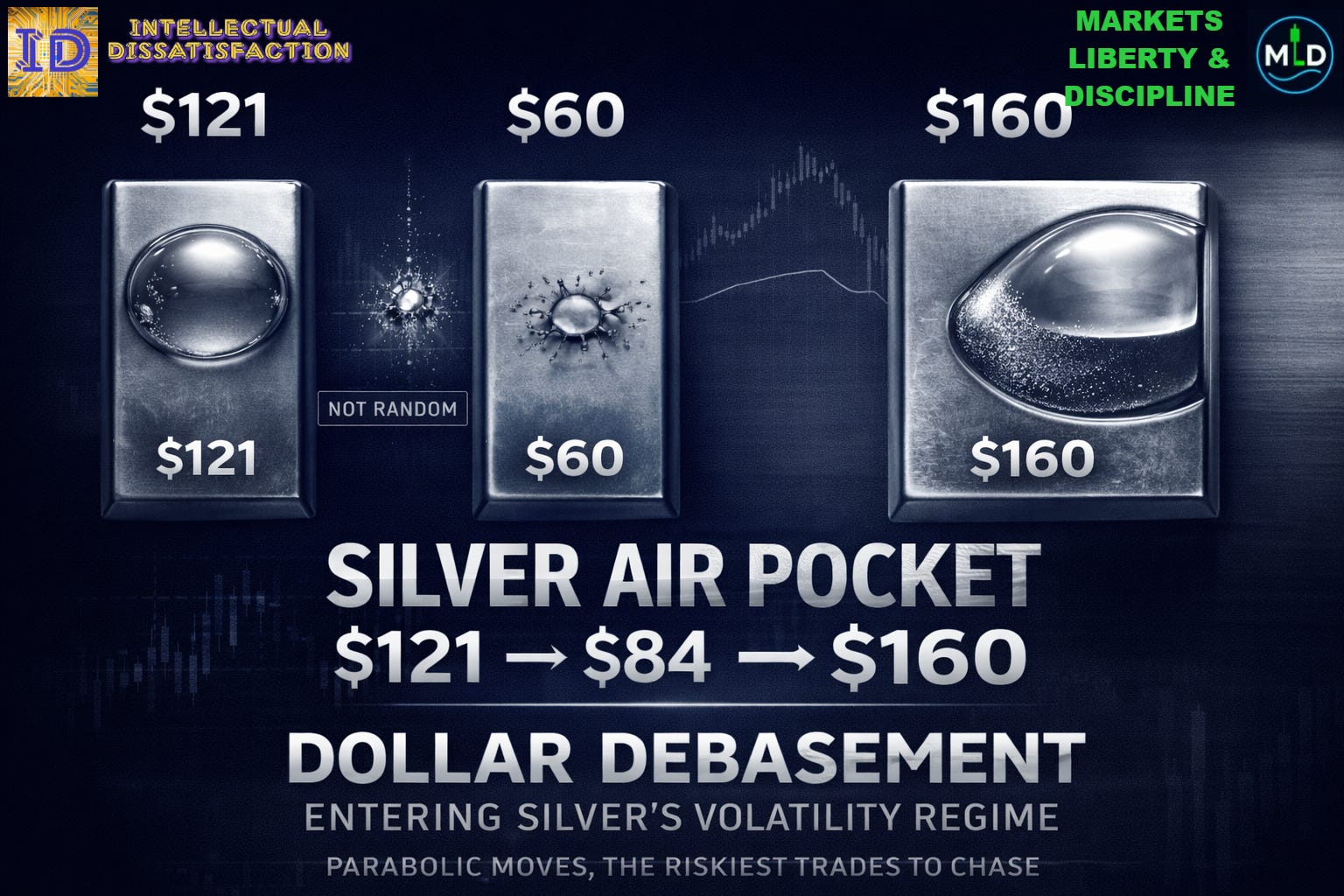
Reuters reported future silver down 27.7% to $83.99/oz at 1:57 p.m. ET on January 30, 2026 (1857 GMT), after trading as low as $77.72/oz the same day; it also reported future silver hit a record high of $121.64/oz on Thursday, January 29, 2026. (Reuters)
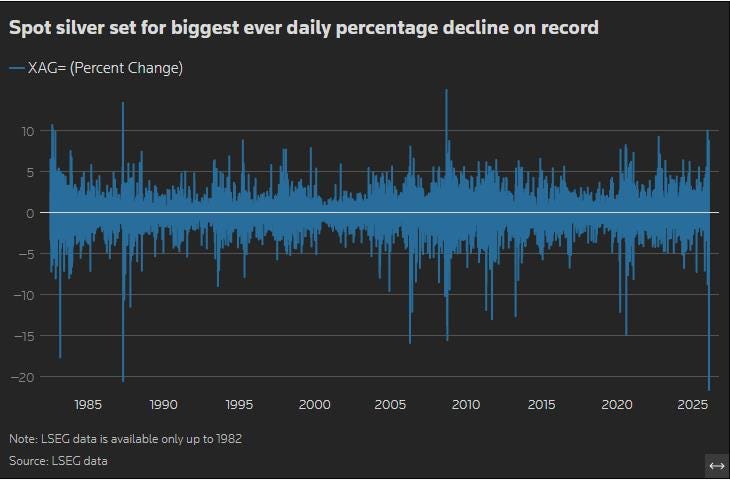
In the prior silver upswing, Reuters also reported spot silver “briefly reaching $95.87/oz” on January 20, 2026, before easing. (Reuters)
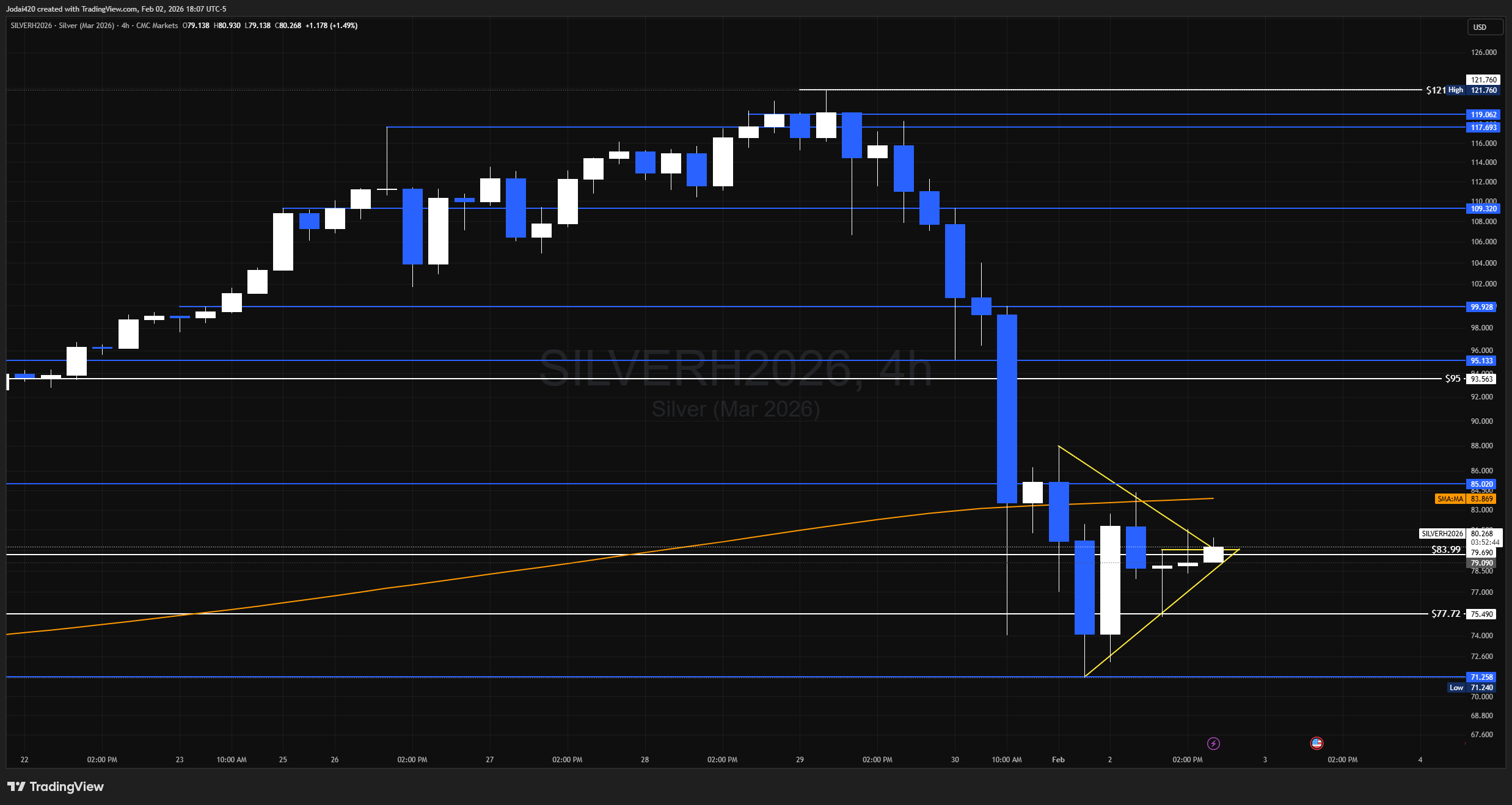
If investors want the macro interpretation that survives a cross examination, start here. Silvers price chart looks consistent with a regime where long duration risk is repriced, policy credibility is fragile, and positioning with leverage turns every macro headline into a forced move.

Term premia and why the long end matter
The Federal Reserve Bank of New York published “Treasury term premia” estimates (ACM model) as a measure of compensation that investors demand for holding longer maturities rather than rolling over short term exposures according to the Federal Reserve Bank of New York.
When term premia rise, the price of duration falls. That puts pressure on anything financed by the low discounted rates. Volatility propagates across rates, FX, and commodities, because of hedging costs and collateral constraints all being repriced together at the same time.

Japan’s 40 year yield, the ‘Global Circuit Breaker’ People Ignore Until it’s already tripped

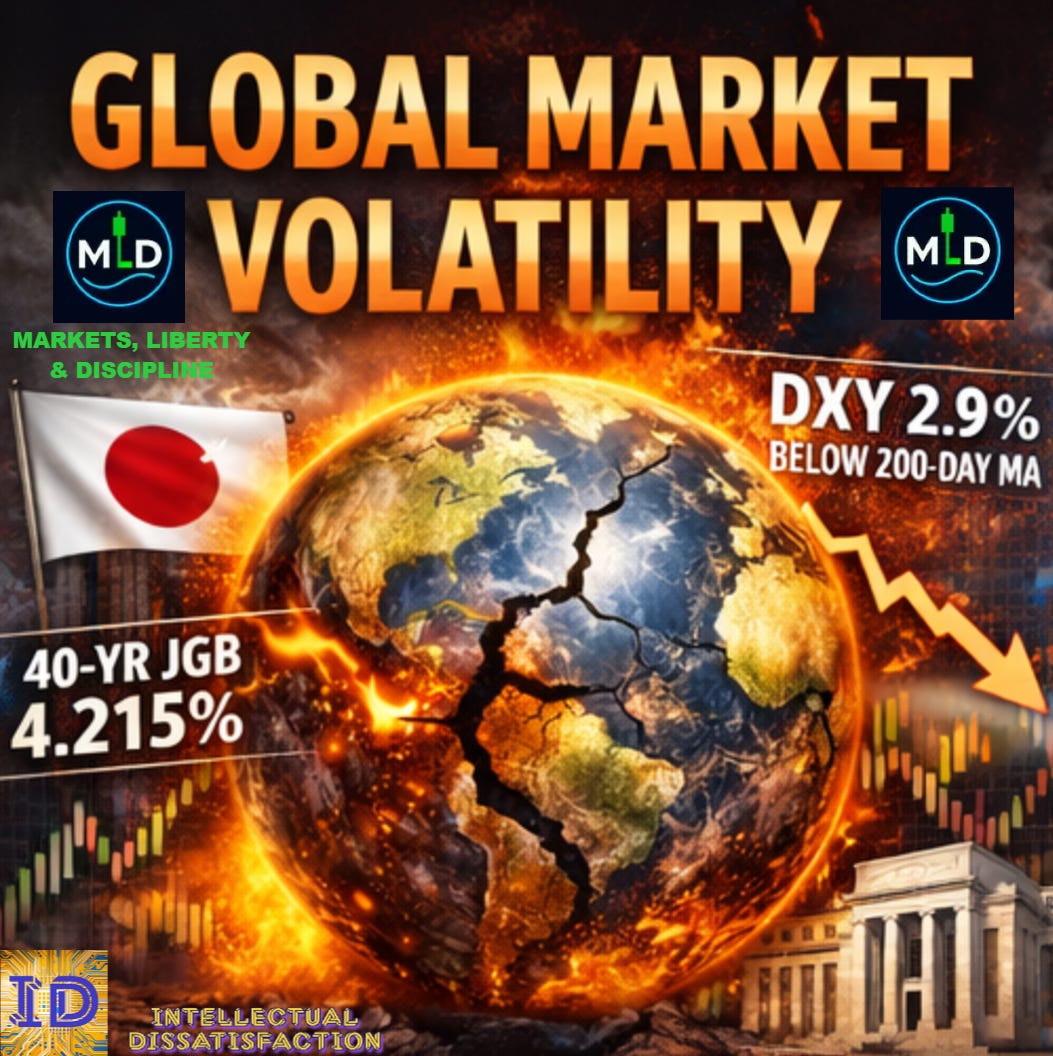
A January 2026 selloff pushed Japan’s super long yields sharply higher according to Reuters that described the 30 year and 40 year yields breaching 3.8% and 4% respectively in that article.
A Bloomberg market wrap up noted that the 40 year yield was pulling back from an all time high of 4.215%, which had been just touched over the prior week. That puts January 20th around the shock window for investors in the financial sector according to Bloomberg.
For decades, Japan has been a long duration funding hub for other nations. When Japan's long duration funding end gaps, it forces global investors to reassess what a risk free loan actually consists of in a world where the marginal buyer is now political, and not economic.
That repricing doesn’t stay local. It effects markets across the globe. This is also one of the reasons as to why commodities have been behaving more like meme coins recently. The past generation of investors have been conditioned by crypto. Massive sell offs and liquidations have become the new normal.
Right now the dollar is weak. The bigger point is the dollars anchor instability, not FX vibes.
Barchart technical data shows that the U.S. Dollar Index (cash, DXY00) is trading around 2.90% below its 200 day moving average at the time this article was written. the 200 day MA shown as 98.641 at the time according to Barchart.com.
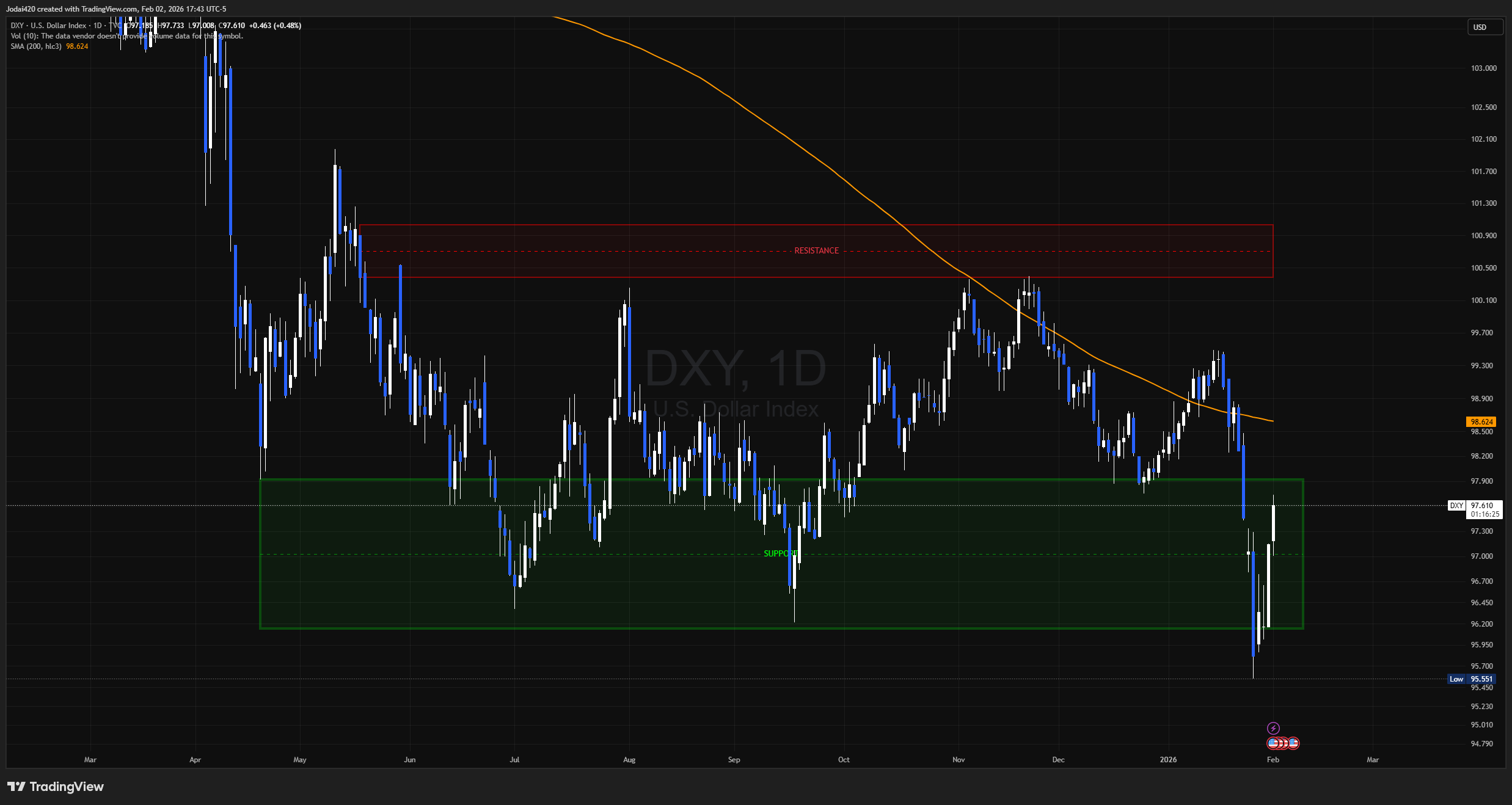
On the same day, Reuters reported that the dollar index was up 0.7% on January 30, 2026. Which meant the dollar had rebounding from a four year low earlier in the week. This was also during the period where we saw a precious metals selloff according to Reuters
A soft dollar does have the ability to support commodities at margin prices. The anchors or the credible fiscal paths plus the credible monetary reaction functions are what is actually unstable. That is a large part as to what is causing the instability of the dollar.
If investors are staring down a world like that, they will get rallies that look like monetary debasement hedges, and drawdowns that look like liquidity events within a 24 hour period!

Why silver whipsaws harder than gold
CME Group lists COMEX silver futures as 5,000 troy ounces per contract, priced in dollars per troy ounce. CME Group
Silver is a two channel asset. It is stuck between the industrialists that need it for production and the central bankers who want it for their vaults. That’s why silver always overshoots it's target price. First Silver attracts the trend leverage investors and when the money is finally broken, the silver liquidation cycle begins once funding tightens enough.
If the January spike was leverage assisted by materials, then the January 30 air pocket is exactly what investors expect. Once the marginal buyer becomes a forced sell, regardless of longer run fundamentals, the top is very near. Silver has only the 5th and final Elliot wave left for an upward movement dead cat bounce.

The libertarian point that actually matters for investors
Discretionary regimes or fiscal promises without constraints, lead to the risk of a monetary regime change if volatility cannot be eliminated. Instead they make it worse by concentrating it, and then releasing the volatility in bursts.
Investors don’t get stable prices. Instead, investors get delayed price signals and violent catch up movements where they are forced to chase the market.
Reuters tied the January 30 metals selloff to profit taking, amid broader macro drivers. Reuters noted the Fed chair news catalyst was when President Trump named Kevin Warsh to succeed Jerome Powell as the Federal reserve chair when Powell’s term ends in May. Now it might actually get a federal reserve that is also on board with America First policies after removing the globalist at the helm of the institution according to Reuters.

The strongest counterpoints and why the thesis still holds
Counterpoint 1:
“This was just a speculative blow off top and crash. It had nothing to do with the macro.”
Response:
That may be partly true, and it strengthens the point. A leveraged sensitive market is precisely what you get when rates & FX anchors are unstable and all risk that a premia are repriced in jumps.
Counterpoint 2:
“Japan is idiosyncratic. Meaning it won’t transmit.”
Response:
Japan can be idiosyncratic and still be systemic because it affects cross border hedging, duration allocation, and funding assumptions. The transmission channel is positioning and funding. It doesn't make any headlines.
Counterpoint 3:
“The dollar rebounded; the story is over.”
Response:
One rebound does not restore credibility. It only changes which positions are forced to sell out first, starting the long squeeze.

What would invalidate this thesis that is observable?
Japan’s super-long yields stabilize without policy backpedaling AND without spillover into global hedging costs. Which will be observable via cross currency basis per volume.
Term premia compress meaningfully. This would be observable via the NY Fed term premia series. Meanwhile long duration assets regain orderly bid according to the Federal Reserve Bank of New York
Silver volatility falls structurally. It is observable via options, implied volatility and realized volatility rather than merely a bounce after liquidation.

The Bottom line
Silver did not just go to $95. It went from $95.87 on Jan 20th to a record $121.64 by Jan 29th and then back down to $83.99 on Jan 30, 1:57 p.m. ET according to Reuters.
That sequence is consistent with a world repricing risk premia in discontinuous steps. Leverage is making every step look like a fiscal cliff.


Verification notes
Spot silver down 27.7% to $83.99/oz at 1:57 p.m. ET on Jan 30, 2026 (1857 GMT); intraday low $77.72/oz. Instrument: spot silver. Source type: Reuters.
Spot silver hit a record high of $121.64/oz on Thu Jan 29, 2026. Instrument: spot silver. Source type: Reuters.
Spot silver “briefly” reached $95.87/oz on Jan 20, 2026. Instrument: spot silver. Source type: Reuters.
Reuters described Japan’s 30 year and 40 year yields breaching 3.8% and 4% respectively during the Jan 20 selloff window in an article dated Jan 21, 2026 12:45 AM UTC). Instrument: Japan government bonds, 30Y/40Y yields. Source type: Reuters
40-year JGB yield “all-time high of 4.215%” pulled back by Jan 28 auction reporting. Instrument: Japan 40-year government bond yield. Source type: Bloomberg.
I did not use “record since 2007 introduction” language unless supported; this item does support “all-time highs.”DXY00 shown ~2.90% below its 200-day moving average (200-day MA shown as 98.641 at retrieval). Instrument: U.S. Dollar Index cash (DXY00). Timestamp: page retrieval time not displayed in the captured lines; treated as “current at retrieval.” Source type: Barchart.com
Dollar index up 0.7% on Jan 30, 2026 in Reuters metals report context. Instrument: DXY
Source Type: Reuters.
Trump named Kevin Warsh to succeed Jerome Powell as Fed chair in May. Reuters reported context. Instrument: policy/personnel event. Source type: Reuters.
NY Fed publishes Treasury term premia estimates (ACM model). Instrument: term premium estimates, maturities 1–10 years. Source type: Federal Reserve Bank of New York
COMEX silver futures contract unit 5,000 troy ounces; dollars per troy ounce. Instrument: COMEX silver futures. Source type: primary/official CME Group.
“Rising term premia → duration repricing → cross-asset volatility.” This is a consistent model interpretation, not directly asserted by any single source.
The January spike was leverage assisted and forced selling drove the air pocket on the chart.
Educational Disclaimer
This article is for educational and informational purposes only and does not constitute investment advice. Trading and investing—especially in futures and other leveraged instruments—entails substantial risk, including the risk of total loss. A standard futures risk disclosure, notes investors may sustain a total loss of funds deposited to establish or maintain a futures position, and investors may lose more than their initial deposit. (fiadocumentation.org) Most short term or intraday traders lose money over time, and day trading can involve severe financial losses. (SEC) Investors need to consider their own financial situation and risk tolerance. Investors should consult a qualified, licensed, financial professional before making any investment decisions.


It was not organic it was a JP Morgan silver heist using the same illegal paper fraud manipulation they employed from 2008 to 2016 and paid a huge fine for. Here is how they did it: https://elliottmiddleton.substack.com/p/update-on-silver