



The first opponent PLUR GRR faced at Sully’s Irish Pub was not another DJ. It was football.
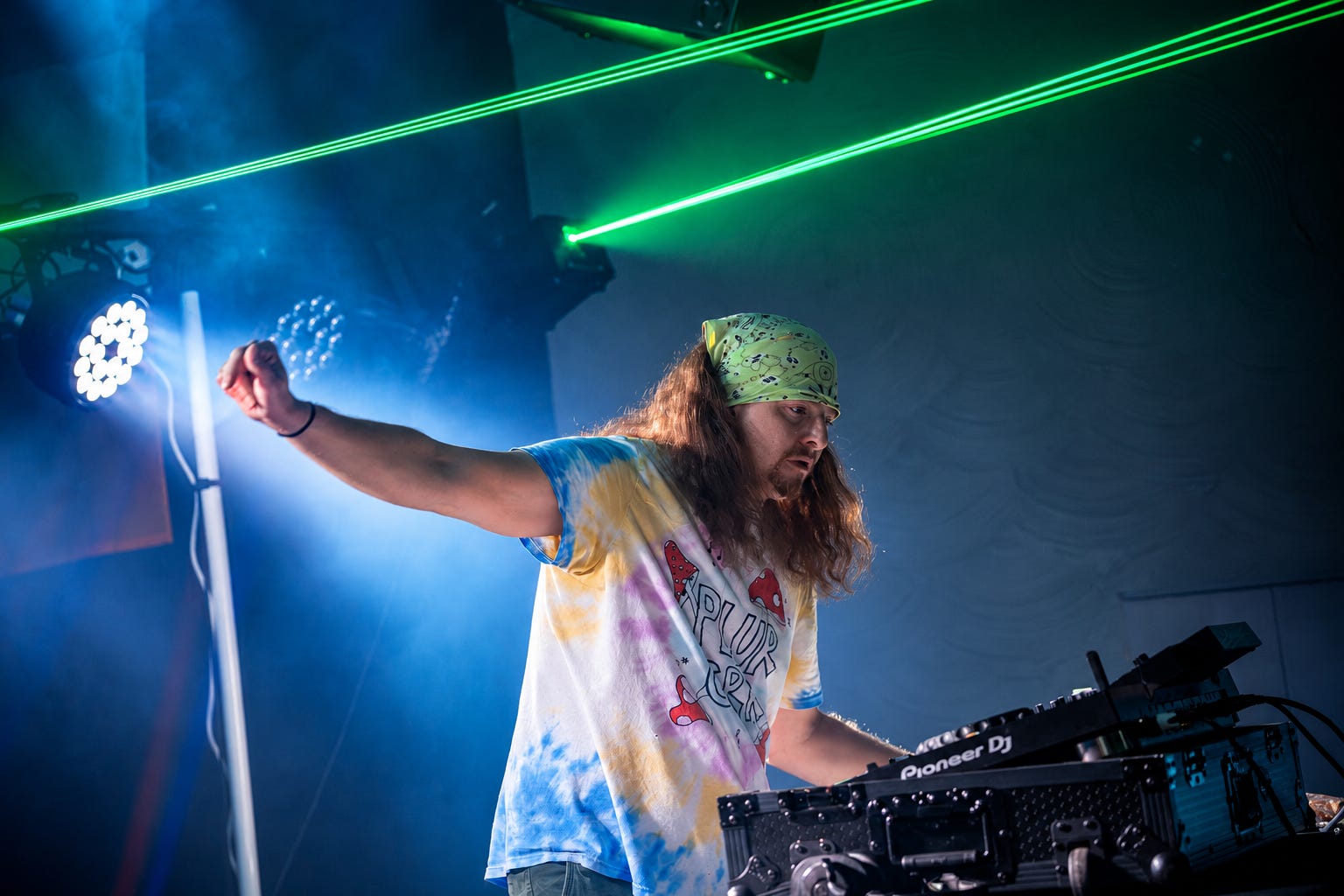
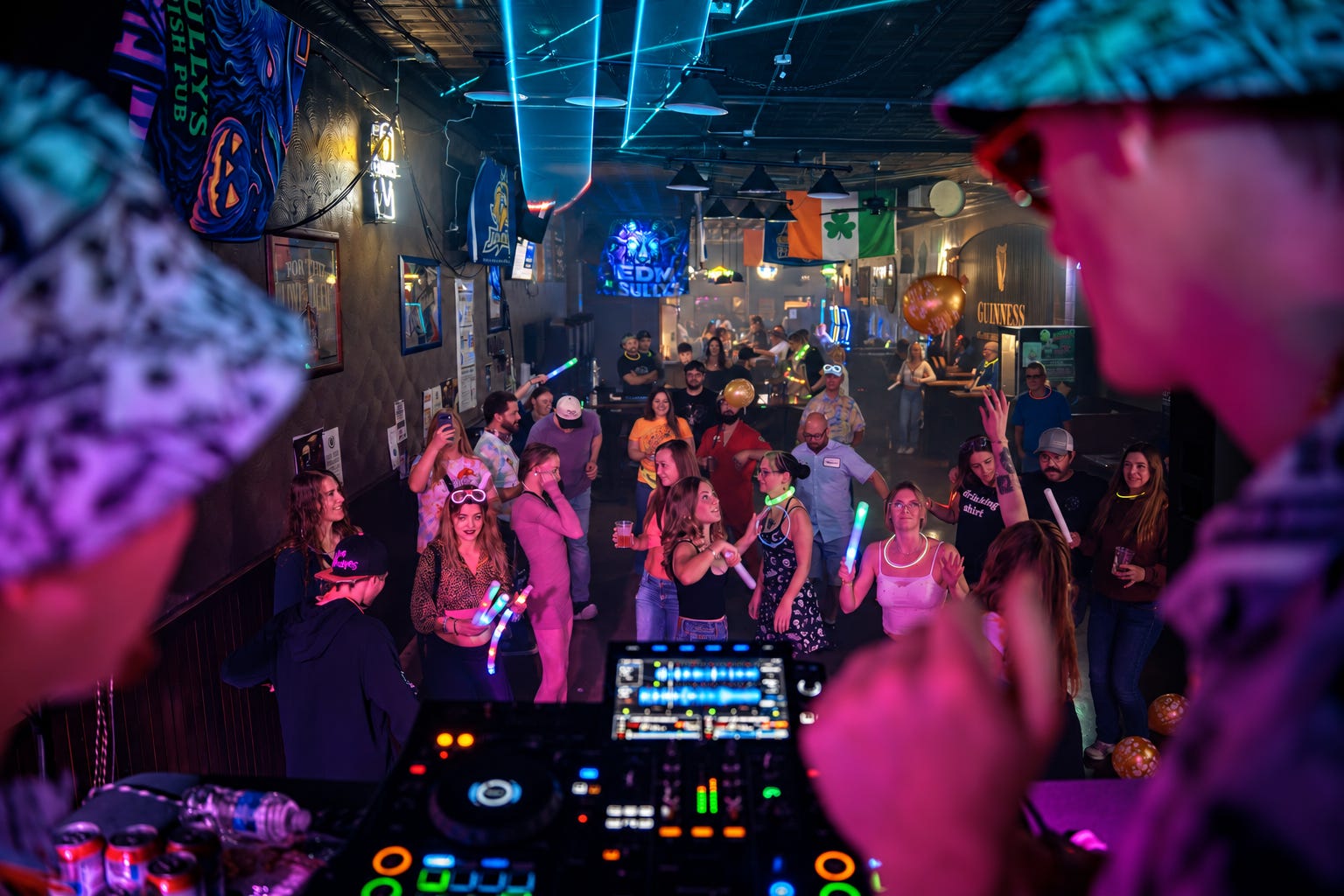
Across Brookings, South Dakota State was putting 57 points on New Haven, including 33 in the second quarter, and most of the city’s Saturday-night attention followed the Jackrabbits. Inside Sully’s, lasers cut bright green and violet lines across a dance floor with too much room on it. The bar staff was ready. Green Room Productions had the lights, sound and booth in place. PLUR GRR stood behind the decks in a tie-dye shirt and bandana, long hair spilling over his shoulders, prepared to play for whoever had made it downtown before the final whistle.
There are easier situations for a performer. A thin early room exposes everything: every transition, every attempt to pull someone away from the bar, every moment when an artist could decide to conserve himself until more people arrive. PLUR GRR did not play cautiously. He moved, pointed, leaned over the mixer and treated the people in front of him as though the room had already filled.
He deserved a later slot. He has for a while.

Thirty years in one hour
We have watched PLUR GRR get handed the opening assignment at enough regional shows to know the pattern. He played with his hair flying and his whole body in motion at ShoreFest in 2023, then closed the 2024 Four Winds EDM afterparty with a freestyle set after technical trouble disrupted the lineup. He has his own traveling EDM crew, people willing to put miles behind them to see what he will do next, and he has continued making one-off, unreleased material shaped in part by the blunt-force spectacle of DJ Diesel’s Bass All-Stars events.


At Sully’s, his prepared list offered 30 tracks moving from 130 beats per minute to 156. The numbers explain the acceleration, but not the joke, or the nerve. PLUR GRR reached across roughly three decades of radio memory and dragged the familiar material into a modern bass set: Belinda Carlisle’s “Heaven Is a Place on Earth,” Timbaland’s “The Way I Are,” Beastie Boys’ “Intergalactic,” Outkast’s “The Way You Move,” Kelis’ “Milkshake” and Far East Movement’s “Like a G6.” Each recognition arrived a fraction of a second before the remix changed the weight beneath it.
The selections kept becoming stranger in combination. Creed’s “One Last Breath” gave way to a Hairitage remix of Linkin Park’s “Faint.” MGMT’s “Kids” sat near Paramore’s “Ain’t It Fun.” A UK garage bootleg of Limp Bizkit’s “Break Stuff” ran into the “Cha Cha Slide,” followed by a DirtySnatcha flip of Backstreet Boys’ “Everybody.” On paper, that sequence looks like somebody lost control of the aux cord at a millennial wedding. In the room, PLUR GRR made the collisions the point. The recognizable chorus pulled people forward; the altered drop showed them why he had chosen it.
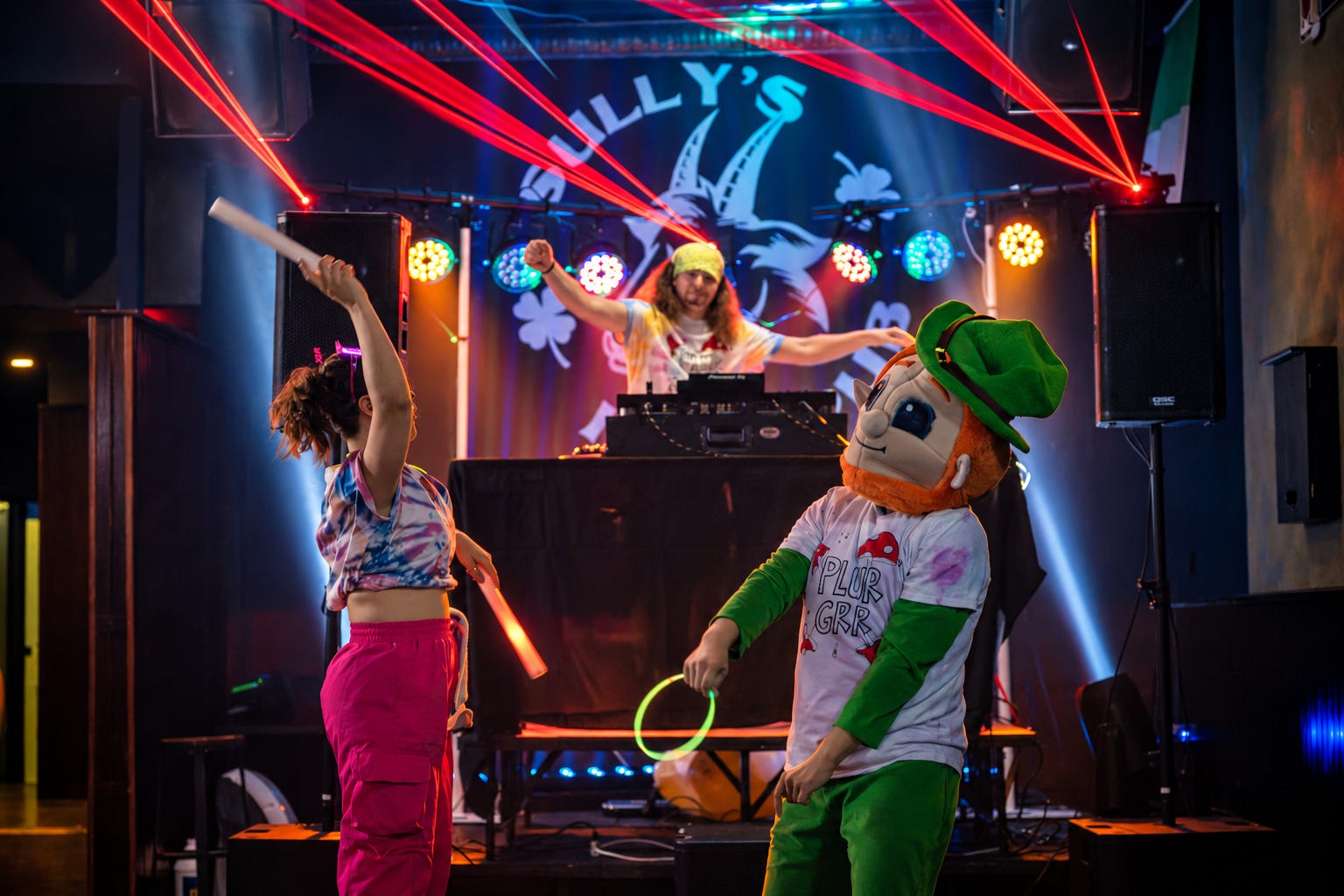
His version of crowd work was embedded in the track selection. Someone who did not know YOOKiE or Virtual Riot could still react when Blur’s “Song 2” or Owl City’s “Fireflies” appeared. Someone raised on Paramore, Blink-182, System of a Down or Korn heard those songs stripped from their usual guitar-band surroundings and pushed toward 150 BPM. The set did not require electronic-music fluency before entry. It supplied the invitation, then rattled the glassware.
The prepared sequence closed with three pieces bearing his own name: a PLUR GRR remix of TYNAN’s “His Name Is,” another titled “I Don’t Rap” and a 156-BPM PLUR GRR bootleg whose file name rendered the title as “It’s B—, Rains It Pours.” He spent most of the hour showing what he could do to songs people carried with them, then signed the final stretch himself.
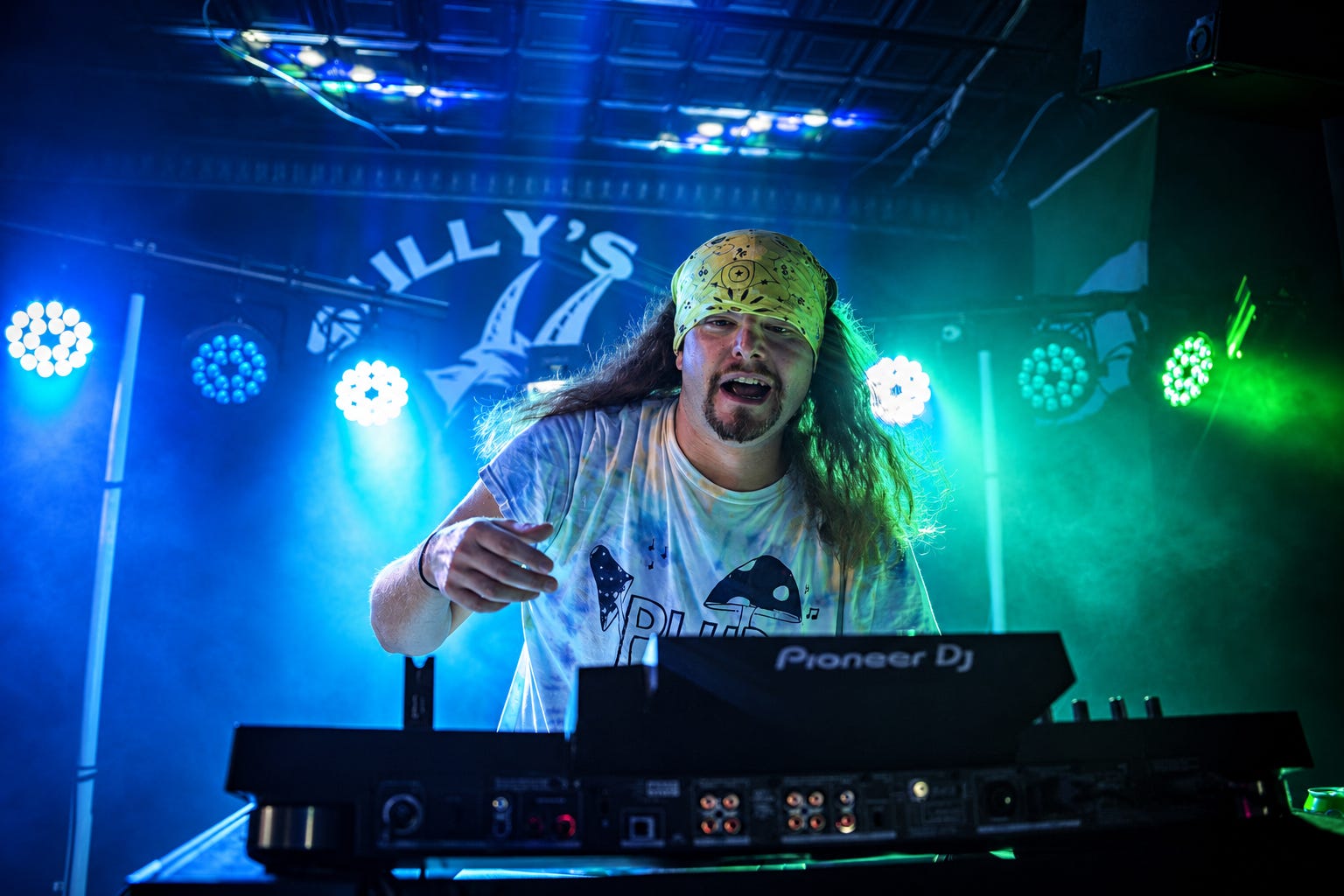
Calling that opening-slot work undersells it. The room was slow because the city had another appointment, not because the set failed to connect. PLUR GRR played through the scheduling problem and left the next act a floor already trained to expect surprise.
Money in the air
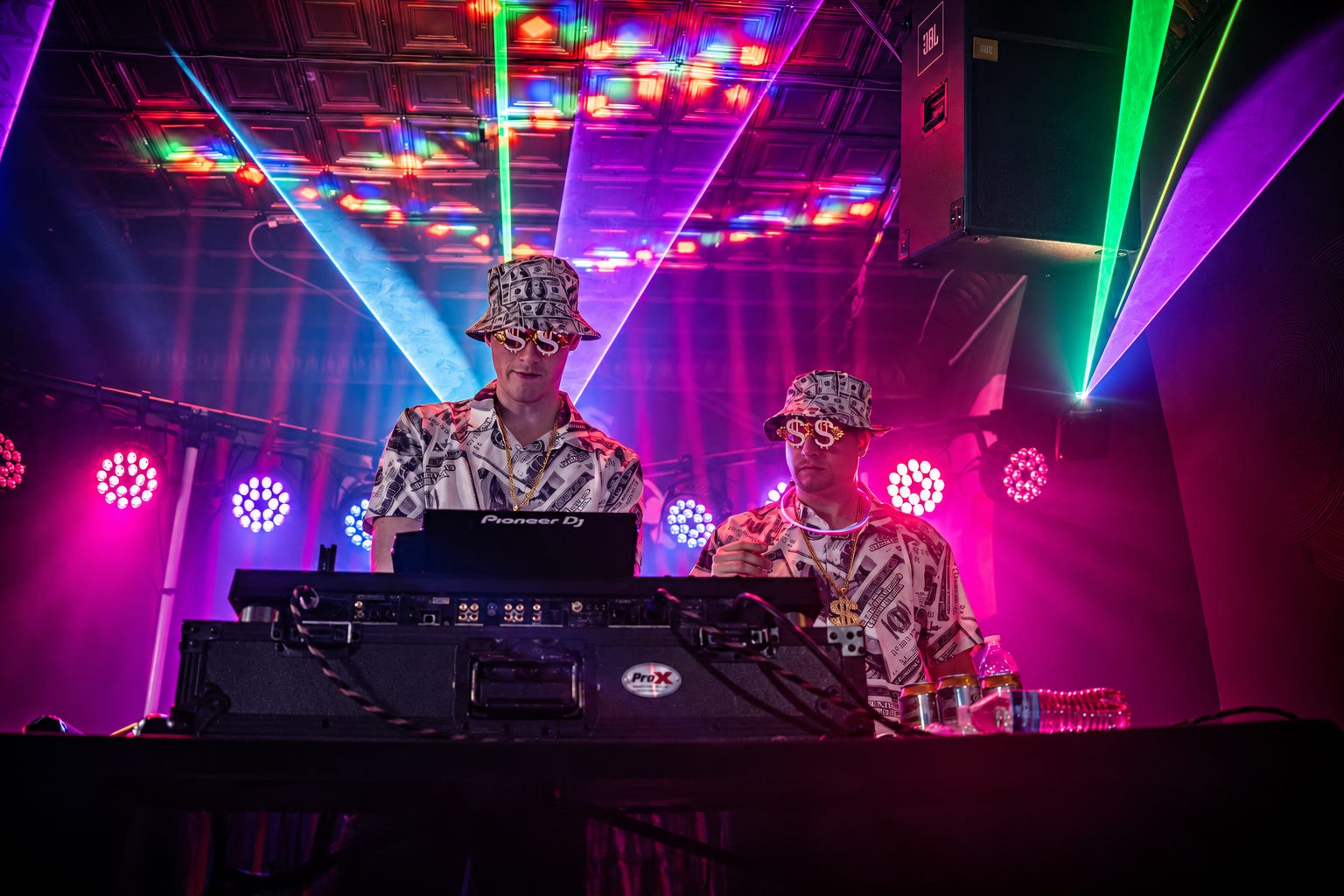
By the time JU$T FO CA$H followed, the crowd had begun to trickle in. The duo arrived dressed as a complete visual premise: matching money-print polos, hats, sunglasses and chains, each detail pushing the joke until subtlety had no chance of surviving. Their name was not merely printed on the flyer. It governed the hour.
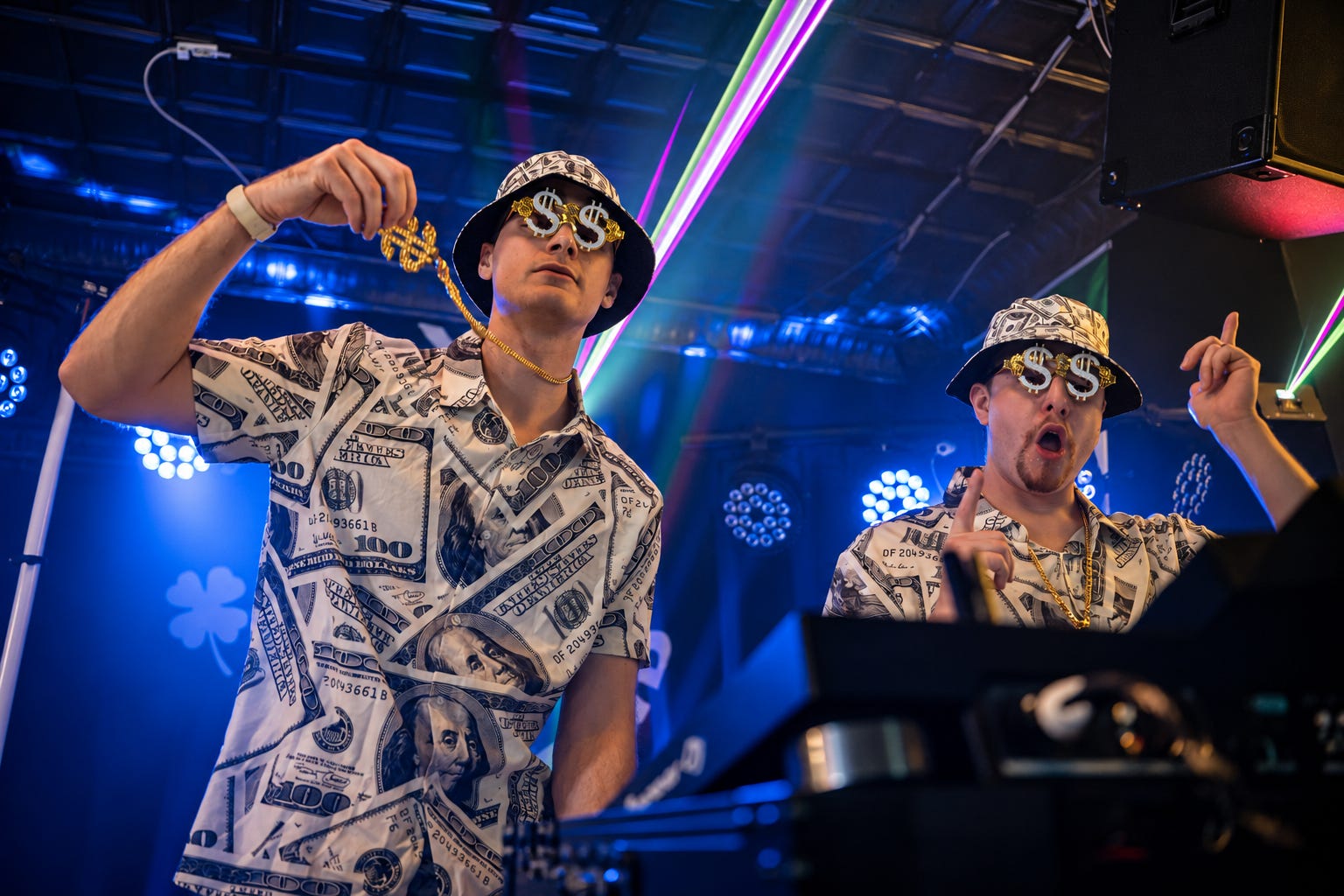
They brought balloons into the crowd, fired party poppers and scattered cash confetti while trading gestures behind the booth. The props could have become a distraction if the pair had treated them as decoration. Instead, everything was aimed outward. Hands went up. Faces turned from the bar. The duo kept reaching for anyone who had not yet committed to the dance floor, unwilling to leave a motionless body unchallenged if a balloon, a beat or a handful of fake money might solve the problem.
The concept also connected cleanly with PLUR GRR’s recorded world. His 2026 album JU$t FO CA$H (Pt. 1.5) is ten tracks of weaponized dollar signs and financial vulgarity: “WE NEED$ YOUR MONEY$,” “Greedy APR Rate$,” “Dolla$ Make Ya Holla$,” “Everla$ting Intre$t” and “Ca$hin In.” Onstage at Sully’s, the idea became physical. Money was no longer a spelling gag on a screen. It was clothing, confetti and permission to act ridiculous for an hour.
Their chemistry carried the spectacle. One could work the controls while the other played directly to the floor, then both would snap back into the same pose or gesture. Matching outfits made them immediately legible from the back of the room, but synchronized commitment sold it. They looked like two men who had agreed that restraint was a poor investment.
The timing could not have been cleaner. South Dakota State finished a 57–14 win over New Haven, and Brookings began moving again. People entered Sully’s in clusters just as HLLND—SDSU’s own Ben Helland—took control of the booth. The early negative space disappeared. Shoulders filled the gaps near the bar. The dance floor tightened.
HLLND responded by raising the bass beyond anything the preceding sets had attempted.
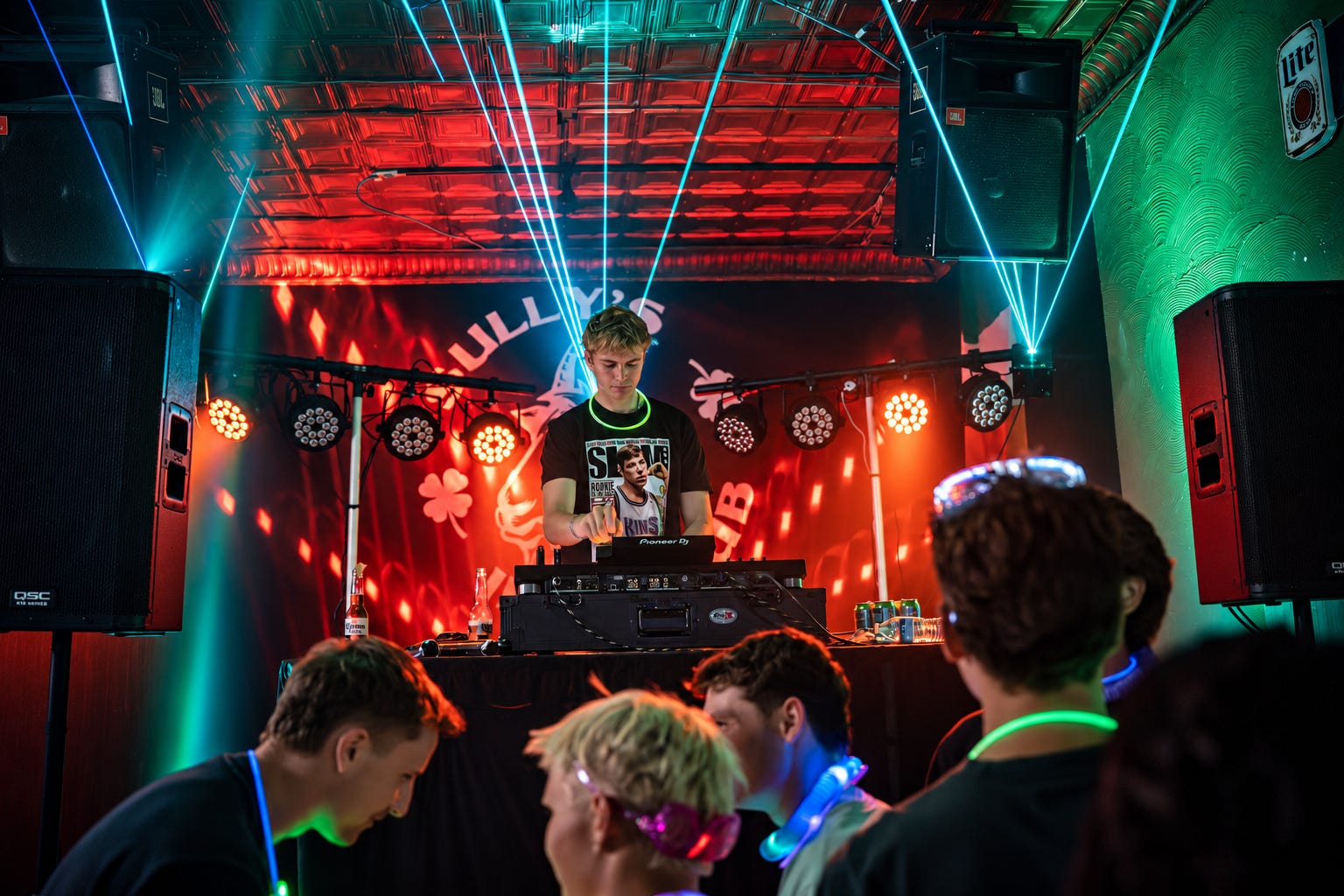
He did not receive a polite hometown welcome. He received the kind built from recognition and a fresh football win: people jumping in place, cheering toward the booth and dancing with the loose, relieved momentum of a Saturday that had gone exactly their way. Green laser lines stretched above their heads while glow sticks blurred in the foreground. Helland stayed focused at the controls, occasionally looking up to measure what the room could take, then pressing harder.
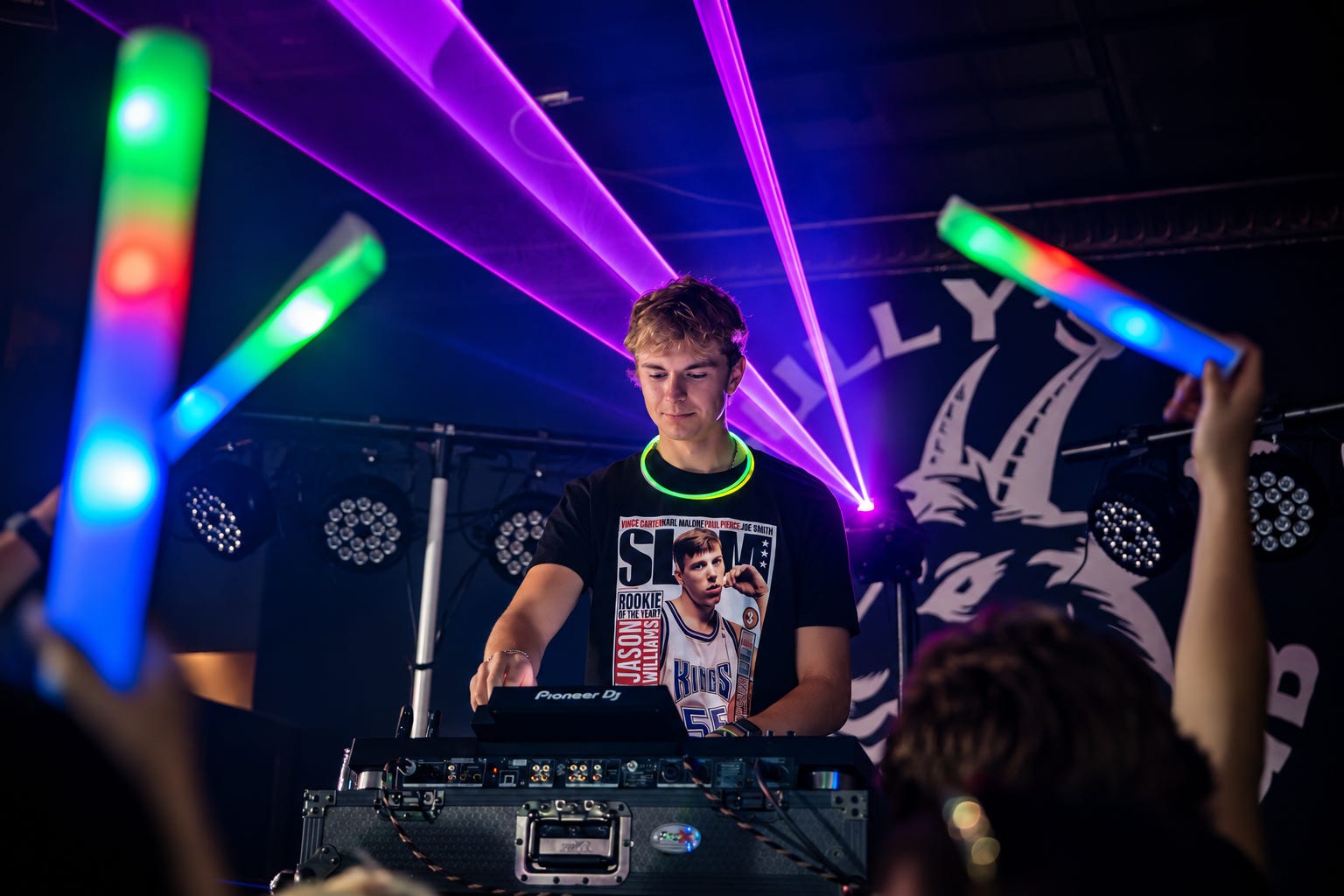
The strongest evidence of his control was not simply the volume of the cheering. It was how quickly the late-arriving crowd behaved like it had been there all night. HLLND inherited people coming from a football game, a bar already warmed by two very different performances and a production system throwing color across nearly every visible surface. He did not reset the room. He absorbed all of it and made the bass heavier.
Please consider Donating to Sponsor an article even $1 helps!

The switch nobody saw
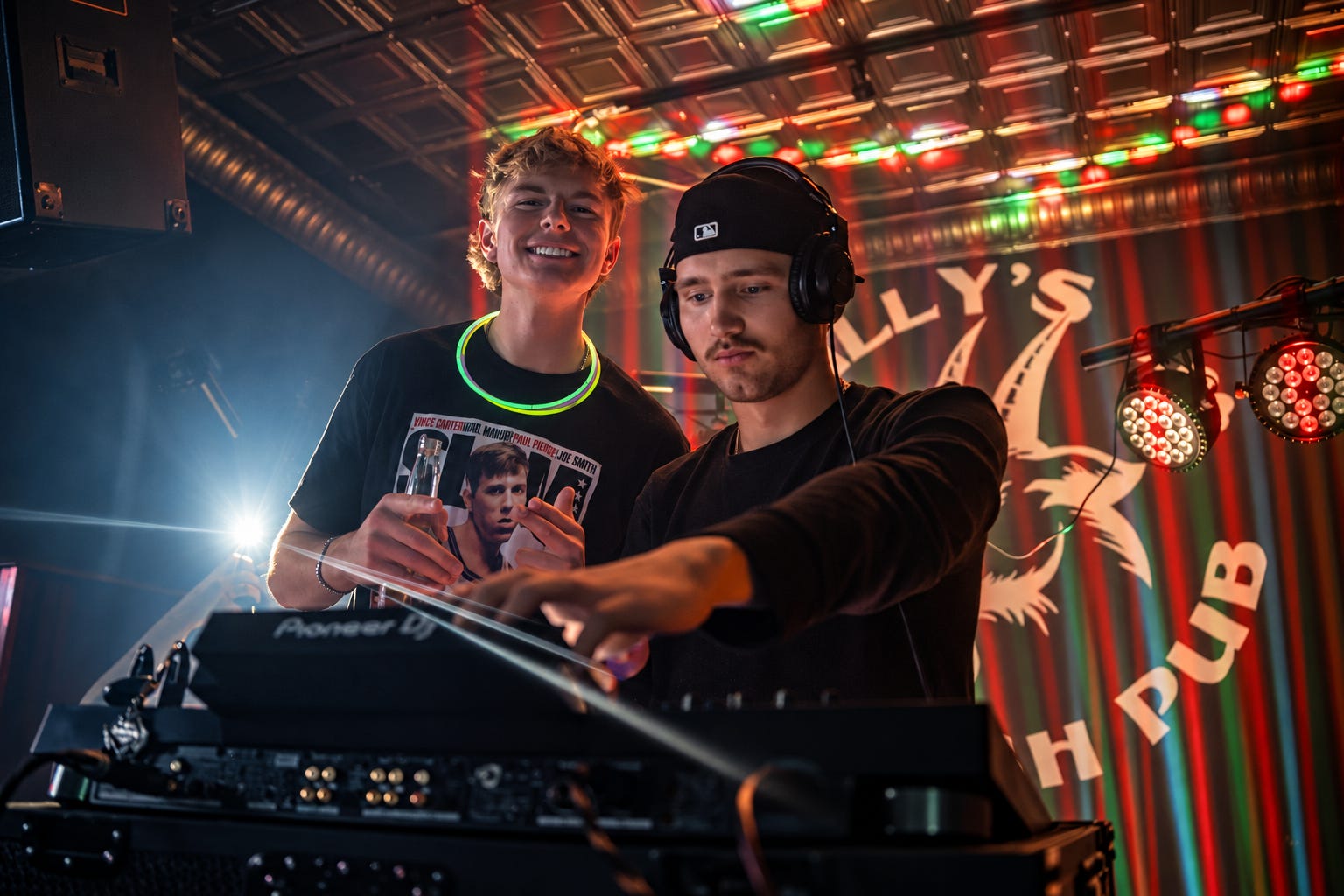
K.PSH came next, although “next” suggests a clean break that never happened. HLLND and K.PSH paired up at the booth and constructed the transition together. There was no obvious dead space, no ceremonial clearing of the decks and no sharp change that announced a new name on the bill. Even while watching for it, the exact handoff nearly slipped past unnoticed.
That kind of changeover requires more than matching tempos. The departing DJ has to leave the next performer room without draining the floor, while the incoming artist has to establish control without making the collaboration look like a contest. HLLND and K.PSH handled it with a shared-booth ease. One remained close enough to the mixer to keep the line intact while the other began shaping what followed.
By then, Sully’s was packed from the dance floor back toward the bar. K.PSH had the advantage of receiving the room at its fullest, but he also had the responsibility of keeping a crowd that had already moved through nostalgic bass flips, a costumed money party and HLLND’s hometown escalation. The reaction did not flatten. People kept dancing, raising drinks, waving glow sticks and pressing toward the front while the ceiling lights shifted between hot orange, purple, blue and green.
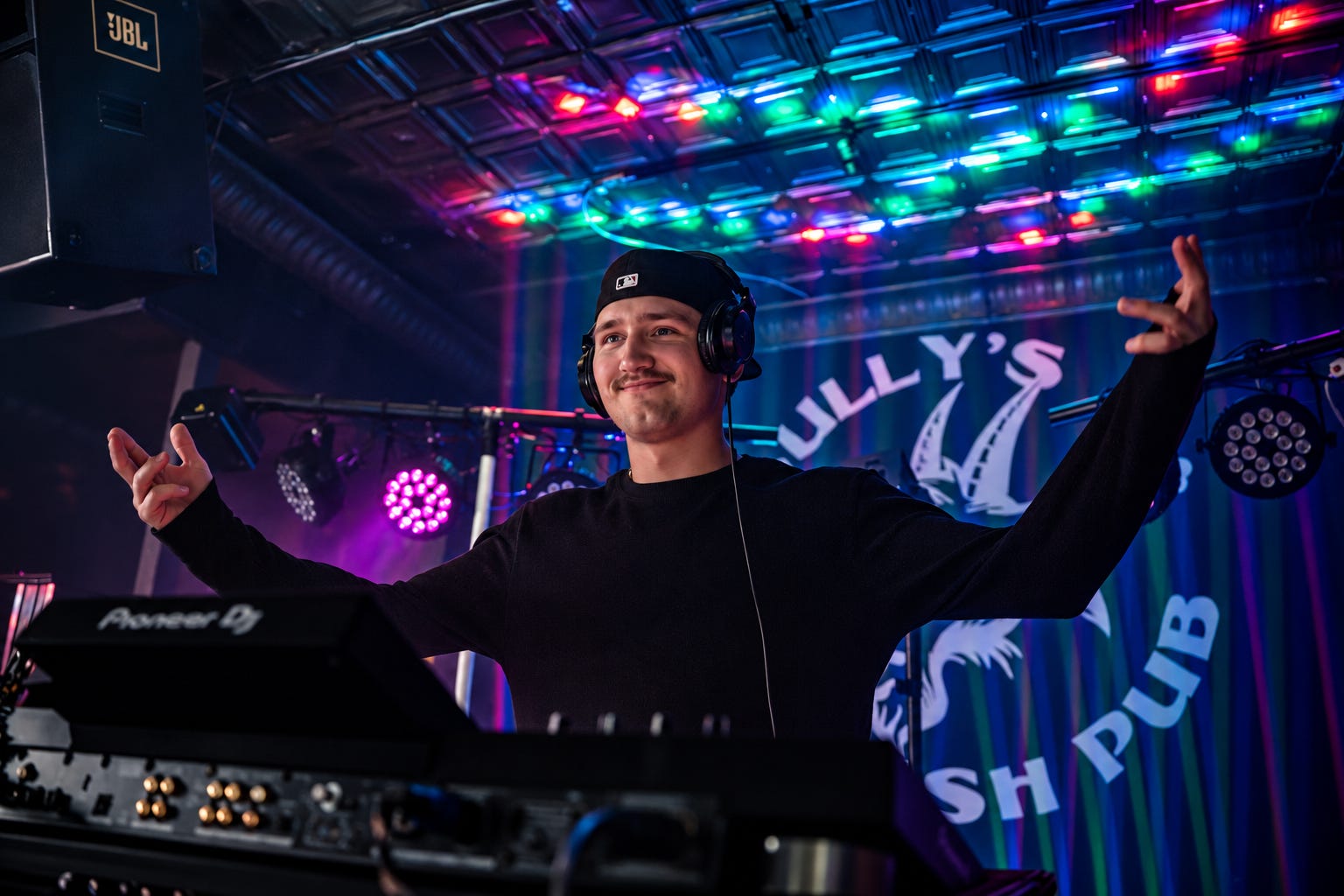
The packed final stretch also made the early part of the night look different in retrospect. The opening room had not been a verdict; it had been a delay. Green Room Productions and the staff at Sully’s kept the night functional while the football game held much of Brookings elsewhere, then accommodated the rush when that audience arrived. Drinks continued moving across the bar. The booth remained active through each handoff. Lights and sound turned a downtown pub into a workable bass room without hiding the place underneath it—the goat logo, Irish flags and bar fixtures remained visible behind the performers.
Afterglow
Hours earlier, PLUR GRR had faced empty pockets on the floor and played as though they were already occupied. By K.PSH’s closing stretch, they were. The crowd stood shoulder to shoulder beneath the same lasers that had crossed open space at the beginning of the night.
That progression should not bury what happened before the football crowd arrived. PLUR GRR sampled 30 years of songs, accelerated the room from 130 to 156 BPM and finished with his own material while working the most unforgiving position on the bill. ShoreFest already showed what his physicality could do in an intimate room. Four Winds showed him recovering a disrupted afterparty and closing it at capacity. Sully’s offered another version of the same argument: he can manufacture movement before circumstances begin helping him.
There will always be a need for an opener capable of doing that work. PLUR GRR has done it often enough.
Please consider Donating to Sponsor an article even $1 helps!
