


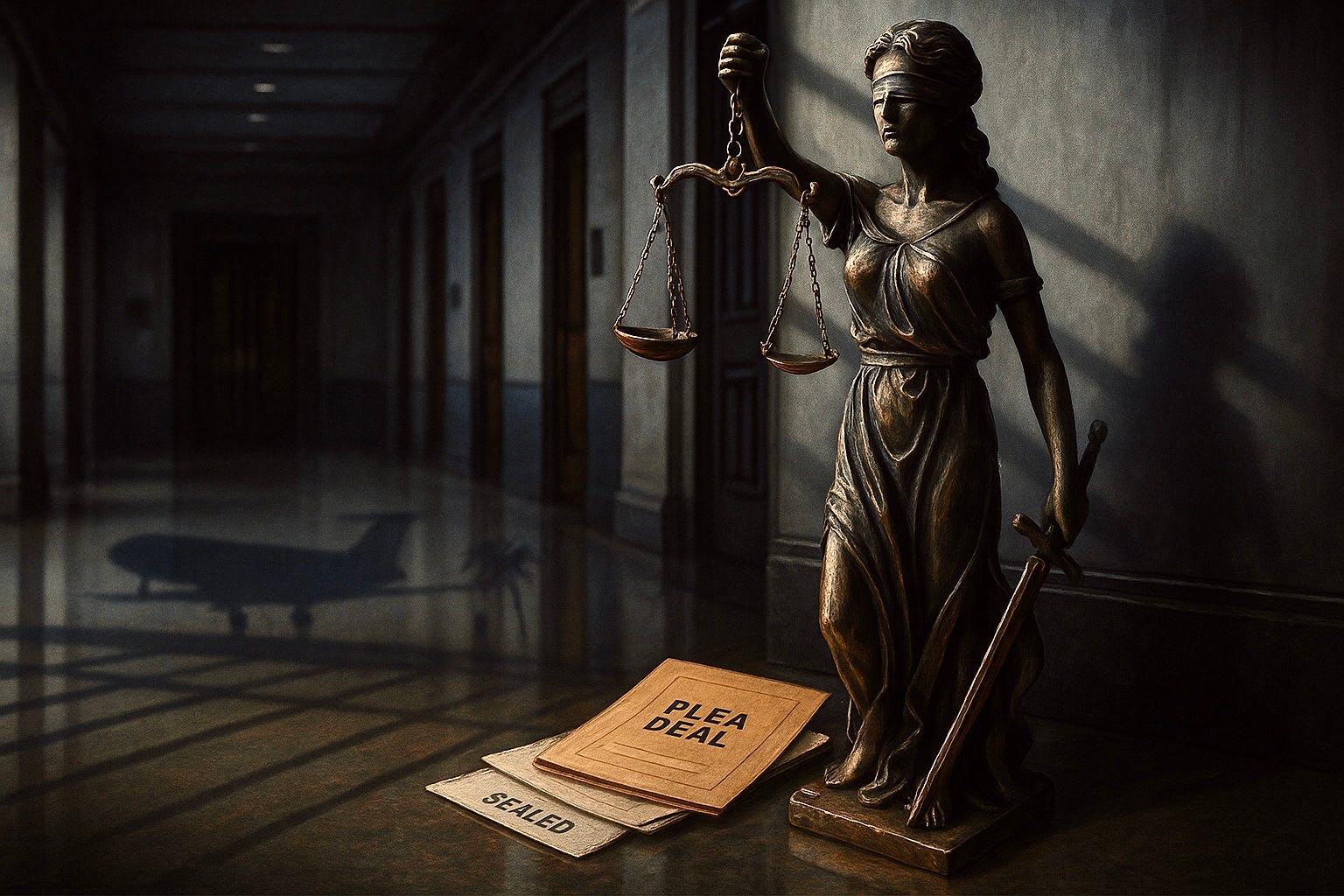
In November 2025, the Epstein Files Transparency Act passed the House 427–1 and the Senate by unanimous consent. Days later, Donald Trump signed it — after fighting it for months — and ordered the Justice Department to cough up all unclassified Epstein records within 30 days, with only narrow carve‑outs for active investigations and victim privacy.
Senate Passes Release of Epstein Files Unanimously

After I wrote about the House’s 427–1 vote to force the release of the Epstein files, the big open question was whether the Senate would smother it in “concerns” and procedure. The Senate just passed it unanimously, by unanimous consent, with no amendments.
So what happened in this case that finally forced Congress to demand sunlight, and why didn’t they do it the first time?
You don’t get to the Epstein Files law in 2025 without understanding what the system already knew by 2008 and chose to bury. This first part is about that decision: the timeline of abuse, the Palm Beach case, the non‑prosecution agreement (NPA), and the roles that prosecutors, institutions, and social gatekeepers played in helping Jeffrey Epstein walk away.
Not because of a clever technicality.
Because they decided to let him.

He didn’t come out of nowhere
If you only know Epstein from the island memes and the 2019 arrest, the story looks like this: mysterious financier appears, runs a trafficking operation, gets caught, dies in federal custody, conspiracy theories forever.
Reality is a lot more boring — and worse.
A pattern going back at least to the 1990s
By the time Palm Beach police ever heard his name, there was already a decade‑long pattern in motion.
In the 1990s, women like Maria Farmer later described being abused or witnessing abuse linked to Epstein and his circle in New York and other locations. Those accounts eventually surfaced in court filings and reporting, but they didn’t trigger a serious law‑enforcement response at the time.
According to a later timeline reconstructed from investigations and court records, Epstein’s pattern was already set:
A wealthy older man with no obvious, legitimate explanation for his wealth
A rotating group of young women and girls, many recruited by other girls with the promise of cash
A stable of properties where he could isolate victims
The properties as crime scenes
The core of Epstein’s real-estate footprint is not a mystery. It’s in court filings and estate documents:
A waterfront mansion in Palm Beach, Florida
A massive townhouse on East 71st Street in Manhattan
“Zorro Ranch” in New Mexico
A Paris apartment
Two private islands in the U.S. Virgin Islands, including Little St. James, which locals had already nicknamed “Pedophile Island” long before the rest of the world caught up
Victims and witnesses consistently place abuse in all of these locations. Some of that only became public during the Maxwell trial and later civil cases. But the core pattern — and the Palm Beach house in particular — was sitting in front of law enforcement by 2005.

Palm Beach: the case that should have ended him
The modern paper trail really starts in Palm Beach, Florida.
The 2005 complaint
In March 2005, the parents of a 14‑year‑old girl reported to Palm Beach police that Epstein had sexually abused their daughter at his mansion during what was supposed to be a “massage.”
Palm Beach PD opened an investigation. Over the next year:
Detectives identified dozens of potential underage victims, many telling similar stories of being recruited by another girl, brought to the mansion, and paid cash for escalating sexual contact
They built a case that looked a lot less like “one bad incident” and a lot more like a structured system — recruitment, payment, repeat visits, referrals
The state’s first response: undercharging the pattern
Despite the volume of evidence, the Palm Beach County state attorney’s office presented only a narrow case to a grand jury in 2006. The result was a single state charge: solicitation of prostitution.
Police were furious. They believed they had built a case with multiple underage victims and a clear pattern of exploitation. Instead, they saw a powerful defendant get treated like a run-of-the-mill vice bust.
So they did something rare. They pushed upward, urging federal authorities to step in.
By July 2006, the FBI had opened a broader federal investigation looking not just at Palm Beach, but at other locations where the same pattern might be playing out.
For a brief moment, it looked like Epstein might actually face the kind of federal sex‑crimes case that ruins powerful men for real.
That’s not what happened.

The non‑prosecution agreement: the most important document in the story
If there is a single piece of paper that explains why we’re still talking about Epstein in 2025, it’s the federal non‑prosecution agreement (NPA) negotiated in 2007–2008.
This is the “sweetheart deal.” And it’s worse than the meme version.
What the plea “deal” actually did
According to the Justice Department’s own Office of Professional Responsibility (OPR) and multiple independent reviews, here’s the structure:
Epstein would plead guilty in Florida state court to two prostitution‑related charges:
Felony solicitation of prostitution
In return, the U.S. Attorney’s Office for the Southern District of Florida would:
Decline to bring federal charges in an already‑developed sex‑trafficking case
Grant immunity to “any potential co‑conspirators” identified in the investigation
Seal the agreement and never tell the victims it existed
Epstein then:
Received an 18‑month county jail sentence (he served about 13 months)
Was given extensive work‑release, leaving jail for up to 12 hours a day, six days a week, supposedly to work at an office
Registered as a sex offender, but kept his mansions, his social life, and his network
That’s not a normal outcome in a case where law enforcement has identified dozens of potential minor victims.
Who signed off — and how DOJ judged itself
OPR was eventually forced to look at its own house. In a 2020 report, it concluded:
Then-U.S. Attorney Alex Acosta had full authority to approve the NPA
Federal prosecutors in his office negotiated and executed the deal
The decision to resolve the case this way reflected “poor judgment”, especially in failing to notify victims
OPR did not find provable “professional misconduct” or direct improper influence tied to Epstein’s wealth or connections
In plain language: “Yes, this was awful. No, we’re not calling it a violation of our own rules.”
The important part is less the internal label and more the facts OPR confirms:
There was an active federal investigation
Prosecutors had drafted a federal indictment
They chose to shut it down with an agreement that immunized unnamed co‑conspirators and kept victims in the dark
That’s not a technicality. That’s a policy choice.

The Crime Victims’ Rights Act: the victims sue their own government
The decision to hide the deal from victims didn’t just look bad. It was illegal.
The CVRA case
Represented by lawyers like Brad Edwards and Paul Cassell, several victims sued the government under the Crime Victims’ Rights Act (CVRA), arguing that federal prosecutors had violated their rights by secretly cutting the deal.
The CVRA isn’t a suggestion, it promises basic things like:
The right to reasonable, accurate, and timely notice of court proceedings
The right to confer with prosecutors
The right to be treated with fairness and respect
In February 2019, U.S. District Judge Kenneth Marra agreed with them: federal prosecutors violated victims’ rights by structuring and executing the NPA in secret.
He called out:
The secrecy of the negotiations
The failure to notify victims as required by law
The way the deal effectively shut down the federal case while victims were led to believe it was still active
Then — and this part is important — the courts wrestled with what remedy the law actually allows. Victims ultimately didn’t get the NPA voided retroactively. Epstein was already dead by then, and the procedural mess is its own saga.
But the core finding stands. The DOJ broke its own victims’ rights law to protect this deal.
That’s the kind of failure that usually leads to hearings and reforms.
In Epstein’s case, it took more than a decade and a front‑page investigation to get even that much.

Enablers and gatekeepers: the ecosystem around Epstein
The obvious villains are Epstein and his co‑conspirators. The less obvious villain is the ecosystem that made it possible for his abuse to run for years and for his first case to be defused.
The recruiters and fixers
Victims repeatedly describe being recruited by other young women — often only slightly older than they were — who were themselves paid by Epstein to bring in more girls.
That ecosystem includes:
Ghislaine Maxwell, convicted in 2021 of multiple counts related to recruiting and trafficking minors for Epstein, now serving a 20‑year sentence
Other assistants and staff who scheduled “massages,” managed travel, handled cash, and smoothed logistics. Their names appear throughout civil suits and investigative files, even if they never saw the inside of a criminal courtroom
Without that layer, Epstein is just a rich creep. With it, he’s running a pipeline.
The prosecutors and the Department of Justice
The most uncomfortable “enablers” aren’t in his Rolodex. They’re in case captions.
Local prosecutors in Palm Beach who undercharged the case after police identified a pattern
Federal prosecutors who negotiated immunity for “any potential co‑conspirators” instead of testing their case in open court
A Justice Department that needed outside pressure and a media investigation to even admit it had “poor judgment”
When people talk about “elite impunity,” this is what they mean. It’s not a shadowy global cabal. It’s normal institutions choosing to bend the rules for the right defendant and then telling themselves it was a close call.
The money and the social legitimacy
Epstein’s mysterious wealth and connections helped cushion all of this.
For years, he was deeply tied to billionaire Leslie Wexner, serving as Wexner’s money manager, holding power of attorney, and acquiring properties linked to Wexner before Wexner says he cut him off around 2007.
Major institutions — universities, foundations, banks — took his money, his donations, and his introductions. In exchange, he got prestige, access, and people who would vouch for him as a serious philanthropist.
That doesn’t mean every person who went to a dinner at his townhouse knew what he was doing. It does mean he wasn’t some fringe weirdo hiding in a bunker. He was baked into social, financial, and political networks.
And those networks made it easier to see his behavior as a PR problem instead of a criminal one.

Where Trump fits in this first chapter — and where he doesn’t
If you spend any time online, you’ve seen wildly confident claims about Trump and Epstein: that Trump “ran” Epstein, that he was secretly behind the 2008 deal, that he’s on some definitive “client list.”
The record we actually have is a lot narrower — and also not flattering.
The early‑2000s Trump–Epstein overlap
We know, from contemporaneous reporting and more recent fact‑checks, that:
In 2002, Trump told New York Magazine that Epstein was a “terrific guy” and that they both liked “beautiful women… on the younger side”
They moved in the same Palm Beach and New York social circles in the late 1990s and early 2000s, showing up together at parties and in photographs
Trump appears in flight records at least once on an Epstein‑linked plane, on what’s been described as a short hop between Florida and New York
None of that is nothing. It’s a documented social association with a man Trump now insists he “was never a fan” of.
What Trump did not do in 2008
Now the key point for this part of the story: the Florida plea deal and NPA happen in 2007–2008.
Trump is not president. He’s a private citizen with a golf empire and a reality show.
The Justice Department’s OPR report and independent analysis of the NPA don’t show him or his administration anywhere near the decision‑making chain:
The NPA was negotiated and signed by prosecutors in the Southern District of Florida, under U.S. Attorney Alex Acosta, with input from Main Justice
OPR found that Acosta had the authority to make the deal and that, while he exercised “poor judgment,” there wasn’t evidence of outside political pressure dictating the outcome
There’s plenty to say about Trump’s later handling of the Epstein saga — his shifting public statements, his use of the case as a political weapon, his current DOJ’s games around the files. That’s for Part 2 and Part 3.
For this first chapter, the honest summary is:
FACT: Trump was socially acquainted with Epstein, praised him publicly in 2002, and shared overlapping spaces in Palm Beach and New York
FACT: There is no evidence Trump had any role in the 2008 plea deal or NPA. Those decisions were made by DOJ and Florida prosecutors
ALLEGATION: Various civil suits and online claims have tried to tie Trump to specific criminal conduct in Epstein’s orbit, but none has been proven in court
If future document releases change that picture, we adjust. But we don’t backfill the record from memes.

What the system knew by 2008 — and what it chose to do
By the time Epstein walked into the Palm Beach County jail in 2008, here’s what the system already had:
A 2005 complaint from the parents of a 14‑year‑old
A local police investigation that found dozens of potential victims and a repeating pattern
An FBI probe into conduct in Florida and beyond
A drafted federal indictment for sex crimes that could have carried real time
A growing awareness inside DOJ that this was not a one‑off vice case, but a serial predator with resources and reach
And then…
Federal prosecutors negotiated a secret agreement that:
Killed the federal case
Immunized unnamed “potential co‑conspirators”
Concealed itself from victims in violation of federal law
Epstein served about a year in conditions most people would describe as lightly supervised work‑release, then went back to his network of properties.
For more than a decade afterward, he continued to move through elite spaces until the Miami Herald’s Perversion of Justice investigation detonated the story in public and forced the federal system to touch it again.
If you wrote that arc as fiction, an editor would tell you it’s too on‑the‑nose.
But this is the part that explains why, in 2025, Congress suddenly pretended to discover a passion for transparency. The Epstein Files law isn’t about a single island or a single dead defendant. It’s a late reaction to the first time the justice system looked at all of this and chose to make it go away.
Part 2 is about what changed when Epstein was finally arrested again in 2019 — and why that second chance ended with another failure, another official story, and another wave of people who don’t believe a word of it.

Citations & Further Reading
(Grouped roughly by topic; not exhaustive, but enough to follow the paper trail.)
Epstein’s abuse, properties, and early investigations
Julie K. Brown, “Perversion of Justice” series, Miami Herald. (Miami Herald)
“Perversion of Justice: A Miami Herald investigation,” Miami Herald (Dec. 19, 2019). (Miami Herald)
“Timeline: Jeffrey Epstein’s federal investigations before 2019,” Factually. (Factually)
“What properties were in Jeffrey Epstein’s estate?” Factually. (Factually)
“Where is Jeffrey Epstein’s island — Little St. James?” CBS News. (CBS News)
“Jeffrey Epstein timeline: How the Palm Beach County case led to 15 more years of sex abuse,” Palm Beach Post / syndication. (Blue Water Healthy Living)
The 2005–2008 Palm Beach case and federal NPA
“What was the outcome of the 2005 investigation into Jeffrey Epstein?” Factually. (Factually)
“What charges did Jeffrey Epstein face in his 2008 Florida case?” Factually. (Factually)
“Key details of Jeffrey Epstein’s 2008 Florida plea deal,” Factually. (Factually)
DOJ Office of Professional Responsibility, “Investigation of the USAO-SDFL’s Resolution of Its 2006–2008 Federal Criminal Investigation of Jeffrey Epstein” (Nov. 2020). (Department of Justice)
Kenneth A. Marra, “Opinion and Order” (Feb. 21, 2019), finding CVRA violations in the secret NPA. Summarized in CBS News and Factually. (CBS News)
Enablers, Wexner, and institutional ties
“What evidence ties Leslie Wexner to Jeffrey Epstein before 2019?” Factually. (Factually)
Gabriel Sherman, “The Mogul and the Monster: Inside Jeffrey Epstein’s Decades-Long Relationship With His Biggest Client”, Vanity Fair (2021). (Vanity Fair)
Trump and Epstein (pre‑2019)
“Fact Check: Did Donald Trump call Jeffrey Epstein a ‘terrific guy’?” Newsweek. (newsweek.com)
“What we know about Trump’s relationship with Jeffrey Epstein,” Vox (2025). (Vox)
Epstein Files Transparency Act (for context in the intro)
H.R. 4405 – Epstein Files Transparency Act, Congress.gov. (Congress.gov)
“Epstein Files Transparency Act,” Wikipedia summary (legislative history and vote counts). (Wikipedia)
Michael Balsamo, “Trump signs bill to release Jeffrey Epstein case files after fighting it for months,” Associated Press (Nov. 19, 2025). (AP News)

