



A new South Dakota coalition is preparing a referendum campaign against Senate Bill 245, one piece of the property tax relief package signed by Gov. Larry Rhoden earlier this year.
The group, South Dakotans for Fair Taxes, includes Bread for the World SD, the South Dakota AFL-CIO and Dakota Rural Action. Its leaders say SB 245 should be referred to voters because, in their view, it funds homeowner property tax relief through a sales-tax structure that will fall more heavily on working families, renters and others who may not receive direct property tax benefits.
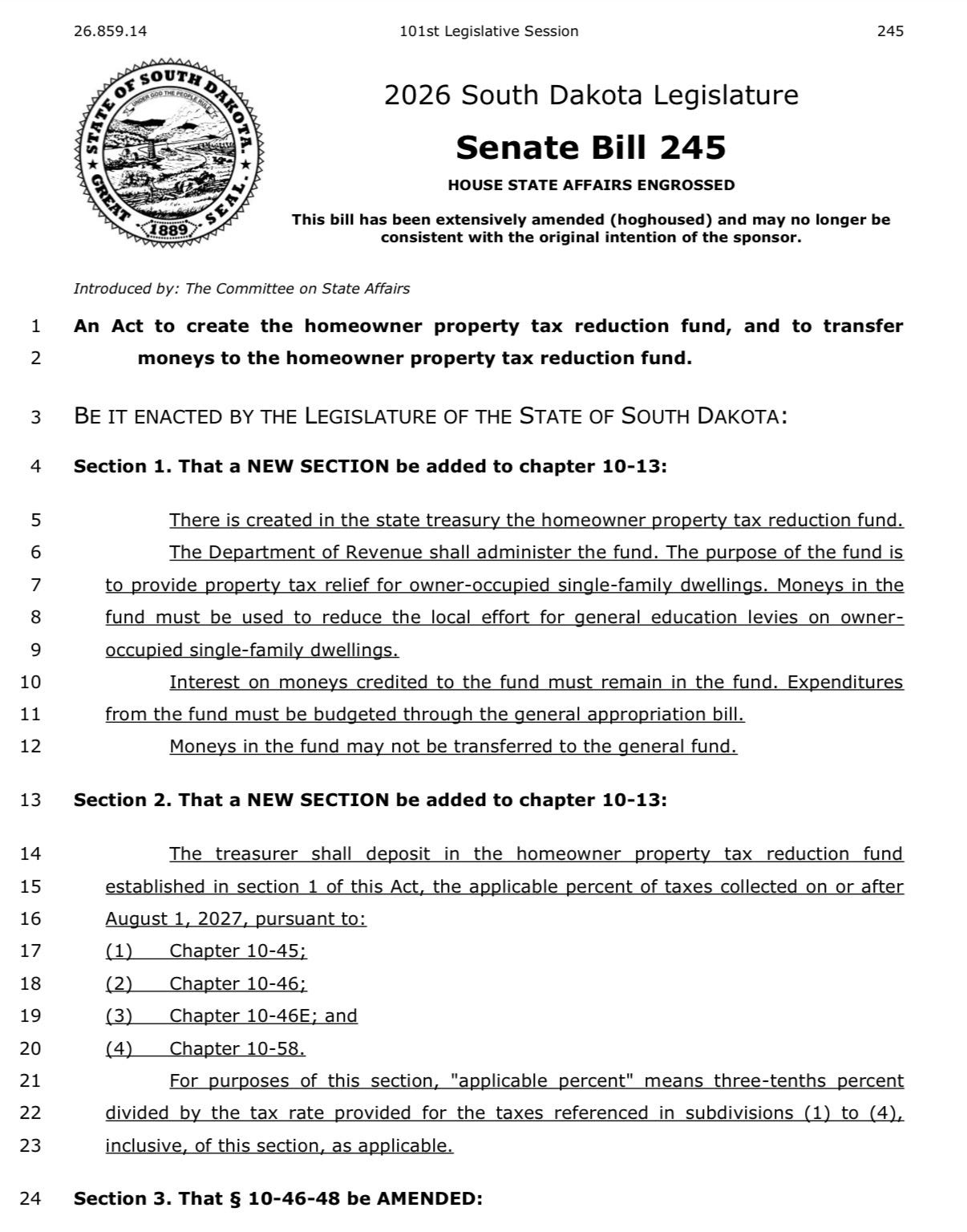
SB 245 creates a “homeowner property tax reduction fund” administered by the Department of Revenue. Under the bill text, the fund is designed to provide relief for “owner-occupied single-family dwellings” by reducing the local effort for general education levies on those properties. The bill also directs a portion of future sales and use tax revenue into that fund beginning July 1st, 2027 and includes a $55.9 million transfer from the revenue replacement fund beginning July 1st, 2026.
The policy is connected to South Dakota’s temporary sales tax reduction passed in 2023, when lawmakers lowered the state sales tax rate from 4.5% to 4.2% for four years. That cut is scheduled to sunset, returning the rate to 4.5%. SB 245 would dedicate revenue tied to that three-tenths of a percent to homeowner property tax relief rather than allowing it to flow into the general fund.
Supporters of the broader package have framed it as a major response to rising property taxes. When signing SB 245 and SB 96, Gov. Rhoden’s office described the bills as delivering “the largest property tax cut in South Dakota history.”
But opponents argue the structure matters as much as the size of the cut.
In its announcement, South Dakotans for Fair Taxes said the bill excludes renters, agricultural land and multi-family housing from direct relief while relying on sales tax revenue paid by a much broader group of South Dakotans. Cathy Brechtelsbauer, a volunteer with Bread for the World’s South Dakota chapter, called the bill “a blatant transfer of wealth from the lower incomes to the higher incomes,” arguing that renters should not be asked to pay higher sales taxes to fund relief for homeowners.
Matt Edzards, an executive board member of the South Dakota Federation of Labor, AFL-CIO, and a National Association of Letter Carriers shop steward, made a similar argument in the coalition’s release, saying the same sales tax increase would be paid by workers regardless of whether they own property.
The coalition’s critique centers on a familiar tax-policy tension: property taxes are highly visible and can create pressure for homeowners, especially as valuations rise. Sales taxes, by contrast, are spread across everyday purchases and are generally considered more regressive because lower-income households tend to spend a larger share of their income on taxable goods.
That does not mean homeowners are the only people affected by property taxes. Renters can indirectly pay property taxes through rent, and landlords may pass costs along over time. But SB 245’s direct relief mechanism is limited to owner-occupied single-family dwellings, which gives opponents an opening to argue that the bill does not evenly match who pays with who benefits.
The campaign also arrives as polling suggests South Dakotans may be skeptical of trading higher sales taxes for lower property taxes. A South Dakota News Watch/Chiesman Center for Democracy poll of 500 registered voters, conducted April 7-9 by Mason-Dixon Polling and Strategy, found 49% opposed and 33% supported swapping lower property taxes for higher sales taxes, with 17% undecided. The margin of error was plus or minus 4.5 percentage points. That poll, however, was reported in the context of the broader property tax package, including SB 96, which allows counties to raise sales taxes in exchange for property tax reductions, so it should not be read as a poll solely on SB 245.
To place a referred law on the ballot, South Dakota petition sponsors must gather signatures from registered voters equal to 5% of the total vote for governor in the last gubernatorial election. For 2026, the Secretary of State lists that threshold as 17,508 signatures. Referred laws must be filed within 90 days of the Legislature’s adjournment.
For voters, the eventual question may be less about whether property taxes need attention and more about how that relief should be funded. SB 245’s supporters can argue the bill targets a pressing problem for homeowners and dedicates future revenue to a defined property tax purpose. Opponents can argue that the chosen funding mechanism asks the broader public, including renters and lower-income households, to subsidize relief that is not broadly available.
That debate is now moving from the Capitol to the petition table. If South Dakotans for Fair Taxes gathers enough valid signatures, voters could have the final say on whether this part of the state’s property tax plan stands.

