



The Cultural Gravity of Mrs. Doubtfire
What is there left to say about Mrs. Doubtfire that hasn’t already been written, quoted, meme-ified, or lovingly argued over in the three decades since its release? The 1993 film starring Robin Williams has long cemented itself as more than a family comedy. At its core, it is a story about desperation, identity, and the messy, painful love of a father who refuses to disappear from his children’s lives, even if his methods are, to put it mildly, unconventional.
That emotional backbone is precisely why adapting Mrs. Doubtfire for the Broadway stage feels like such a high-wire act. Not only are audiences deeply attached to the film, but they are attached to Robin Williams himself. His performance as Daniel Hillard, and by extension, the formidable Euphegenia Doubtfire, is iconic in a way that borders on sacred. Any stage adaptation must wrestle not only with the mechanics of translating film to theater, but with the weight of memory.
Which is why skepticism feels like the only reasonable posture going in as I have said in my other movie to stage reviews.
Hollywood-to-Broadway adaptations often struggle to justify their own existence. For every successful reimagining, there are several productions that feel like nostalgia dressed up in choreography. I’ve learned to approach these projects cautiously, hopeful but guarded. Mrs. Doubtfire , however, does something rare. It earns its place on the stage.
A Stage Version That Understands the Assignment
From the opening moments, the production signals that it understands what makes the story work. This isn’t a carbon copy of the film, nor is it a gimmicky musical overlay. Instead, it’s a thoughtful reinterpretation that leans into the theatricality of live performance while honoring the emotional beats audiences expect.
Watching this familiar story unfold in real time, set changes happening before your eyes, characters moving fluidly through space rather than cuts and edits, adds a surprising intimacy. The magic of theater lies in its immediacy, and Mrs. Doubtfire uses that to its advantage.
The Robin Williams Problem (And the Way Through It)
One of the biggest challenges of the production is obvious. How do you step into a role made famous by Robin Williams without being swallowed by comparison?
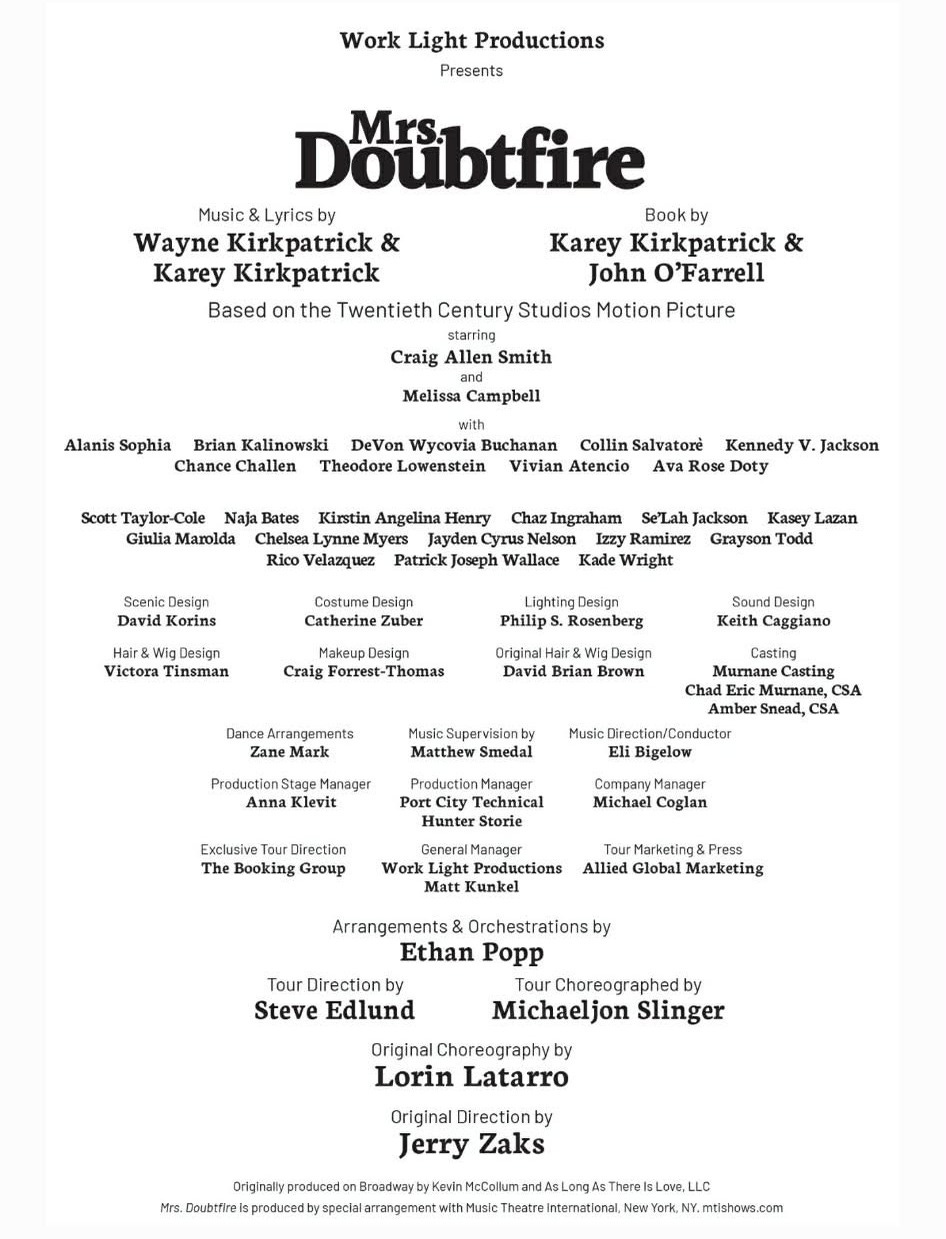
Chaz Ingraham, performing as the understudy for Daniel Hillard/Mrs. Doubtfire, meets that challenge head-on. Rather than attempting a full imitation, Ingraham finds a careful balance honoring Williams’ comedic rhythms while allowing room for his own interpretation. The result feels respectful without being trapped by nostalgia.
Physically, the role is demanding. Watching Ingraham navigate rapid costume changes and maneuver in and out of the Doubtfire suit during fast-paced scenes is impressive on its own. The technical precision required never overshadows the character work, which remains grounded and emotionally present even amid the chaos.
Miranda Gets Her Due
Melissa Campbell, delivers a strong performance as Miranda Hillard, stepping into a role originally portrayed by Sally Field. Miranda is often misunderstood as the antagonist of the story, but this production resists that simplification. Campbell plays her as both resolute and wounded. A mother doing her best to create stability while carrying the weight of a broken marriage. Her performance adds depth and credibility to a character that could easily be flattened.
The Kids Walk Away With It
Yet for all the star power and nostalgia, it is the children who unexpectedly steal the show.
Alanis Sophia, portraying Lydia Hillard, is nothing short of remarkable. Her stage presence commands attention, and her vocal performance consistently rises above the ensemble. There’s an ease and confidence to her work that suggests a performer well beyond her years. If this production is any indication, she is absolutely someone to watch moving forward.
Design, Pace, and the Hidden Engineering of “Seamless”
The technical elements of the show deserve equal praise. The set design is dynamic and cleverly utilized, allowing the story to move seamlessly from scene to scene without breaking immersion. Transitions feel purposeful rather than mechanical, keeping the audience engaged rather than distracted. The humor lands, the emotional moments breathe, and the pacing rarely falters.
Why It Works
What ultimately makes Mrs. Doubtfire succeed as a musical isn’t just the jokes or the spectacle, it’s the heart. Beneath the wigs, accents, and rapid-fire one-liners lies the same truth that resonated in 1993: love is complicated, families are imperfect, and sometimes the people we care about most don’t fit neatly into our expectations.
By the final curtain, it’s clear this production isn’t merely trading on nostalgia. It understands why the story has endured and trusts the audience to feel those same emotions anew.
Curtain Call
In the end, Mrs. Doubtfire doesn’t just survive the transition to the stage, it thrives. And that, in itself, feels like a small theatrical miracle.