



From the Streets of Paris, to the Stage
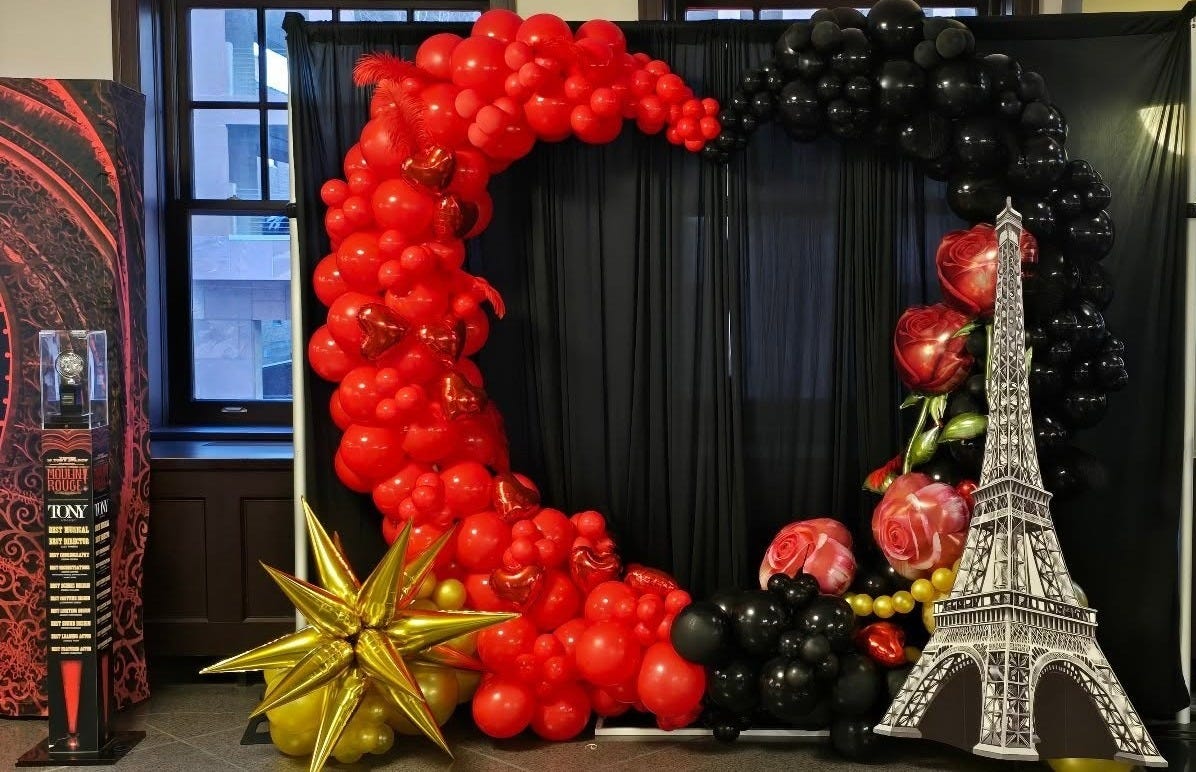
Few movie musicals have had the staying power of Moulin Rouge. Since its 2001 release starring Nicole Kidman and Ewan McGregor, Baz Luhrmann’s glitter-soaked fever dream has held a firm place in my personal canon. The atmosphere. The romance. The maximalist spectacle. And, of course, the jukebox soundtrack that somehow made pop anthems feel at home in 1899 Paris. The Washington Pavilion even had one of the Tony awards, 1 of 10 awarded to the show, displayed when you entered the building.
So walking into the Broadway adaptation of Moulin Rouge The Musical, I carried equal parts excitement and apprehension. Could a stage production replicate the cinematic scale and emotional intensity of a film I’ve watched countless times?
The short answer. Yes. But not without a few notable departures.
A Seat Worth Writing About
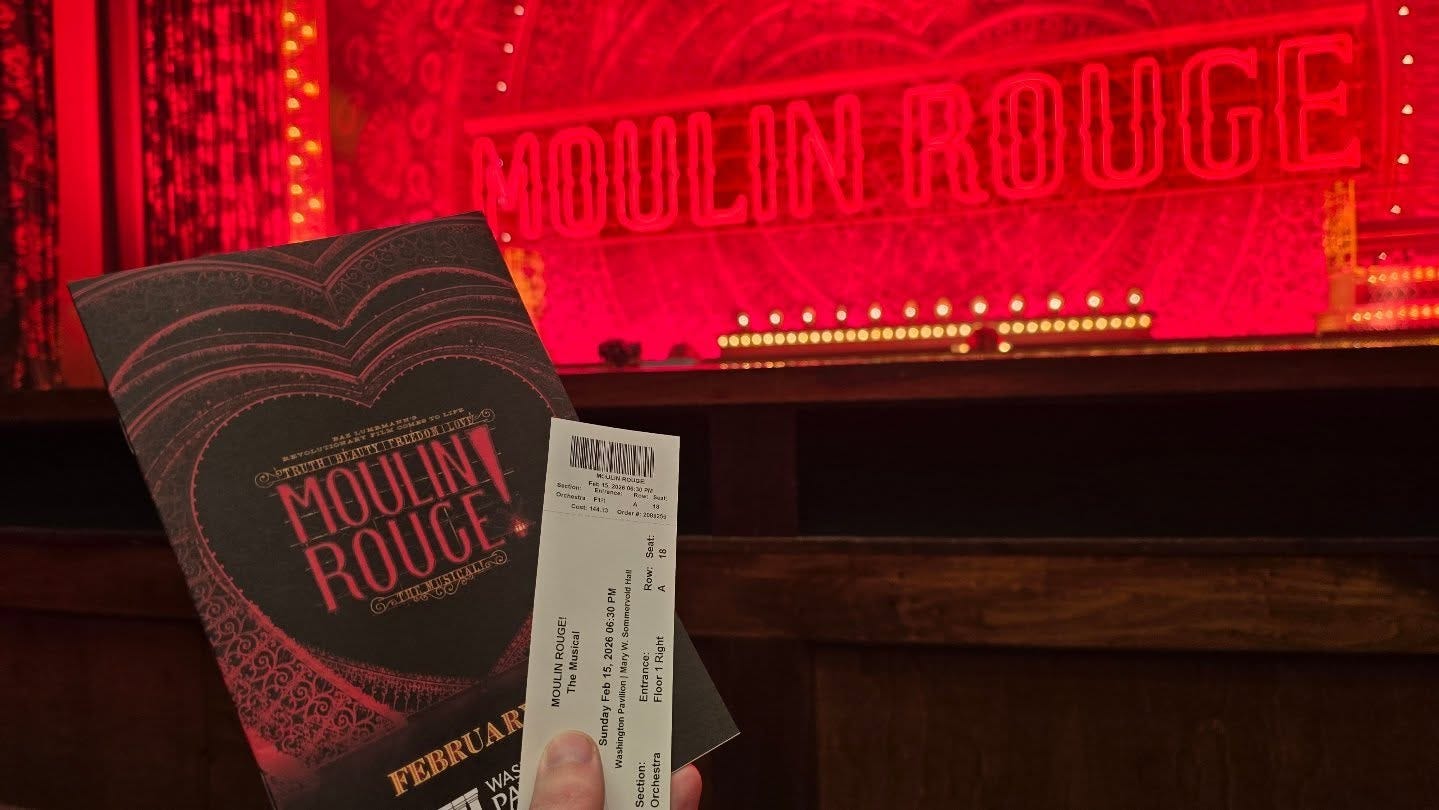
Thanks to a little seat-switching luck at a previous performance of Back to the Future: The Musical, I found myself front and center, seat A18. A rare upgrade from my usual F33 season ticket vantage point. It’s amazing how proximity changes perspective. Up close, the spectacle isn’t just impressive, it’s enveloping.
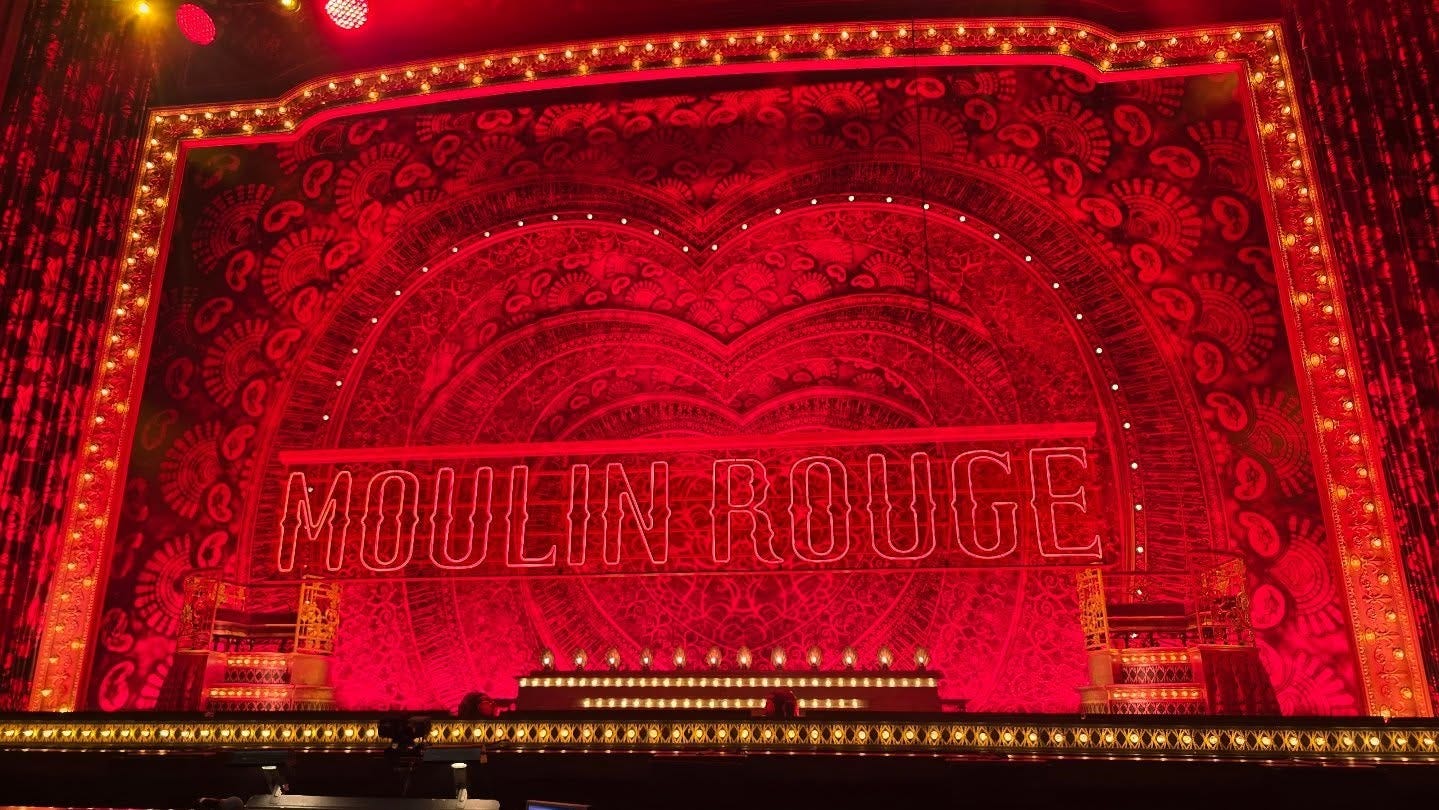
From the moment the house lights dimmed, the set announced itself as the evening’s first triumph. The towering Moulin Rouge windmill sign and the multi-layered heart arch framing the stage created an immediate sense of immersion. It felt less like entering a theater and more like stepping into a world. With Valentine’s Day weekend as the backdrop, the aesthetic only heightened the romance of it all.
The production design is among the most intricate I’ve seen. Moving platforms, rotating elements, and seamless transitions transport the audience from the iconic Elephant dressing room to the cobblestone streets of Paris and into the lavish chaos of the club itself. It’s maximalism done with precision.
Lobby Prologue, Already in Character
Before anyone sang a note, the Washington Pavilion was already doing the work of world-building. The entry décor leaned hard into Moulin Rouge colors and Valentine’s Day energy without feeling like a random heart-bombing. A massive balloon installation curled across a black backdrop like a split personality, half red and half black, studded with shiny heart balloons and oversized roses. A cutout Eiffel Tower stood guard at the edge like a postcard come to life, and a gold starburst balloon flashed at floor level like the whole lobby had its own spotlight. Even the Tony display near the entrance felt less like trivia and more like a little shrine to spectacle. You’re not walking into a neutral building. You’re walking into the pre-show.
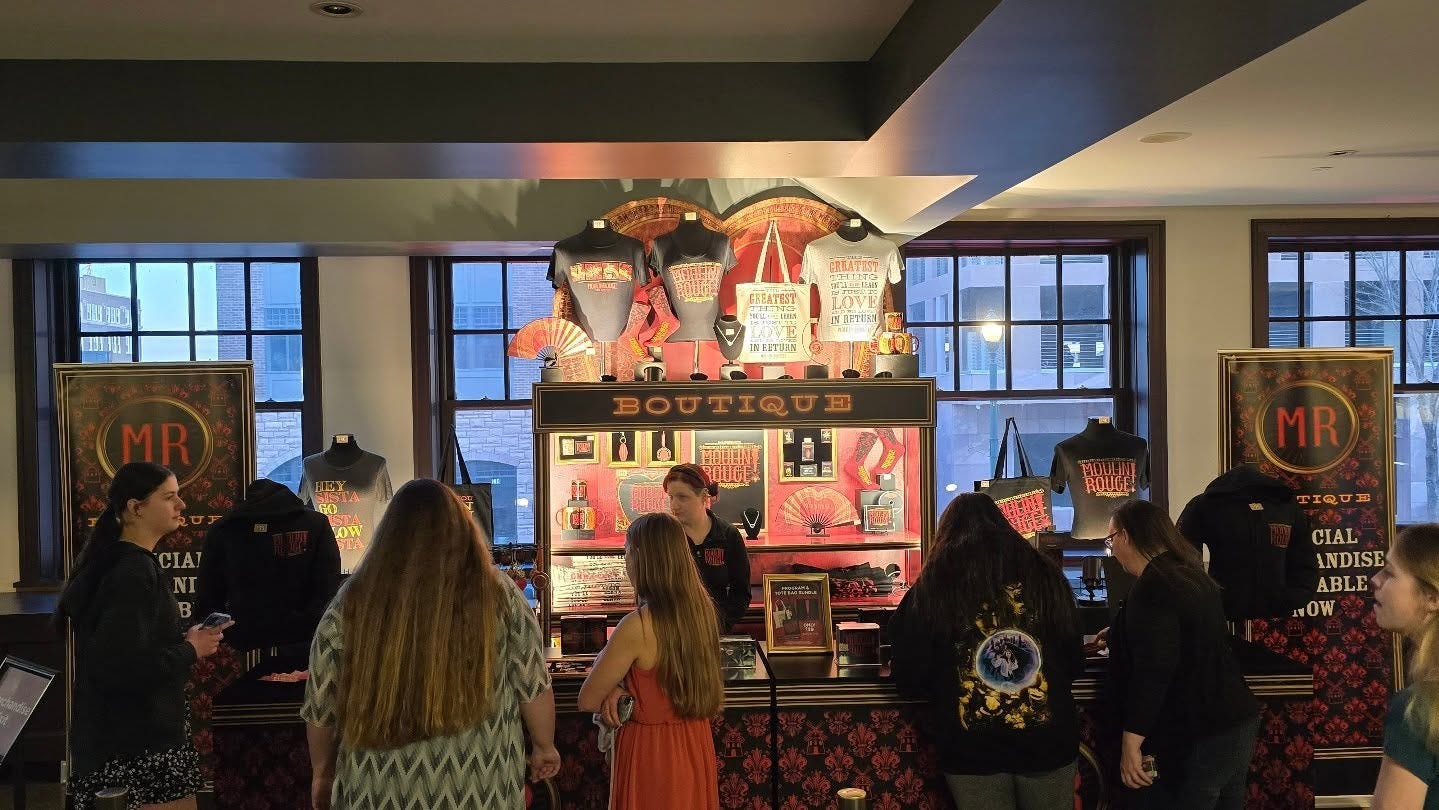
And then there was the merch table, dressed up as the “MR Boutique,” lit like its own miniature set. Shirts and hoodies hung like souvenirs from a glamorous heist, posters framed the booth like club signage, and the crowd gathered the way they do outside a good bar, half shopping and half soaking in the mood. It’s a smart choice for this show. Moulin Rouge sells excess as an invitation, and the Pavilion met it halfway. By the time I found my seat, the night already felt like it had started.
Pop Anthems in the Belle Époque (Beautiful Era)
Like the film, the stage musical leans heavily into mashups. Though with an even more contemporary playlist. Modern hits are woven into the fabric of 1899 Paris, creating a deliberate stylistic clash. At times, the contrast between Belle Époque visuals and 21st-century chart-toppers can feel jarring. And yet, when it works, it really works.
The Elton John medley in the Elephant remains a highlight. “Roxanne” still scorches in the penultimate scene. And “Come What May” lands with the emotional weight longtime fans hope for. The musical understands which pillars of the original cannot be removed.
Rewriting the Duke
One of the production’s most significant changes involves Satine’s relationship with the Duke. In the film, the tension hinges on the Duke’s expectation of exclusivity, but Satine requires celibacy that keeps him intrigued throughout. On stage, however, Satine (Gabriela Carrillo) sleeps with the Duke (Andrew Brewer) almost immediately.
Initially, the shift is jarring. But it ultimately makes sense. Brewer’s Duke is not the bumbling aristocrat audiences remember from the film. Instead, he’s calculating, sharp, and menacing. A far more imposing presence. The darker characterization demands higher stakes, and the rewritten dynamic gives the role greater psychological weight.
Performances: Highs, Heart, and a Few Hiccups
As Christian, Ryan Vasquez leans fully into the wide-eyed, lovestruck writer. At times, the quirkiness spills slightly into his vocals, leading to a few pitch inconsistencies in quieter moments. But when the score calls for power, he delivers. His emotional commitment to the role is undeniable, even if, nostalgically, McGregor remains my definitive Christian.
Jahi Kerse’s Toulouse brings needed levity, embodying the scrappy Bohemian spirit with charm. Still, the omission of his climactic line, “The greatest thing you’ll ever learn is just to love, and be loved in return” in the climactic scene is a surprising cut that longtime fans may feel deeply.
Robert Petkoff’s Zidler is a standout. Equal parts ringmaster and impresario, he guides the audience through the spectacle with charisma and sharp comedic timing. He feels like the evening’s anchor, balancing absurdity with sincerity.
And then there is Satine.
Gabriela Carrillo commands the stage with the confidence and fragility the role demands. Her vocals soar, particularly in the show’s emotional peaks, but it’s her vulnerability that lingers. As Satine’s illness progresses, subtle lighting shifts and labored breaths amplify the tragedy. She is every bit the “Sparkling Diamond,” but one whose brilliance feels heartbreakingly finite.
Spectacle With Staying Power
Seeing Moulin Rouge live, especially from the front row, reaffirms why the story endures. It’s unapologetically extravagant. It’s melodramatic. It’s romantic to its core. And it understands that spectacle and sincerity are not mutually exclusive.
The Broadway production doesn’t replace the 2001 film; it reinterprets it. It darkens some edges, modernizes the soundtrack, and recalibrates certain relationships. But it preserves the beating heart of the story.
And yes, after the curtain fell, I immediately felt the urge to revisit the movie.
Chances are, I will.