



Fundamental Analysis and Technical analysis contained in this post was performed by Andrew Jodice of Markets, Liberty, & Discipline. He’s studied and blends Al Brooks’ theory, Richard D. Wyckoff’s theory, and Charles H. Dow’s theory to conduct his analysis, and implements Al Brooks’ strategy to execute trades.

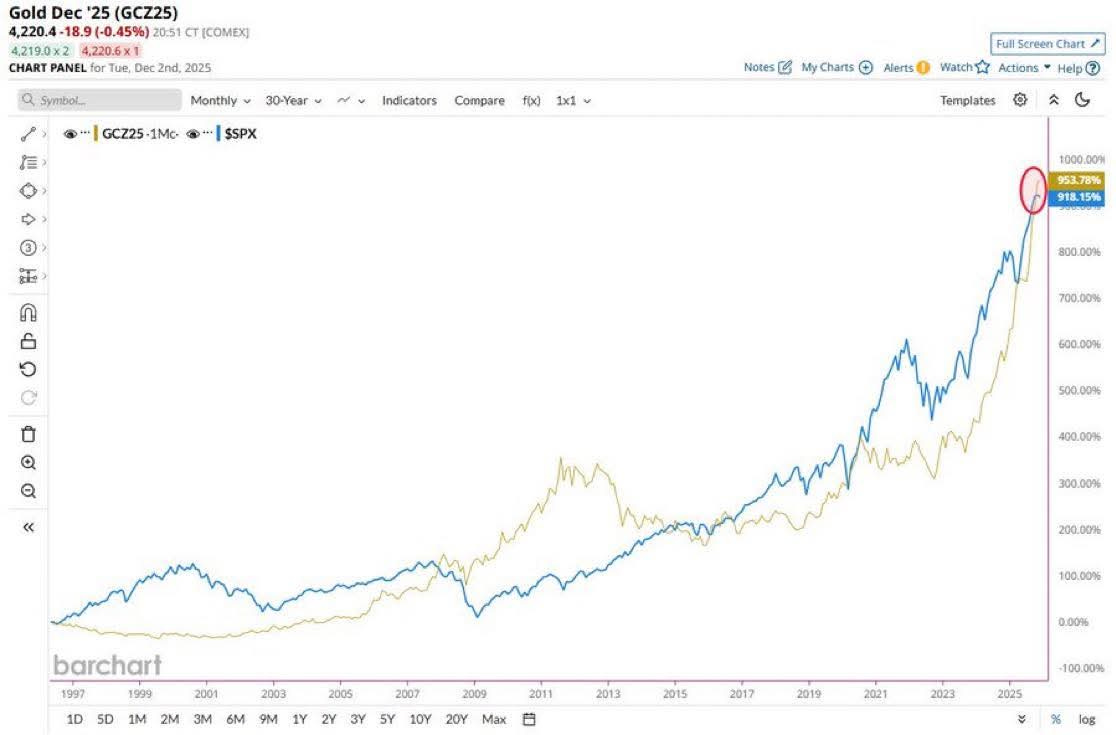
When Investors pull up a 30-year chart and see gold edging out the S&P 500, it does something to their brain.
Part of them whispers, “I knew it, I should have walked the yellow brick road full of Gold.”
Another part whispers, “Great, now I’ve missed another move.”
This article is for the third voice. The voice of reason that says:
“Gold just had a historic run. Now, how do I build a position in gold that’s smart fundamentally, technically, and psychologically… without turning my portfolio into a reddit investing meme?”

The Strange Moment We’re In
Gold isn’t quietly sitting in the corner anymore. It’s the main character.
Over the last couple of years, gold prices have smashed through the $4,000 level for the first time, logging one of their strongest annual performances since the late 1970s.
At the same time, central banks have quietly been hoarding the stuff. Since 2022 they’ve been adding more than 1,000 tonnes of gold a year to their reserves, which roughly doubles their pace from the previous five years, according to the World Gold Council.
While everyone doomscrolls for political drama from central bank pressers, the official sector has basically said:
“Less paper promises, more atoms AKA Physical Gold.”
That context matters, because when investors sit back and pull up a chart of gold stretching across decades, gold is no longer a crisis trade. Research on gold as a strategic asset shows long-term returns broadly comparable to equities on a price basis, but with very different behavior during recessions, inflation spikes, and market panics.
This isn’t about chasing a shiny rock at the top. It’s about asking a calmer, wiser question:
“Given where gold is in its cycle, what’s the right way to start building gold into my portfolio?”

What Gold Actually Does in a Portfolio
When we strip away all the myths about gold, investors will find that gold has three main jobs in any portfolio.
Shock Absorber
When equities and bonds both get punched in the face, gold typically will zig while they zag. That’s why so many Money Managers treat it as a core portfolio diversification tool.
Monetary Insurance
In an era of trillion-dollar deficits, weaponized reserves, and creative monetary policy(FIAT), and when central bankers are buying more precious metals, that is their way of saying, “Central Banks need assets that carry no counterparty risk.” Retail investors would be wise to echo the moves of central bankers in these volatile markets, just obviously in a smaller size.
Speculative Rocket Fuel
Gold can also be traded. When yields fall, the dollar typically weakens, and when we add geopolitical spikes, gold can move like a growth stock. That’s the part of golds cycle that we are currently living through.
Investor strategies need to respect all three roles that gold plays, without thinking they have a crystal ball to find out what role will gold roll into next. Investors should only be invested using verifiable information.

The Fundamental Case: Why Gold Still Has a Seat at the Table
Let’s boil the macro story down to three forces.
Central Banks Are Quietly “Buying the Dip” in Fiat
Ever since sanctions froze a chunk of Russia’s reserves, emerging market central banks have treated that as a memo. Dollar assets can be politically contingent. Bullion in a vault is not.
Official data shows three straight years of above 1,000 ton’s of net buying. That is the strongest and most persistent binge on record. When the institutions that literally run money are loading up, that’s not a Reddit trade — that’s a structural shift.
Real Yields, Debt, and the “Trust Premium”
Gold doesn’t pay interest. It competes with whatever “real yield” (interest minus inflation) you can earn on government bonds.
High, stable real yields? Gold sulks in the corner.
Negative or falling real yields? Gold becomes the adult version of a cheat code.
With debt loads elevated and long-run forecasts calling for lower real returns on bonds, more investors are using gold as a store-of-value anchor rather than a shiny side bet.
If you want a deeper, more mechanical explanation, this primer on how to invest in gold lays out how real yields and currency moves feed into the gold price.
The Psychology of Doubt
We’re in one of those eras where nobody fully trusts anything:
Governments don’t fully trust other governments
Retail investors don’t fully trust banks
Even institutions are gaming out scenarios where a major central bank loses some independence or credibility
Gold thrives on that ambient doubt. Investors don’t need a full-blown currency crisis, they just need enough people thinking, “Maybe I’d like something that isn’t someone else’s liability.”

The Technical Backdrop: The Chart That Makes Everyone Itchy
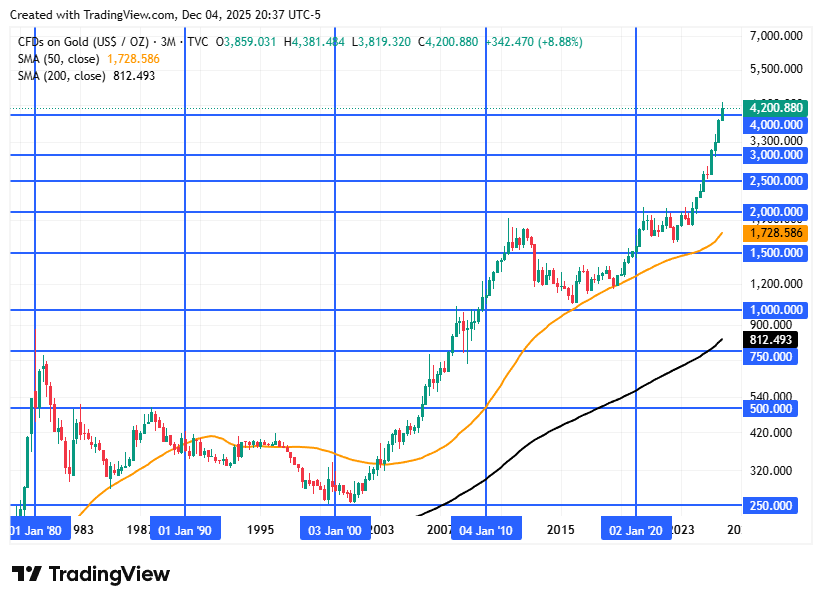
Pull up a long-term chart of gold, preferably on a logarithmic scale. The picture is simple:
Massive base from the mid-90s to early-2000s
Explosive run into 2011
Long, frustrating sideways chop
Then a new breakout that carried price through $2,000, $3,000, and now $4,000+ in a violent, almost vertical fashion
Technically speaking, that’s a powerful secular uptrend that’s also overextended in the short term.
When a market stretches far above its 200-day moving average and sentiment hits euphoria, one of three things usually happens:
It consolidates sideways while fundamentals “catch up.”
It corrects sharply back toward prior breakout zones.
It keeps grinding higher, but with nasty shakeouts to punish late investors.
Investors can’t know in advance which version they’ll get. Instead, investors can design an entry plan that doesn’t rely on being the hero who can nail the exact low.
Think of the current chart as a raging river. You don’t dive in at the fastest point. You wade in from the bank, one step at a time, tied to something solid onshore. Refer to my article on the Sharpe Ratio for a detailed analysis of slowly entering as prices stabilize and volatility fades.
The Simple Playbook: Core + Tactics
Here’s a way to turn all of this into a concrete, human-friendly plan.
Step 1: First, Decide the Job, Second the Percentage
Before any investor touches a ticker, they must decide what job or role will gold fulfill in their portfolio:
If investors want a long-term hedge against inflation, currency risk, and equity bear markets, gold belongs in the core allocation bucket
If you want to trade the current gold bull market, that goes in a separate, tactical bucket with tighter risk limits
Most research on gold and portfolio diversification lands somewhere in the 5–10% of portfolio range for a strategic allocation. Some macro money managers argue for exposure in the low teens, during extremely uncertain regimes.
The exact number comes down to what each investor can withstand. The important part is that investors choose it deliberately before purchasing and not after when we are now emotionally invested.
Step 2: Building a Boring Portfolio is what Money Management is all about
Once investors have a target (say, 7–10% of their investable assets), the next question is how to own it.
A simple, robust split looks like this:
Consists of Bullion / Bullion-Backed Exposure (the Anchor) Large, liquid gold ETFs that hold physical metal in trust, or vaulted bullion if you’re willing to deal with storage
Consists of Gold Miners / Royalty Companies (the Amplifier) Contains a broad ETF of miners or royalty/streaming companies. These tend to move more than the metal, both up and down because they’re businesses with operating leverage
For most investors, the anchor should be much bigger than the amplifier. Think 70-80% of their portfolio as bullion-style and 20-30% of their portfolio as miners inside that overall gold slice within the total portfolio.
The mechanics of bullion vs ETF vs mining stocks, are laid out in every serious guide to investing in gold. The principle is simple, separate the safe haven role from the high beta role.
Step 3: Respect the Run, Stagger Your Entries
Buying anything at all-time highs is uncomfortable for a reason. If you shove 10% of your net worth into gold tomorrow, you’re basically betting that the move will never mean revert past your entry to the 50SMA or 200SMA.
Instead, think in tranches:
As an investor, decide how many months you’re willing to spend to build the position (for example, six or twelve months)
Investors divide their target allocation by the number of months they plan on building the position
Add one tranche or slice on a schedule (monthly or quarterly) and allow yourself to add extra when the market gives you a proper pullback
In plain language:
“I’ll build my gold position slowly, and if the market sells off 8–15% from a recent high, that’s an invitation to buy my next chunk a little early.”
Volatility becomes the mechanism that helps investors, not the thing that scares investors out of the process.
Step 4: Carve Out a Small Tactical Sleeve (If You Want the Spice)
If you’re the kind of investor who likes to lean into trends, create a separate tactical sleeve, consisting of 2–3% of your total portfolio. This sleeve is for more active trades in:
Shorter-term futures or micro-futures
Options on gold ETFs
A more concentrated gold miner basket
The rule here is simple:
Tactical gold trades should never be big enough that a single bad month wrecks your long-term plan.
You’re allowed to be aggressive inside that sleeve. You’re not allowed to let it spill into the rest of your life.
For nuts-and-bolts traders, this guide on how to trade gold walks through the mechanics of futures, margin, and risk controls.
Step 5: Real Traders Pre-Write their Rules Before the Headlines Hit
Here’s the part that separates the professionals from the hobbyists, which is why almost nobody does it:
Real investors decide in advance what they’ll do if gold drops 20–30%
Real investors decide in advance what they’ll do if gold blasts to $5,000+
Examples:
“If gold falls 25% from their average entry, they only act through their regular annual rebalance. Real investors don’t panic-sell.”
“If gold runs so hot that it becomes more than 15% of an investors portfolio, they’ll trim it back to target over a few weeks and re-deploy the profit into other assets.”
Those sentences sound boring, but they’re what separate “long-term investors with a gold strategy” from “A person who bought a shiny object at exactly the wrong time.”
How This Ties Back to the 30-Year Chart
The chart that kicked this off, gold slightly outpacing the S&P 500 over the last three decades, is a story about starting points and regimes.
Gold crushed from the late-90s lows through crises and currency scares. Equities flourished in other regimes. The winner depended on when you started the clock.
If you take one lesson from that picture, let it be this:
The point is not to find the single perfect asset.
The point is to build a team of assets whose strengths show up in different decades.
Gold just happens to be the player getting the ball right now.
Play the Decade, Not the Day
Gold at $4,000 is loud. Financial media loves the superlatives and social media loves the laser-eyed memes.
The serious opportunity isn’t guessing what is tomorrow’s tick. For investors, it’s quietly upgrading their process so that they:
Have a clear role for gold in their portfolio
Accumulate it deliberately, not impulsively
Let macro tailwinds and market structure work over years, not hours
In a world where everyone is chasing the next hot take, methodical, rules-based investing in gold is about as contrarian as it gets.
Build the plan, then let the metal do what it’s done for thousands of years: sit there, quietly compounding the benefit of your patience.
Legal Disclaimer
This article is for educational and informational purposes only. It is not financial advice, not a recommendation to buy or sell any security, commodity, or strategy, and it does not take into account your individual circumstances. Trading and investing in gold, futures, options, or any financial markets involves substantial risk of loss. The majority of active traders and day traders lose money over time. Always do your own research, consider your risk tolerance and financial situation, and consult a licensed financial professional before making any investment decisions.


