


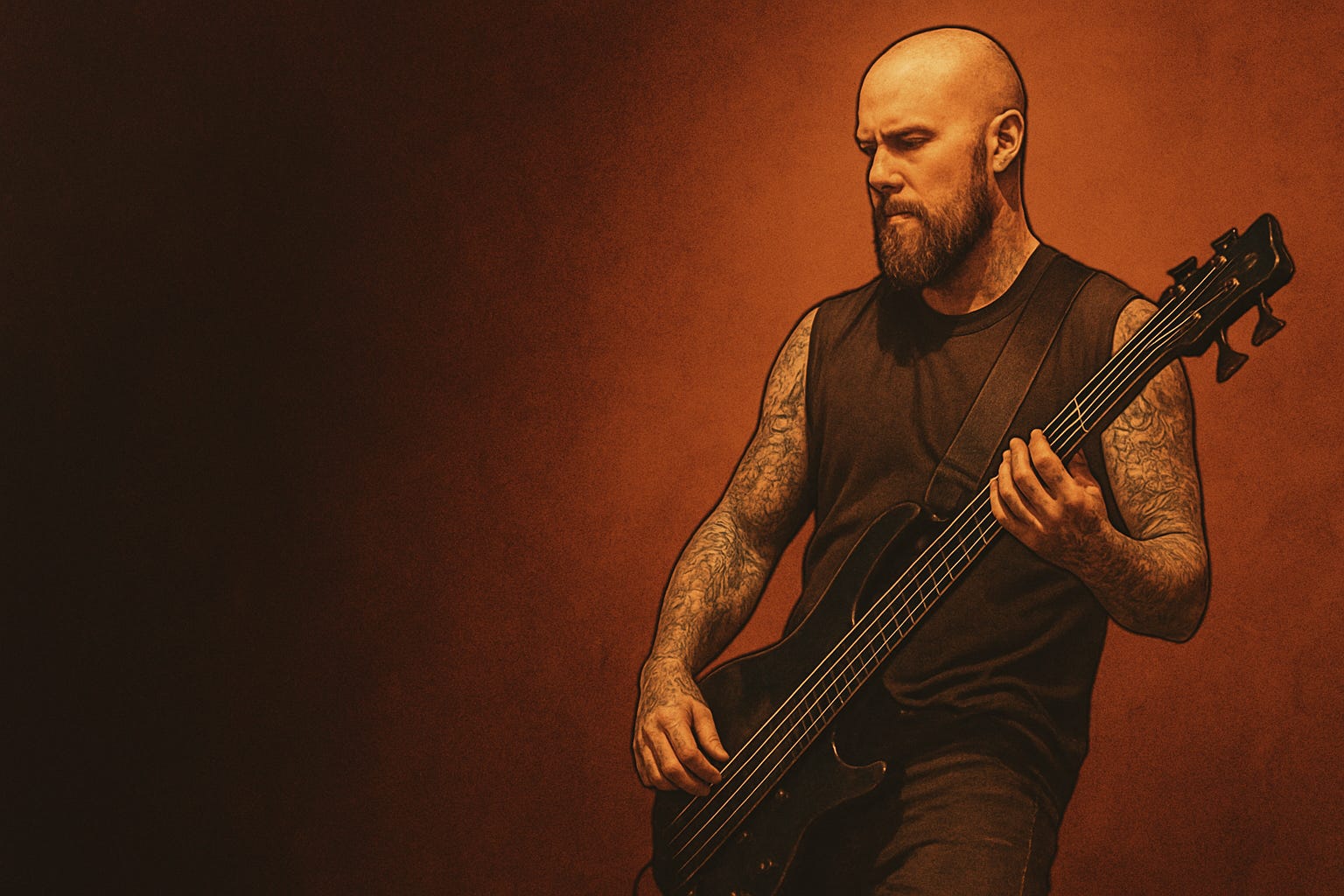

This article is dedicated to Jesus Flores for getting me into Limp Bizkit as a teenager, and is meant as a tribute for Sam Rivers himself!
The news hit like a badly timed breakdown: Sam Rivers is gone. Legacy
Forty-eight years old. Founding member of Limp Bizkit. The quiet architect of those basslines that rattled car doors and teenage ribcages from Jacksonville to every nowhere suburb that ever needed a little louder.
The headlines did their job:
“bassist and co-founder… dead at 48… heartbeat of the band… pure magic… the soul in the sound.”
They summed up a life in a paragraph. But the thing about bass players is, you don’t really understand what they do until you imagine the song without them. Silence where the pulse should be. That’s what this feels like.
So I did the only thing that made sense in a world where Sam Rivers is no longer on this planet: I wrote a stupid-sincere, Guardians of the Galaxy-themed Limp Bizkit parody called “Getcha Groot On.”
Some people light candles. Some people say rosaries. Me? I put a talking tree in baggy pants and handed him a five-string.
The kid in the backseat and the man with the bass
Before we get to Groot, let’s talk Sam.
Rivers was there from the jump, part of the Jacksonville crew that built Limp Bizkit out of skate scrapes, mall anger, and bedroom riffs. The band formed in 1994, crawled out of the Florida scene, and then exploded with albums like Significant Other (1999) and Chocolate Starfish and the Hot Dog Flavored Water (2000)—records that turned nu-metal from a fringe experiment into a global, unfortunate-pants-shaped phenomenon.
Sam’s bass playing was the secret weapon.
Not flashy, not shreddy, not “hey look at me.”
Just deep-pocket, hip-hop-inflected lines that made the riffs feel like they had gravity.
He even scored hardware for it — Rivers picked up “best bass player” recognition around the band’s peak years, a quiet nod to the guy holding the whole circus together from the shadows.
Later came the hard years: liver disease, leaving the band, then the long road back after a transplant. He stepped away in the mid-2010s, got a second chance at life thanks to surgery, then rejoined Limp Bizkit and slipped right back into that low-end driver’s seat.
He helped carry them into the Still Sucks era in 2021 — an album that doubled as a victory lap, an inside joke, and a love letter to the fans who never took their red caps off.
Then October 18, 2025: he’s gone. News outlets and fan feeds fill with black-background tributes. Clips resurface from festival sets, the bass clipping cheap phone mics because everyone was too close to the speakers. The band calls him their heartbeat, pure magic, the soul in the sound.
The internet moves like it always does: from shock to nostalgia to the next trending topic.
But some of us get stuck in the replays.
Why a parody? Why Guardians? Why Groot?
Grief is weird.
Sometimes you break down. Sometimes you build something. Sometimes you put a walking houseplant in a nu-metal band.
“Getcha Groot On” was born out of three overlapping obsessions:
Limp Bizkit – the band that soundtracked way too many nights of teenage bad decisions. Limp Bizkit
Guardians of the Galaxy – Marvel’s band of misfits who keep saving the universe while arguing about playlists.
Sam Rivers’ basslines – the steady center in all that chaos.
Groot is the perfect symbol for Sam in my head:
rooted yet constantly regrowing
quiet but essential
part of the crew’s emotional spine
says very little, means a lot
So I imagined a universe where:
The Milano’s sound system is permanently stuck somewhere between Significant Other and Still Sucks.
Star-Lord is arguing with Rocket about whether nu-metal “counts” as classic.
And in the corner, Groot is just vibing, sap-drunk on sub-bass and starlight.
“Getcha Groot On” is my way of making that universe canon in my own little corner of the internet. It’s a parody in spirit, not in theft: an energy tribute, a wink toward the original “Getcha Groove On” aesthetic without biting its lines. The song reimagines Groot as the bass player of the Guardians, laying it down in the pocket while the rest of the crew blows things up in 7.1 surround.
No lyrics printed here — this isn’t about intellectual property, it’s about emotional property. The song lives best in your headphones anyway.
The bass in Groot’s branches
When I sat down to write the track, I started with the bass first.
If this was going to honor Sam, the low end had to carry the weight. In my head, every bar asked:
Would Sam nod at this groove?
Does it sit in that Rivers pocket—hip-hop tight, rock heavy, never over-playing?
The verses imagine Groot on stage: a living tree with a bass slung across his trunk like a vine, roots plugged straight into the amp, fingertips glowing as they slide across the strings. The chorus is less about words and more about feel: the ecstatic, stupid joy of bouncing with your friends when the drop hits and you stop caring how ridiculous you look.
That was Sam’s gift. Not speeches, not front-man antics. Just permission: to move, to shout, to mosh, to exist too loudly for a few minutes.
So in “Getcha Groot On,” every time the imaginary crowd jumps, it’s for him. Every breakdown is a moment of silence that refuses to stay silent. Every groove is a thank-you note written in low frequencies.
A quieter verse: Sam Rivers the human, not the headline
It’s easy to talk about people only as legends once they’re gone. But Sam’s story was also brutally human.
He struggled with alcohol. His liver failed. He stepped away, not in a blaze of drama but in the quiet, painful way ill health forces people to. He fought his way back through a transplant and recovery, rejoined Limp Bizkit, and went back to work doing the one thing he’d always done: making the room move from the bottom up.
There’s something sacred about that.
Most of us won’t get obituaries, awards, or glossy photo tributes. If we’re lucky, we get a handful of people who remember the way we made them feel.
Sam scored a whole generation’s feelings:
The first time someone cranked Significant Other in a rust-bucket car.
The night some lost kid found a mosh pit that didn’t ask questions.
The way a chorus could make you feel taller than your actual life.
That’s the version of Sam that lives inside “Getcha Groot On”: not “famous bassist,” but the guy whose basslines quietly rewired our nervous systems.
The Guardians mixtape theory of grief
Here’s the thing about Guardians of the Galaxy…
The movies aren’t really about saving the universe. They’re about what you do with the people and songs that save you first.
Star-Lord clings to his mixtape like a life raft.
Every track is a memory, a phantom limb of the people he’s lost.
Limp Bizkit is on my own messed-up mixtape like that. Not because they were “cool” in the critical sense, but because they were there:
When life felt too big and I felt too small.
When I needed something dumb and heavy and cathartic.
When I didn’t know how to talk about anger or grief, but I knew how to hit repeat.
So “Getcha Groot On” is me adding a new song to that personal Awesome Mix: a track where my past (Limp Bizkit), my comfort franchise (Guardians), and my present grief (Sam’s passing) all end up in the same 4/4 time signature.
Some people will hear it and laugh.
Some might cringe.
A few might feel seen.
Sam, I like to think, would just smirk from the backline and nod his head on the two and the four.
For Sam, for Groot, for every quiet heartbeat in the band
Sam Rivers died on October 18, 2025, in Florida, forty-eight years on this planet. Thirty-plus of them in music. A founding member of Limp Bizkit, a player whose last era with the band included festival stages like Reading and Leeds and a late-career victory lap with Still Sucks — a record that now reads like a final chapter he didn’t know he was writing.
If you strip away all the noise, this is what’s left:
A kid from Jacksonville who picked up a tuba, then a bass. MusicRadar
A band that shouldn’t have worked, but did. Loudly.
A catalog of grooves that turned awkward teenagers into temporary superheroes.
A final album that gave him one last chance to anchor the chaos.
My little tribute song won’t change music history. It won’t fix the hole in his bandmates’ chests or comfort his family in any measurable way.
But it’s a way of saying:
I heard you.
I felt you.
The basslines landed.
So here’s to you, Sam:
May your tone always be fat in whatever comes after this.
May your timing stay locked in with whatever cosmic drummer keeps the galaxies on beat.
May every kid who discovers Limp Bizkit in some future thrift-store CD bin feel a little of that heartbeat you dropped into the tracks.
And somewhere, in some imaginary space-bar, I hope Groot is up there on stage — branches swaying, amp humming, crowd roaring — doing exactly what you taught us to do:
Getcha groove on.
Getcha Groot on.
And never, ever underestimate the power of the one holding down the low end.
In the end, that’s what grief is: learning to dance with a ghost in the kick drum, and letting the bass carry you forward anyway.

