



There is a lazy way to read SLUGZ

You could look at the helmet, the darker branding, the uglier textures, the post-SNAILS theatrics, and call it a rebrand. A costume change. A veteran producer finding a fresh wrapper for old instincts. That reading is clean, simple, and wrong.
SLUGZ makes more sense as an evolution.
After 14 years of making music as SNAILS, Frédérik Durand said he had reached a point where he felt like he was “going in circles creatively.” What he wanted was not a new logo. He wanted a new permission structure.
When he first put on the SLUGZ helmet at Montréal’s ÎLESONIQ on August 10, 2025, he said it unlocked “a completely different creative world,” one centered more around lore, storytelling, and even doing vocals himself than the lane he had occupied for years as SNAILS. The official SLUGZ tour archive places that ÎLESONIQ appearance on the calendar, and the answer he gave us explains why the moment mattered. It was not a reveal for the crowd as much as a rupture for the artist.
That is the key to the whole thing. SLUGZ is not interesting because it is darker. Bass music has no shortage of dark. It is interesting because it feels like Durand finally gave himself room to chase the impulses that had been flickering around the edges for years without having to translate them into the expectations attached to the SNAILS name.
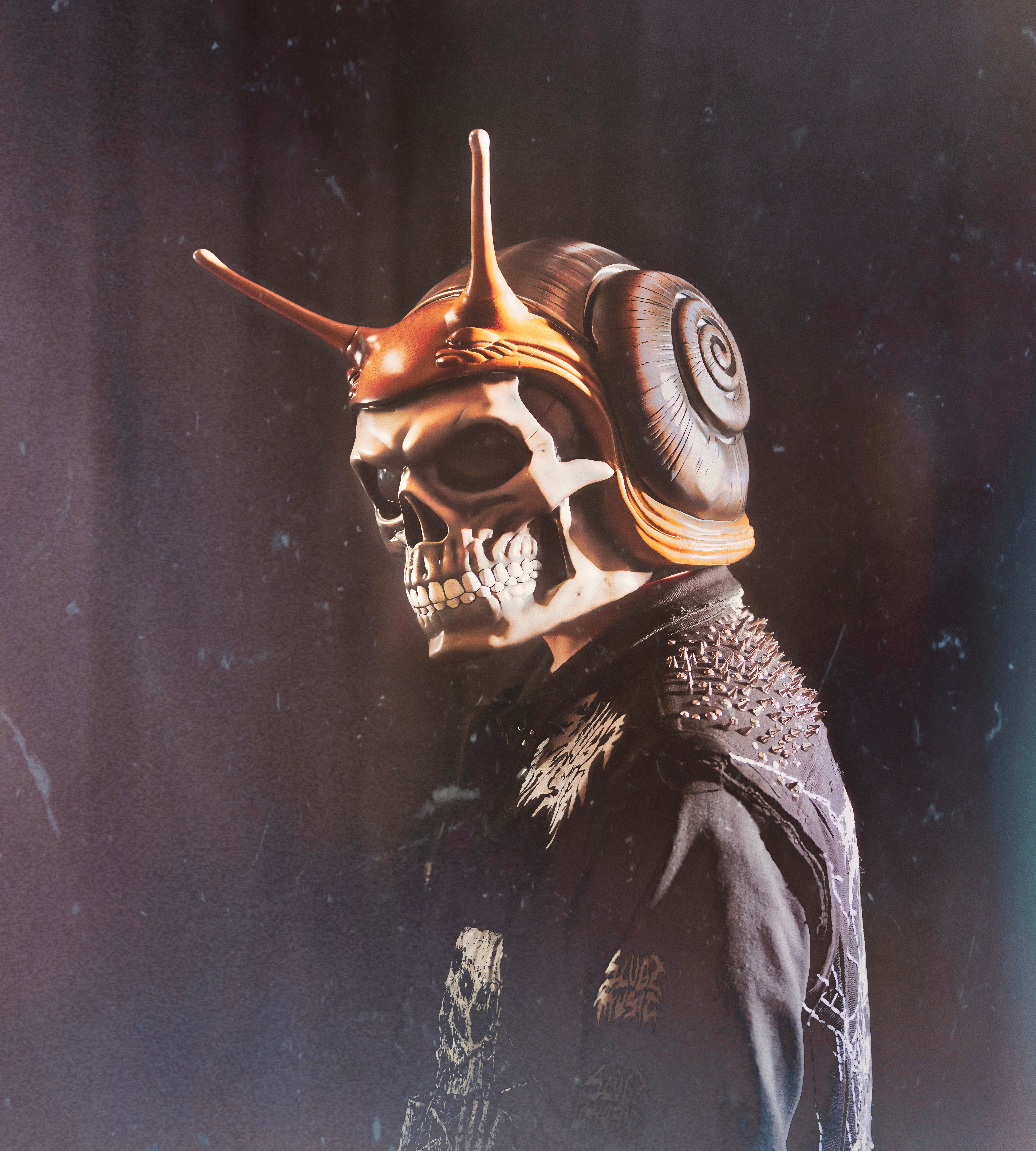
The helmet says that out loud before the music even starts. Durand has described it with the exact sort of grotesque absurdity that made his original rise so memorable: “It’s the dead shell of SNAILS I wear as a trophy.” That line sounds like a joke until you realize it is also the thesis. SNAILS was not neatly retired. In the internal mythology of this new era, he was consumed. SLUGZ stepped out of the carcass.

The world came before the campaign

Most electronic side projects are still music projects first. The lore is decorative. The visuals are seasoning. The fan engagement is mostly a collection of promo mechanics wearing spooky makeup.
SLUGZ feels different because Durand talks about it like a place, not a playlist.
When we asked whether Shellspace lives in his mind more like a video game campaign, a comic universe, or a film franchise, he answered in broader terms than any of those. For him, it is “a whole universe where SLUGZ exists,” and the community is what makes that world alive. He said the SLUGGERZ are not just an audience but the fuel for the project itself, shaping what he builds and how far he takes it.
That tracks with what is already visible across the official SLUGZ ecosystem. The project is no longer just songs and artwork. It includes missions and rewards, and a running set of unlock-based experiences that treat fans less like passive listeners than like inhabitants of an expanding world.
That is a much more ambitious idea than “artist lore.” It edges toward live-service mythmaking. Less album cycle, more campaign architecture.
Durand admitted that a lot of his time between songs goes into building puzzles, coding little experiences, and making things the community can interact with. He called himself “a huge nerd,” which helps explain why the project keeps spilling outside the borders of conventional rollout logic. SLUGZ is not trying to simulate immersion. It is trying to earn it.
The newer “SIGNAL” page makes that especially clear. Rather than simply announcing a release, the site frames the song as something the community helps unlock, with RSVP activity pushing a countdown and the promise of a secret if the target is hit before release day. That is not normal label behavior. That is game-master behavior.
Please consider Donating to Sponsor an article even $1 helps!

The songs are doing the world-building too
The concept would be flimsy if the music did not hold up.
Fortunately, the strongest SLUGZ material does not feel like lore draped over generic bass presets. The tracks themselves carry the narrative weight.
“Underworld” is the clearest example of SLUGZ at its most cinematic. Teminite brings his usual widescreen melodic instinct, but what makes the song hit is the frame around those leads. The official upload opens with Latin-inflected choral material and lyrics about a shell-backed devourer lurking in the deep, which makes the whole thing feel less like a DJ utility record and more like a cursed sea tale with subwoofers. The track premiered on October 29, 2025, and its official text leans hard into that pirate-horror imagery.
When the drop arrives, the song snaps into a double-time assault that feels violent in a specifically theatrical way. Teminite’s bright melodic blades cut through a wall of warped, retching low-end growls that behave like monsters more than like synth patches. This is where due to Snails past style a description may have been to call it “vomitstep”, but SLUGZ killed SNAILS, absorbed his musical powers, and birthed a new evolution of sound. The sound design writhes. It folds in on itself. It feels animated by appetite. More important, it feels intentional. The song rises from eerie prologue to full kraken attack and back down into the murk like a short film with no wasted scenes.
“B.A.S.S.” is built on the opposite philosophy. Where “Underworld” unfolds, “B.A.S.S.” detonates. The official release metadata lists it as a 2025 single distributed by Stem through Slugz Music, and the track’s short runtime tells you almost everything you need to know about its design priorities. It is not here to haunt you. It is here to stamp a crater in a live set.
The Pierce influence shows up in the stop-start groove and the impact-based architecture, but the smartest choice is restraint. The low end comes in huge, clean shapes instead of getting buried under excessive detail. That is why the title joke fans keep making about “Big Ass Super Sub” lands so well. The track behaves exactly like that. Ella Eve’s vocal is the fuse, not the payload. She gives the song just enough human attitude to frame the drop, then gets out of the way. The result is a hyper-efficient festival weapon, the kind of track that does not need to explain itself because your ribcage already got the memo.
“SHELLSHOCK” feels like the manifesto track for the SLUGZ project — the one that tells you what Shellspace is supposed to feel like. Where “Underworld” leans into storybook pirate horror and “B.A.S.S.” is pure weapon, “SHELLSHOCK” sits in between: it’s both lore and lead single.
The official “SHELLSHOCK” page set the tone months before listeners even hit play. It used teaser text whose first letters spelled out the title, wrapping the single in an acrostic puzzle about something buried, walls quivering, light bending, and a signal clawing upward. The release date on that page is September 27, 2025, but the more interesting fact is how perfectly the copy matches the structure of the song.
At 128 BPM, “SHELLSHOCK” has more club-spine than old-school dubstep, but the mood is claustrophobic and paranoid. Panther’s voice gives the track its human anchor, which matters because everything around him sounds like machinery convulsing in the dark. One of the most revealing things Durand told us is that the tiny obsessive detail at the heart of the track was what he calls the “glocks” bassline, a weird central texture he kept slowing, reversing, and reshaping until it gave the whole record its identity. That answer says a lot. SLUGZ songs are not being assembled as chains of drops. They are being built around artifacts. A sound becomes a symbol. A symbol becomes a room in the universe.
Press around the single describes it as a fusion of “heavy basslines, eerie atmospheres, and surreal weirdness,” and that’s a neat summary: the bass hits like industrial machinery spinning up, but the top layers — strange pads, distant FX, shadowy background textures — make it feel less like a rave banger and more like a portal opening through the black mirror.
Reinvention sounds different when it has scars

The emotional backbone of SLUGZ is not just novelty. It is pressure.
Durand framed the project to us as the start of “a new journey, new vision,” and said it represented the fear of starting over without knowing whether he would succeed. That makes the project legible in a different way. The ugliness of the music is not just aesthetic play. It is tied to instability, anxiety, and the weird psychic cost of trying to become something else while the public still associates you with the previous version.
That context sharpens the way he talks about the defamation case that hung over part of his career. He did not treat it like a dramatic origin story. He said that during that period he focused on putting all his energy into music and continuing to build SNAILS, and that the emotions naturally found their way into the work. Once the noise quieted and the court ruled the claims false, he said the experience only pushed him harder creatively and reinforced why he loves creating in the first place. There is no self-pity in that answer. No victory lap either. Just momentum.
When we asked what he would tell a younger artist facing an online accusation crisis in week one, his answer was brutally short. Focus on facts. Let the truth speak for itself.
That economy says something too. SLUGZ is not a grief diary. It is a forward engine.
Since December, the project has kept mutating
This is where the “just a rebrand” theory really falls apart.
If SLUGZ were just a launch gimmick, the slime trail probably would have cooled after the initial burst of lore and helmet drama. Instead, the project has continued to drop material that pushes deeper into its own vocabulary.
On December 12, 2025, Durand released “EMBRACE THE UNKNOWN”, a single officially credited to SLUGZ and SNAILS and distributed through Slugz Music by Stem. The release metadata on YouTube lists Durand as producer, and the track functions like a thesis statement for the emotional logic of the project. Fear is no longer a thing to outrun. It is the environment itself.
Durand has described that song as “Black Mirror EDM,” which is either a joke, a provocation, or annoyingly accurate. Probably all three. It captures the project’s mix of dystopian futurism, theatrical menace, and synthetic unease. The phrase sounds silly until you hear how well it fits.
Then, on February 19, 2026, the official SNAILS channel posted “IN PEACE YOU SHALL LIVE”, the track’s official distribution metadata lists a February 20, 2026 release through Slugz Music. Whether you clock it as the premiere date or the formal release date, the larger point is the same. SLUGZ is still actively expanding, and the material is not drifting back toward safer nostalgia bait. It is getting more committed to the eerie, immersive, self-authored logic of Shellspace.
That matters. Plenty of artists announce a new era. Fewer keep feeding it once the novelty wears off. Durand is still doing the strange labor of making the fiction feel lived in.
SNAILS was never really gone

One of the best answers Durand gave us came when we asked how he avoids accidentally making “a classic SNAILS track with a new logo” every time he opens a SLUGZ project.
He did not pretend he could sever himself from his own history. In fact, he said the opposite. His sound is part of who he is, and it will always be there. The goal is not escape by deletion. The goal is evolution. He described SLUGZ as more of a 2.0 version, one that feels more mature and allows him to tell a deeper story through his voice and the lore around the sound.
That is the right answer, and it is why the project works.
You can still hear the old DNA. The cartoon-gross instinct. The grin behind the grotesque. The joy of making bass music sound like it crawled out of a sewer in platform boots. But now those instincts are pointed with more intent. The world-building gives the ugliness direction. The storytelling gives the heaviness consequence. The fan rituals give the whole thing a sense of shared habitation rather than passive consumption.
That is not a rejection of SNAILS. It is a recontextualization.
Durand even framed the larger transition that way when we asked how he hopes people divide the two eras in hindsight. He talked about the fun of having SLUGZ “kill” SNAILS even though SLUGZ had already been present in the background through the label, the visuals, Sluggtopia, Slugz City, and Slugz Music. In other words, this was less a sudden invention than a figure stepping out of the wallpaper.
The slug was already in the walls.
Afterglow
That is probably the cleanest way to understand the project now.
SLUGZ was never just a darker alias waiting to cash in on reinvention aesthetics. It was the version of Frédérik Durand that emerged when he stopped asking whether an idea was too weird, too coded, too theatrical, too niche, too story-driven, or too far removed from what people expected him to be.
That is why the helmet matters. That is why the puzzles matter. That is why songs like “Underworld,” “SHELLSHOCK,” and “EMBRACE THE UNKNOWN” feel larger than standalone singles. They are not just tracks. They are rooms inside a place he finally allowed himself to build.
And that is what gives Shellspace its charge. Not branding. Not mystery for mystery’s sake. Freedom, wearing the dead shell of an old self like a trophy.
SLUGZ Socials:
Please consider Donating to Sponsor an article even $1 helps!
