


Technical Analysis and Fundamental Analysis contained in this post was performed manually by Andrew Jodice of Markets, Liberty, & Discipline. He’s studied and blends Al Brooks’ theory, Richard D. Wyckoff’s theory, and Charles H. Dow’s theory to conduct his analysis, and implements Al Brooks’ strategy to execute trades.

The Bitcoin Sharpe Ratio has just dropped back into a zone we only see a few times each cycle. On the chart, the ratio has slipped toward zero while the Bitcoin price grinds lower and sentiment turns sour.
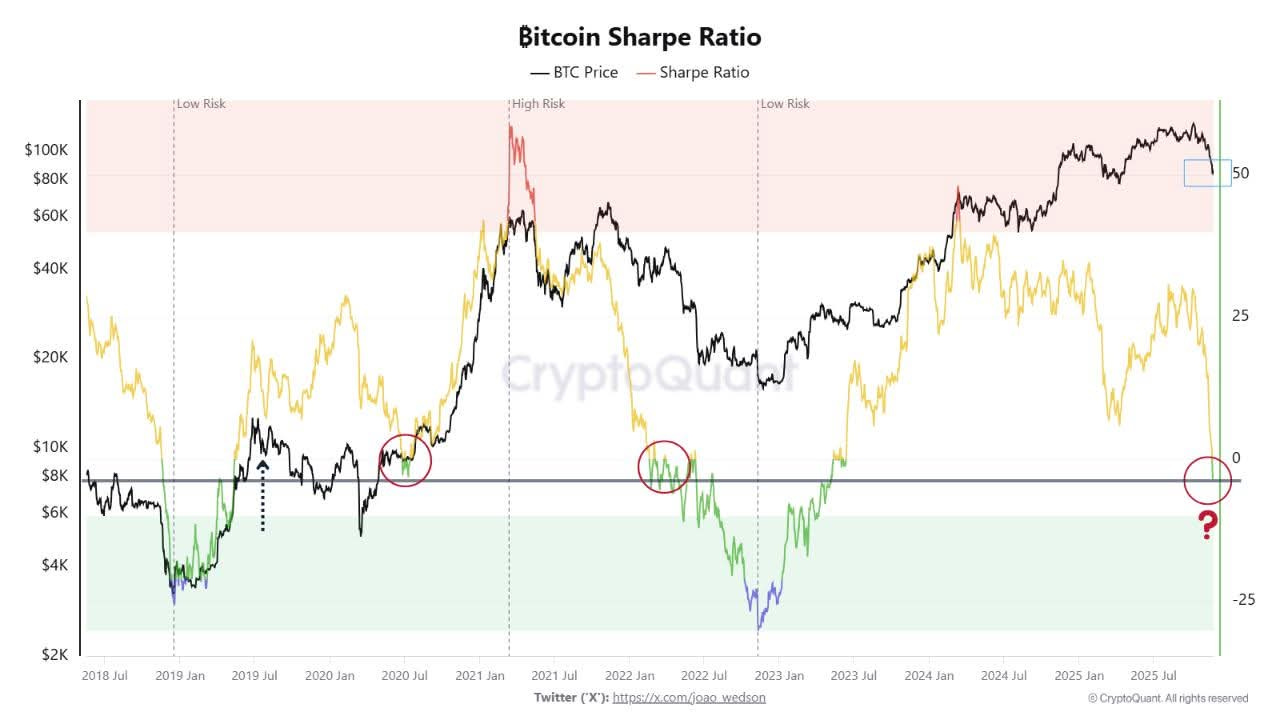
That combination usually feels terrible in real time. Yet in prior cycles, similar Sharpe crashes around 2019, the March 2020 selloff, and the early-2022 washout turned into some of the best forward risk-adjusted returns for patient Bitcoin investors.
The current message from the data isn’t “volatility is over.” It’s that, mathematically, the payoff for taking carefully sized risk is starting to improve while most participants are still focused on recent pain.

What the Bitcoin Sharpe Ratio Is Telling Us
The Sharpe Ratio measures how much return an asset has delivered per unit of volatility. In simple terms:
High Sharpe = strong returns relative to the risk you had to sit through.
Low or near-zero Sharpe = weak, noisy, or negative returns relative to that risk.
In this chart:
The black line is the Bitcoin price chart.
The yellow line is the Bitcoin Sharpe Ratio over time.
The background bands highlight rough “low-risk” and “high-risk” zones for new entries.
A Sharpe Ratio collapsing toward zero tells you that recent returns have been poor relative to volatility. The market has been punishing risk-takers by liquidating traders who were overleveraged. The market has been disappointing to late buyers, but what else is new in trading? Don't be a whales exit liquidity. However, that reset is exactly what tends to improve future risk-reward trades for the next cohort of smart investors.

Why Low-Sharpe Windows Have Mattered in Past Cycles
The current reading lines up with three prior low-Sharpe zones on the chart:
The 2018–2019 bear-market capitulation area
The March 2020 COVID crash
The early-2022 deleveraging phase
Each episode had the same emotional signature. Using the bullet points below, and the headlines in crypto today, it sure looks & sounds familiar huh?
Headlines and sentiment were overwhelmingly bearish.
The crypto market felt broken or uninvestable.
Short-term price action was choppy and hard to trade.
Whales forced weak-handed investors out of the market through what I call spook the investors is a tactic where whales starr an intense period of selling pressure in a short period of time. This spooks retail investors, who start to sell off their BTC as they hit their “Uncle Zone” and as traders are liquidated from the volatility initiated by the whales to rattle everyone's tree for their BTC. The whales who started the sell off, are typically the ones taking the otherside of the trade before they move price up again.
With volatility normalizing, the window where low Sharpe ratios produce outsized forward returns for investors who sized their positions carefully allowed them to hold through the noise before a move up.
Remember past performances never guarantees future results. However, this is a structural pattern: Sharpe collapses when the pain is already in the rear-view mirror for someone else and never before.

The Math Behind Contrarian Bitcoin Investing
Contrarian investing in Bitcoin isn’t about magically picking the bottom tick. It’s about recognizing when the distribution of future outcomes starts quietly tilting in favor of smart money investors.
A low or negative Sharpe Ratio is one of those moments where;
Weak recent returns mean expectations have been reset.
Volatility shakes out the most fragile positions.
New buyers are no longer competing with euphoric, late-cycle FOMO flows.
Layer the Sharpe profile on top of Bitcoin cycle drivers, like Bitcoin halving cycles, on-chain adoption metrics, and structural inflows via Bitcoin ETFs and investors should come to the basic thesis that upside scenarios remain alive while a lot of downside pain has already been realized in the market.
Now don't confuse what I am saying and think that the market can’t go any lower. It means that the expected value for patient, risk-aware investors is improving from when the market had its euphoric highs from this Bitcoin bull market.

How Investors Can Navigate This Window Without Blowing Up Their Account
A rare risk-reward window is not a green light to over-leverage into crypto. It’s an invitation for smart-money investors to tighten their process and let risk drive decisions instead of emotion.
1. Size positions, don’t make heroic predictions.
The right question isn’t “Is this the bottom?”
but:
“What allocation to Bitcoin as a portfolio asset keeps me solvent across most scenarios?”
Smart-money investors define a maximum portfolio weight for Bitcoin and they stick to it. Position sizing is set by risk tolerance, time horizon, and income. Not by headlines or social media.
2. Use volatility to scale in, rather than chasing price.
When Bitcoin volatility is elevated and the Sharpe Ratio is low, markets rarely form a neat V-bottom. Instead of piling in on every bounce, disciplined investors build exposure gradually over time because they accept that the exact low in a market is unknowable.
3. Put pre-planned tranches in writing.
Pre-planned tranches mean you decide in advance to buy or sell in clearly defined chunks rather than all at once.
Example: you want a 10% Bitcoin allocation, executed in four tranches of 2.5% each. You set simple rules—such as specific price zones, time intervals, or volatility conditions already set in stone that tell smary money investors exactly when to deploy each tranche.
This turns volatility into a tool: you’re executing a written plan instead of reacting emotionally to every move.
4. Use periodic portfolio rebalancing to keep Bitcoin in its lane.
Rebalancing starts with a target mix. For example, 60% equities, 30% bonds, 10% Bitcoin. On a set schedule (monthly or quarterly) or when weights drift too far, investors trim what’s above target and then add the extra to the stocks that are below it's position percentage in their a smart money investor’s portfolio. This is one of the many ways professional money managers manage a risk adjusted portfolio.
If Bitcoin rallies and grows to 18% of the portfolio, smart money investors systematically sell back down toward 10%. If it falls to 6%, investors buy up to 10%. Rebalancing naturally buys weakness, sells strength, and prevents a single volatile asset from silently dominating an investor’s risk.
5. Define risk limits in advance.
Before you add exposure, decide how investor’s respond to drawdowns:
What loss on a position or on the total portfolio forces investor’s to cut back?
How long are investor's prepared to hold through volatility?
Which other assets—cash, bonds, equities, real estate—will offset an investor's crypto risk?
Writing these rules down makes it much harder to rationalize oversized bets in the heat of the moment.
6. Filter noise from signal.
Low-Sharpe regimes are full of scary headlines, blame, and drama. To avoid getting whipsawed, build simple, objective rules that are based on price levels, volatility bands, or trend filters, that tell you when to add to a position, when to reduce a position, and when to sit on your hands and do nothing. Decisions that are grounded in data rather than emotion are what separate the amateurs from the professionals who can survive in high-volatility markets without blowing their account.

What Could Break the Pattern?
It’s important to be explicit about the risks that could invalidate this bullish interpretation of a low Sharpe Ratio:
A deterioration in global liquidity or risk sentiment could keep crypto markets depressed much longer than prior cycles.
New regulatory shocks, exchange failures, or technological issues could trigger another leg down.
The macro environment underpinning earlier recoveries—especially central-bank policy and fiscal stimulus—may not repeat.
In other words, a low Sharpe Ratio improves the odds for future risk-adjusted returns compared to the euphoric peak, but it does not guarantee a swift or V-Shaped recovery.

Why This Window Rarely Stays Open for Long
Look across the full chart and one thing stands out: the “low-risk” bands and near-zero Sharpe readings are short-lived compared with the long stretches of trend that follow. Once positioning is cleaned up and flows stabilize:
The Sharpe Ratio recovers,
The trend structure improves, and
The easy contrarian entries vanish.
By the time the narrative feels safe again, the best Bitcoin risk-reward is usually behind you.
Right now, the data suggests we’re in one of those rare pockets where the short term still looks messy, but the long-term math is starting to lean back toward disciplined, long-horizon buyers. Whether you act on it or not, it’s a window worth paying attention to.

Educational Disclaimer
This article is for educational and informational purposes only. It does not constitute financial, investment, or trading advice, and it should not be relied on to make any specific decision. Trading or investing in Bitcoin and other cryptocurrencies involves significant risk, including the risk of total loss. Most short-term and day traders lose money over time.
Always perform your own research, consider your personal financial situation and risk tolerance, and consult a qualified, licensed financial professional before making any investment decisions.


