



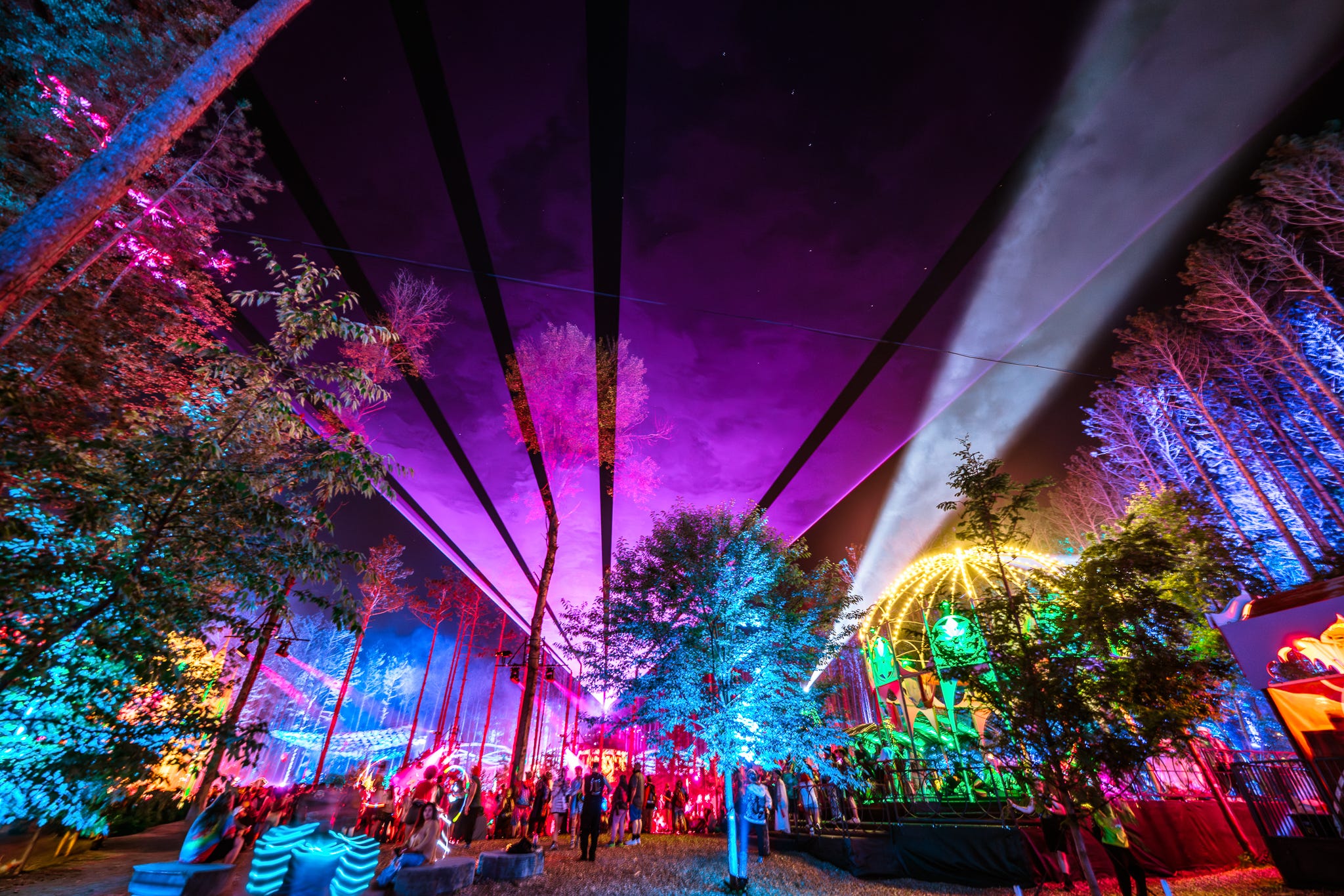

By the third day at Electric Forest, most of that has become secondary. Your backpack starts filling with things you never packed: bracelets from strangers, business cards you’ll actually keep, trinkets tucked into forgotten pockets, photographs that already feel nostalgic and conversations that somehow became part of your weekend before you realized they were happening.
Hope had traded Friday’s Bowsette cosplay for Miltank on Saturday, and looking back, it couldn’t have been a better fit for the day ahead. Miltank has never been the loudest Pokémon in the room. It isn’t built around spectacle. It’s built around care, support and keeping everyone around it going. Saturday turned out to have that same heartbeat. Instead of chasing one massive headline after another, we found ourselves spending the day with the people who quietly hold Electric Forest together. They don’t always stand beneath the biggest stage lights, but without them, the Forest wouldn’t feel like the place so many of us return to year after year.
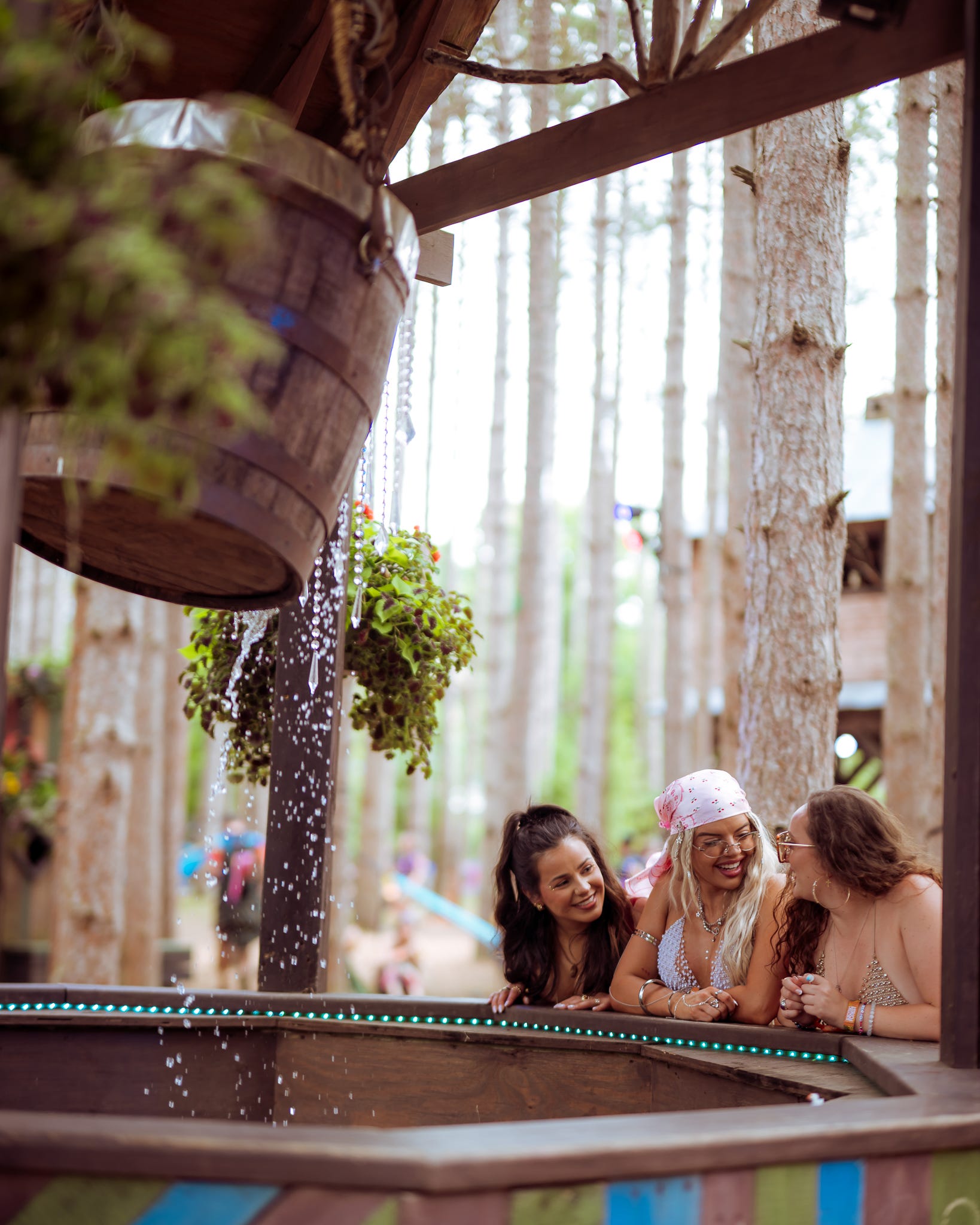
Michigan continued to treat us kindly. The cooler evenings had given us something festival veterans never take for granted: a full night’s sleep. Eventually the morning sun began turning our tent into a slow cooker, gently convincing us it was time to get moving. Cameras were packed. Batteries were checked. Recorders were tested one more time. Devin had managed to secure an interview before the festival officially opened with Sheriff Phoenix, the person leading one of Electric Forest’s most beloved institutions, the Grand Artique Trading Post.
By the time we reached the entrance, the festival hadn’t technically opened, but it was already alive. Thousands of people waited patiently outside the gates, each carrying their own excitement for what Saturday might become. Some compared schedules one last time before inevitably abandoning them. Others adjusted elaborate costumes or topped off hydration packs. Friends reunited after getting separated the night before while first-time attendees scanned the towering pines with the kind of wide-eyed excitement that’s impossible to fake. The gates hadn’t opened yet, but the Forest had already begun.

Every object remembers someone
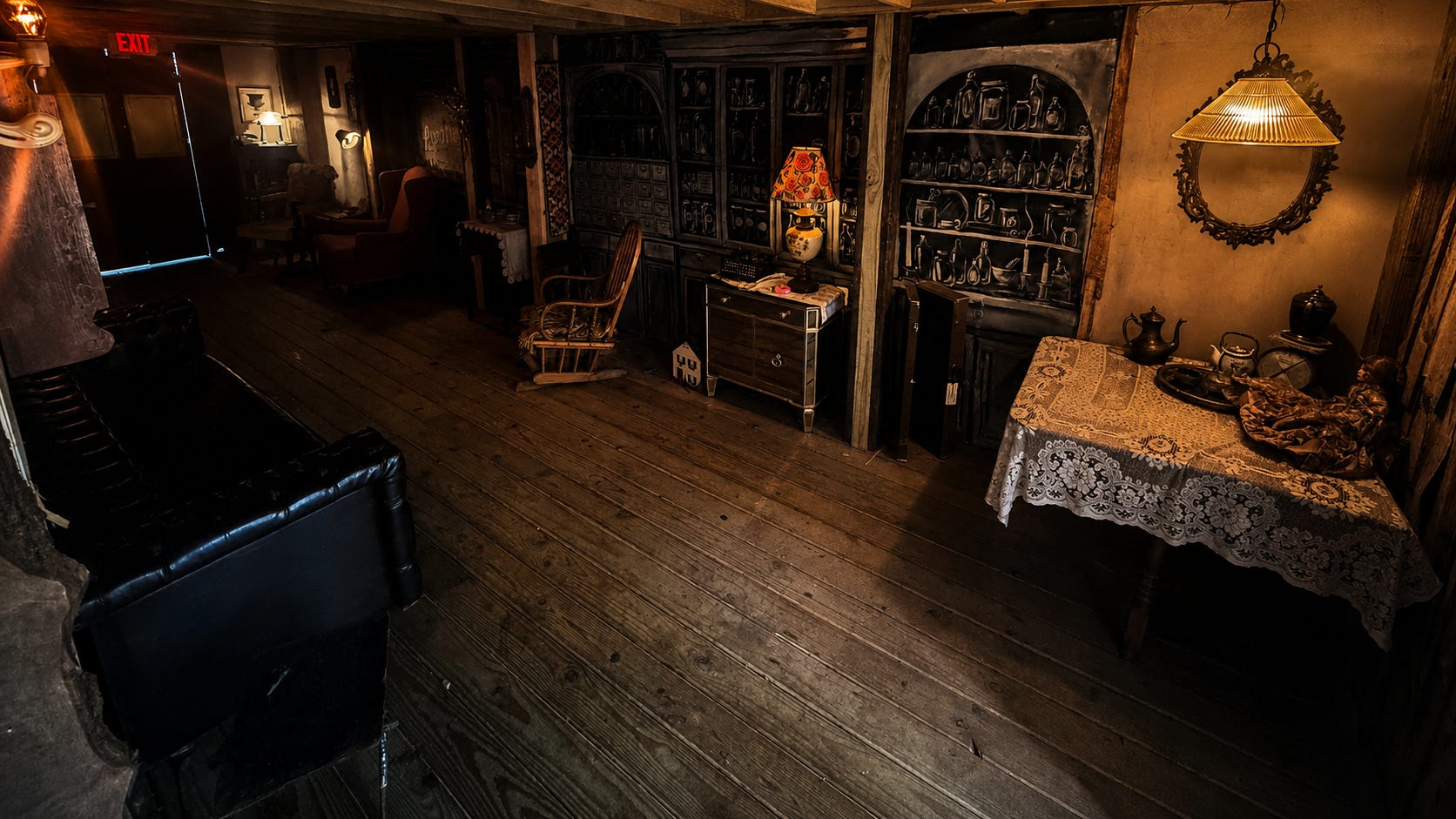
The Grand Artique Trading Post doesn’t feel like a store.
It feels like discovering the forgotten attic of a fantasy novel.
Shelves overflow with antique keys, vintage jewelry, weathered books, strange instruments, tiny curiosities and objects that refuse to explain themselves at first glance. Nothing inside looks mass-produced, and nothing feels anonymous. Every item seems to carry the quiet weight of another life before arriving here. That’s because every single one does.
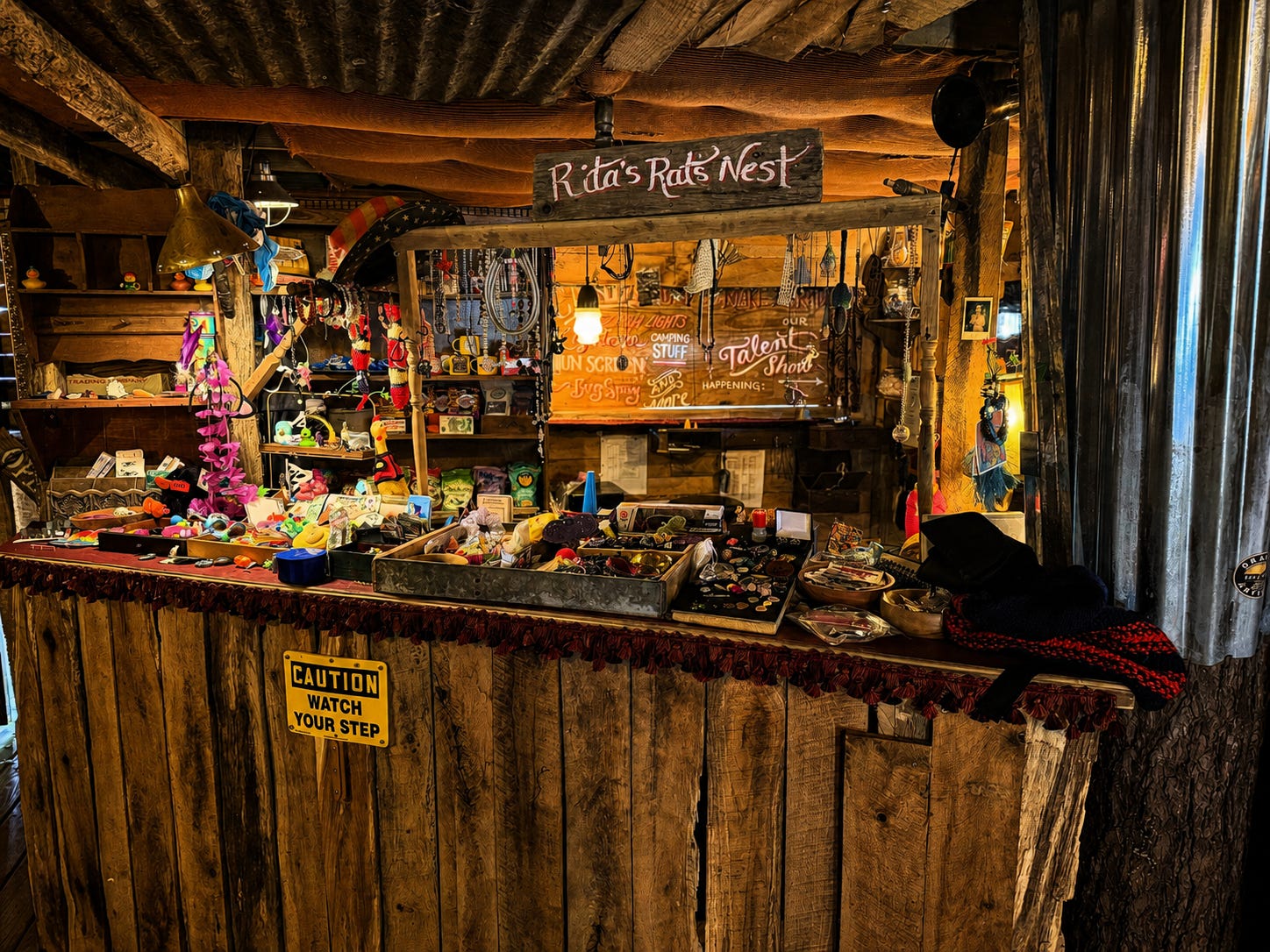
Sheriff Phoenix greeted us with the warmth of someone welcoming old friends back into their home. It didn’t take long to understand that while visitors often think they’re walking into a place built around trading objects, the Trading Post has always been about something much deeper. Every item on those shelves arrived because someone believed its story wasn’t finished yet. The staff carefully documents those stories, preserving not only the objects themselves but the memories attached to them until another person walks through the door and feels an unexpected connection.
Listening to Phoenix describe the process completely changed the way we looked around the room. A wedding ring traded after the end of a marriage might one day become part of someone else’s beginning. A necklace that accompanied years of adventures might eventually inspire a new one. A simple brass key worth only a few dollars could become priceless because it reminds someone of their grandparents’ farmhouse. The Trading Post doesn’t ask, “How much is this worth?” It asks, “Why does this matter to you?” The answer is almost never found in the material. It’s found in the memory.
Phoenix’s own story could have easily become one of the legends traded across that very counter. Growing up around parents who worked as antiquers and auctioneers, they admitted antiques never held much appeal while they were younger. That changed after discovering Electric Forest. Years ago, Phoenix stood on the opposite side of the counter, slowly building a friendship through trades with Grand Artique co-founder Shane Dolan. A century-old military trumpet. A bracelet Shane had found during his honeymoon in Morocco. An antique dagger. Even a holy water sprinkler from a Catholic priest’s estate that had reportedly been used during thirteen exorcisms all became part of those early exchanges. Over time, the objects became less important than the conversations surrounding them.
Eventually, Phoenix walked back to the counter carrying another collection of treasures, but this time the trade they wanted wasn’t sitting on the shelves.
They wanted a job.
That simple request changed everything.
The trade was accepted, and Phoenix joined the Grand Artique family, eventually traveling with the organization around the country before inheriting the very role once held by the person who first welcomed them behind the counter. Somewhere along the way, the antiques they once overlooked became the language through which they now connect with thousands of people every year. It wasn’t simply a career. It was finding the place where every part of themselves finally made sense.
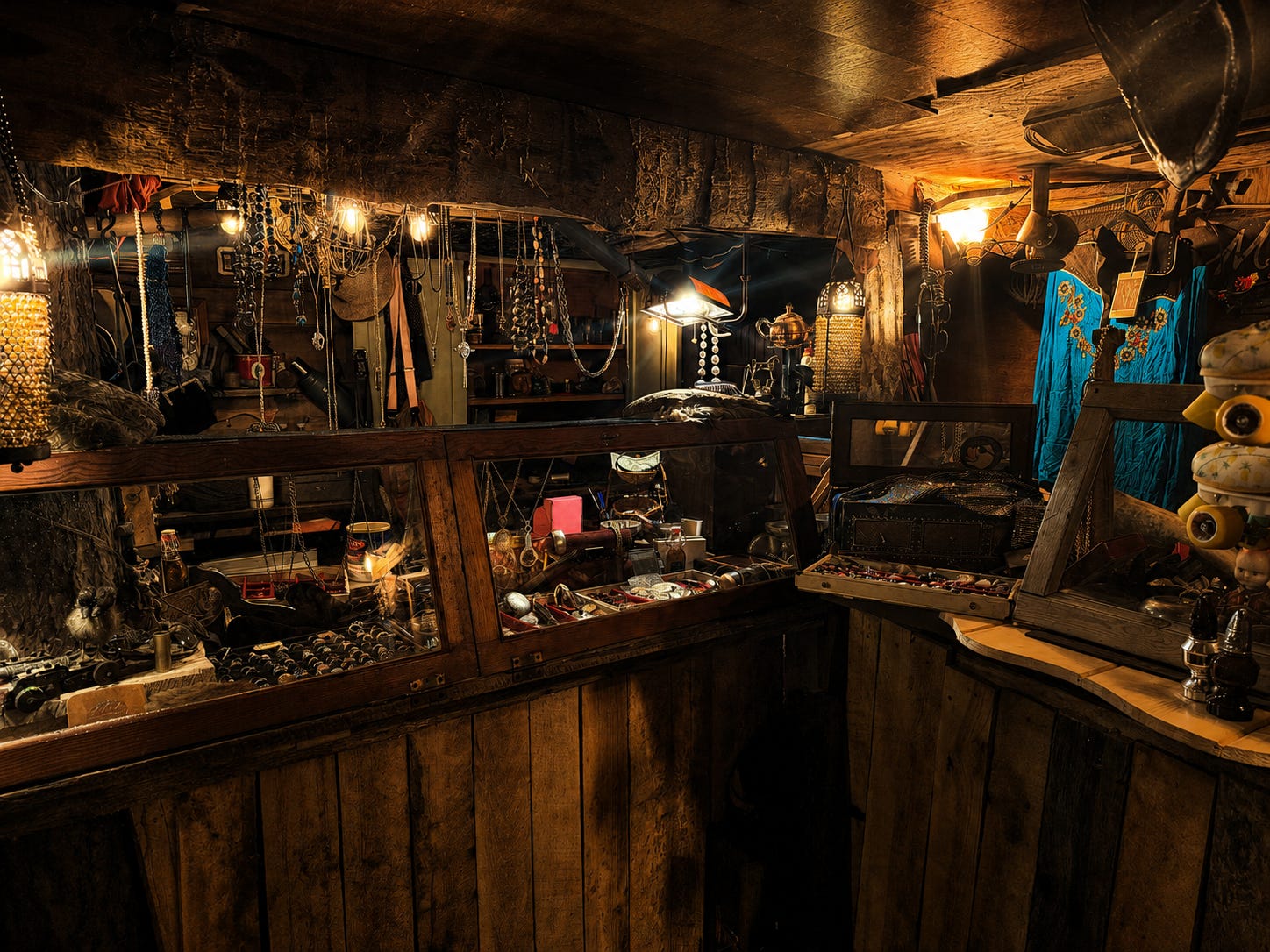
How this interview came to be you ask? Yesterday, Phoenix looked at Devin for a second, smiled and recognized him from a trade they had made years earlier. Not because of a press badge. Not because of Intellectual Dissatisfaction. Simply because of a conversation and an exchange that had stayed with them. In a festival attended by tens of thousands of people, that memory surviving all those years somehow felt completely believable. Electric Forest has always been unusually good at remembering people.
The recognition made Devin’s newest trade even more meaningful. After a little friendly negotiation, Phoenix agreed to part with a necklace inspired by The NeverEnding Story, explaining that it had originally come from someone they had met at Lightning in a Bottle in California. Like nearly everything in the Trading Post, it had already lived an interesting life before arriving in Rothbury. Now it was beginning another chapter.
As we wrapped up the interview, Phoenix shared another fact that perfectly captured the scale of what happens behind the scenes. After each festival, the crew carefully packs, catalogs and stores nearly ten thousand individual objects, preserving not just the items themselves but the stories attached to them so they can continue traveling from festival to festival until the next person discovers them. It’s an incredible amount of work for something that exists almost entirely because people believe memories deserve another chance.
Walking back outside, we arrived just as the gates swung open.
The crowd flowed into Sherwood Forest like water finally finding an open riverbed. Some sprinted toward favorite stages hoping to claim the perfect hammock spot before anyone else. Others wandered with no destination at all, content to let the Forest decide their day for them. Watching thousands of people disappear beneath the trees, it struck me that every one of them had unknowingly brought something worth exchanging. Maybe it was a bracelet. Maybe it was a story. Maybe it was simply a smile offered to the right stranger at the right moment.
By the end of the weekend, almost none of them would leave carrying exactly what they brought in.
Please consider Donating to Sponsor an article even $1 helps!

The Forest chooses participants
Once the initial wave of people disappeared beneath the trees, the Forest settled into its familiar rhythm. One of the things we’ve always appreciated about arriving early is getting to watch the place wake up instead of being dropped into the middle of the rush. Vendors rolled open their storefronts, actors quietly slipped into character long before most guests would ever meet them and artists made the final adjustments to installations that would soon become backdrops for thousands of photographs. There was a calmness hanging over Sherwood that only exists for a short window every morning before the festival fully stretches its legs.
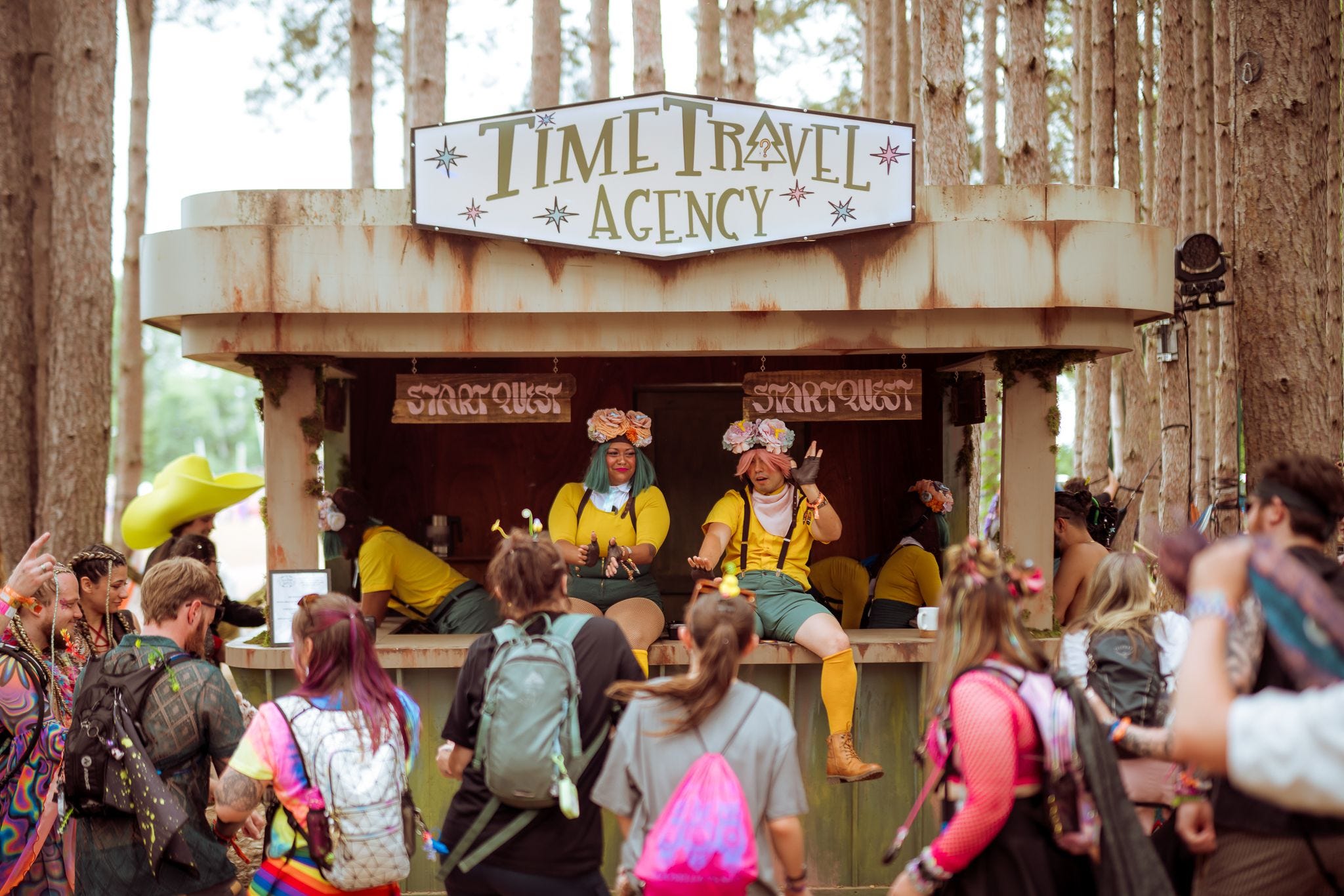
That slower pace gave us another opportunity to spend time with the people behind one of Electric Forest’s most recognizable traditions, the Time Travel Agency.
For years we’ve enjoyed participating in the annual scavenger hunt, collecting clues that slowly unlock hidden experiences tucked throughout the Forest. Like many attendees, we always treated it as another entertaining side quest without giving much thought to the people responsible for building the experience. Sitting down with the show’s creators completely changed our perspective.
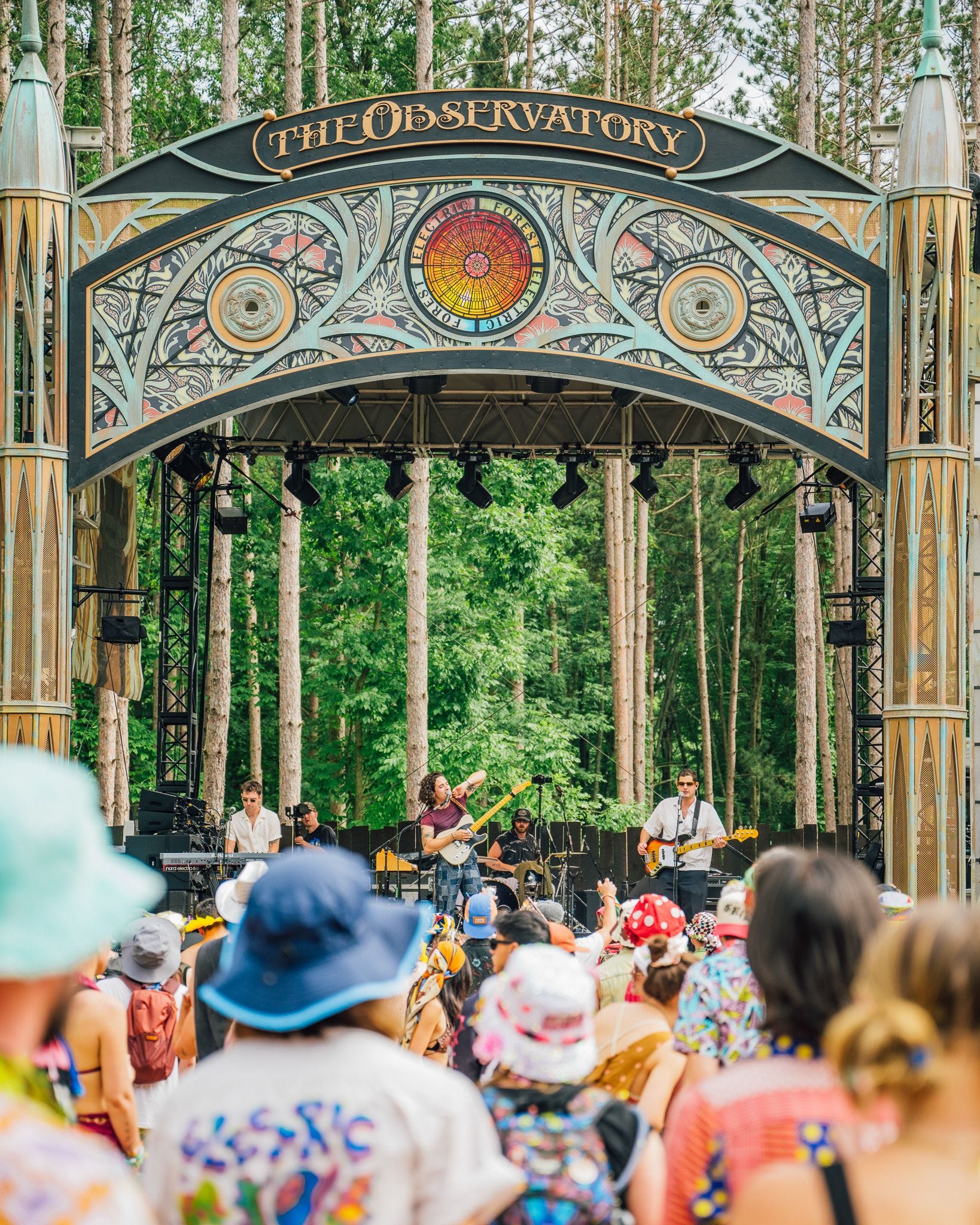
One of the first things they told us surprised us. The Time Travel Agency didn’t begin as a corporate attraction dreamed up inside a conference room. It started as a fan project. Electric Forest saw the creativity behind it, embraced it and slowly helped it grow into the experience thousands of people now line up to enjoy every year. Somehow that origin story made perfect sense. So many of the Forest’s traditions begin because someone cared enough to build something simply for the joy of sharing it.
This year’s story revolved around six moments throughout history where goodness had almost happened before being lost. Rather than watching the story unfold from the sidelines, guests became time travelers tasked with restoring those moments themselves. That small shift completely changes the experience. You aren’t standing in line waiting for actors to entertain you. You’re helping tell the story. Every clue solved, every hidden room discovered and every strange interaction with a wandering character becomes another piece of a much larger puzzle.
The creators laughed when we asked how many people eventually discover every secret.
“Nobody.”
Not even them.

Even after helping build the experience, there were moments they hadn’t personally witnessed because the story evolves differently for every participant. They also shared that the six puzzle experiences were designed and built in roughly a week before the festival, an incredible amount of work considering the detail poured into each environment.
It explained something we’d noticed all weekend without fully understanding why. Every actor we encountered remained completely committed to their role. Whether it was the mechanic “repairing” Hope’s moxie, the eccentric dentist handing out toothbrushes or the mysterious witch who would become part of our evening later that night, nobody ever slipped out of character. The Forest doesn’t ask performers to simply play a role. It asks them to become part of a living world.
The interview also answered one lingering question from Thursday. Completing the Time Travel Agency quest doesn’t simply earn participants a commemorative pin. That pin quietly becomes another key. Those paying close attention may eventually find themselves standing near a wall of purple roses where another hidden doorway reveals itself. We won’t spoil what waits beyond that point because discovering it yourself is part of the magic, but knowing how carefully these experiences are layered only deepened our appreciation for the people creating them.
A place called Space Fruit
Eventually, all the wandering catches up with you.
By Saturday afternoon we’d already logged miles through Sherwood Forest, conducted interviews, explored hidden rooms, photographed vendors and chased stories that kept branching into new ones. Festivals have a funny way of distorting distance. You convince yourself you’ve only been walking for a little while before your legs quietly remind you that you’ve crossed the grounds several times already.
Thankfully, we already knew exactly where we wanted to stop.
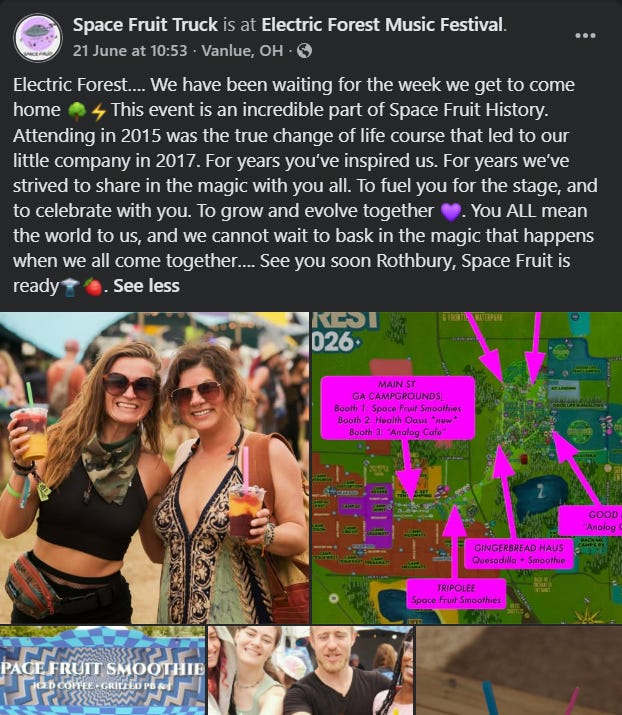
Our relationship with Space Fruit actually began long before Electric Forest. We first discovered them at Secret Dreams Festival, where they quickly became our favorite food vendor of the entire weekend. More than once they rescued us from the dangerous combination of heat, exhaustion and forgetting that your body occasionally needs something besides caffeine and determination. So when we learned they weren’t simply returning to Electric Forest but had expanded into one of the festival’s largest food operations, sitting down with them became one of our highest priorities.
By this point in the afternoon, grabbing another smoothie and one of their kale salads wasn’t just another meal. It had quietly become part of our own festival tradition.
I’ll admit something.
I’m usually the person who arrives at a festival with every intention of eating healthier, only to realize three days later I’ve somehow survived almost entirely on fried food and questionable life choices. Somehow Space Fruit keeps breaking that cycle. Their kale salad, packed with fresh vegetables and enough substance to actually fuel the rest of the day, became one of the best meals I ate all weekend. Pair that with one of their smoothies topped with their signature frozen Space Fruit, and suddenly eating well doesn’t feel like sacrificing anything.
It also solves a problem almost every summer festival creates. Once the afternoon heat settles in, there are days when solid food becomes less appealing than something cold you can sip while making your way to the next stage. The smoothies are refreshing without feeling heavy, and when you’re trying to make it through another six or eight hours of walking, dancing and carrying camera gear, they become exactly what your body hoped you’d find.
What surprised us most wasn’t the menu.
It was the story behind it.
Founders Bri and Kelvin explained that Space Fruit began with two high school friends who simply fell in love with music festivals. Like countless young festivalgoers, they wanted to keep coming back year after year, but reality eventually reminds everyone that road trips, tickets and camping gear aren’t free. Instead of giving up the lifestyle they loved, they asked themselves a different question.
What if the festival became our work?
That simple idea eventually became Space Fruit.
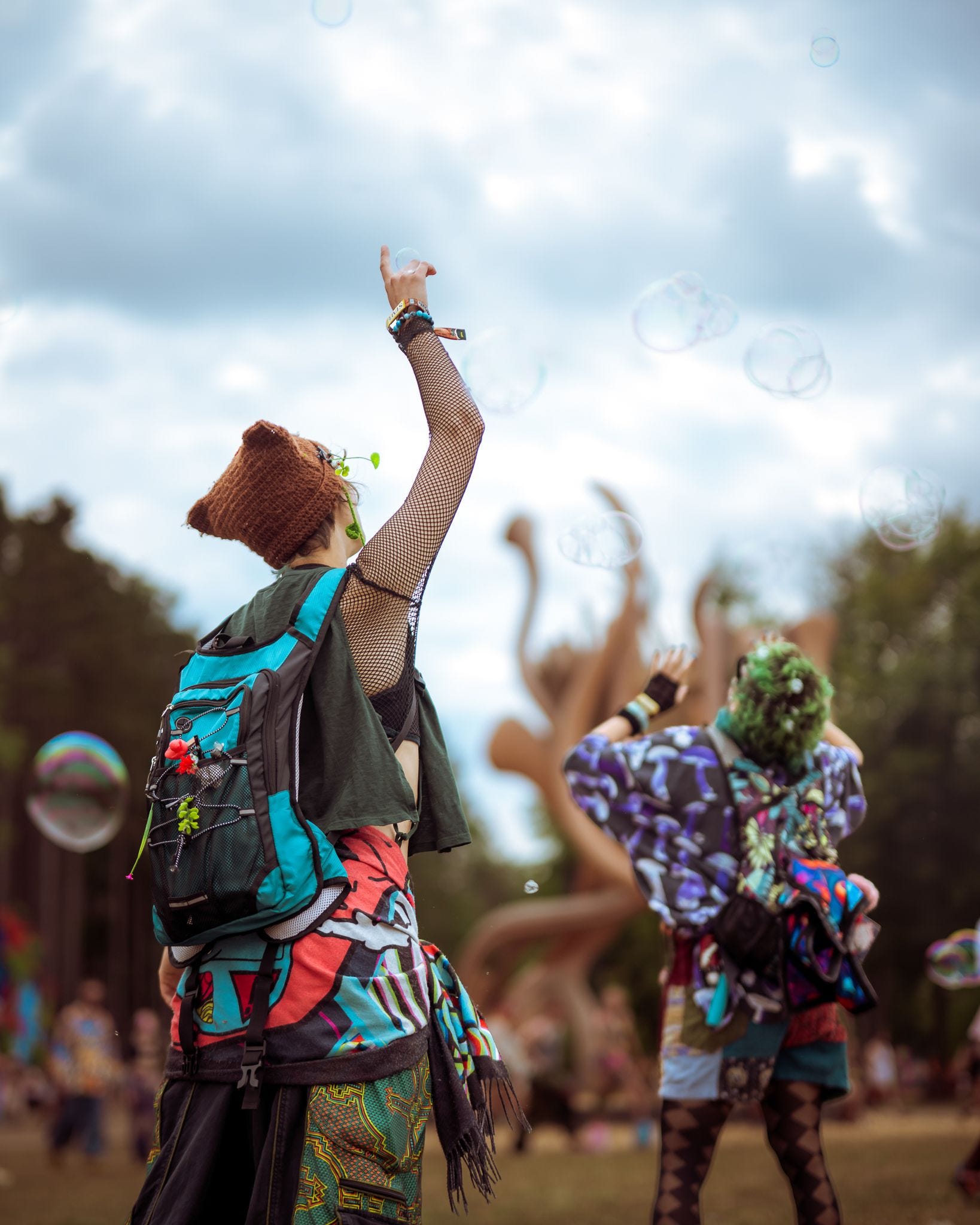
Kelvin smiled while remembering his first Electric Forest over a decade ago. He talked about how the music drew him in, but it was the people, the vendors and the little communities scattered throughout the grounds that stayed with him long after the weekend ended. Their dream wasn’t simply to sell food. It was to become one of those experiences someone would remember months later while telling stories about their weekend.
Listening to them, it became obvious that dream had already come true.
Today, Space Fruit has grown far beyond a single booth. This year alone they operated eight different locations throughout Electric Forest while managing a team of more than 110 employees. Alongside their smoothie stands they’ve introduced their Health Oasis locations, offering fresh farm-inspired meals, expanded into their Space Ideas quesadilla concept and even created two Analog Cafés that provide guests with a quieter place to recharge. What started with two teenagers hoping to afford another festival season has grown into one of the largest independent operations inside Electric Forest.
Even with that growth, none of them spoke like people chasing expansion simply for the sake of getting bigger. Every answer eventually circled back to the same thing.
People.
That became especially clear listening to Pip tell his story. Introducing himself with a grin as “Pip the Potter,” he explained that he and Bri originally met through festivals, became close friends and eventually fell in love. Bri couldn’t resist laughing that he had “married his boss,” a joke that immediately filled the room with the kind of easy chemistry you only get from people who’ve genuinely built something together.
Pip described recognizing Space Fruit’s potential almost immediately after meeting Bri. He believed so deeply in what they were creating that he jumped in headfirst, helping transform a promising little operation into the company sitting in front of us today. Rather than talking about profits or business plans, he kept returning to the same idea over and over again.
Support.
Support the team.
Support the guests.
Support the experience.
That philosophy became especially visible in the Analog Café, one of the additions Pip seemed most excited to share. Calling it a café almost undersells what they’ve built. Hidden within the bustle of Electric Forest, it feels like someone quietly tucked an old neighborhood coffee shop into the middle of a music festival. Vinyl records spin throughout the day while people settle into comfortable chairs with a cup of coffee, escaping the constant movement outside for a little while. The conversations slow down. Friends reconnect before disappearing back into the crowd. Rather than trying to compete with the chaos surrounding it, the Analog Café embraces the opposite approach, becoming a sanctuary where the volume is measured more by conversation than by speakers.
Watching people drift in and out, it became obvious that many weren’t there simply because they wanted coffee. Some had been walking since morning. Others had been dancing until sunrise. A few looked perfectly content to sit quietly and let the world pass by before stepping back into another adventure. That simple idea kept appearing throughout our Saturday. We had seen it inside the hidden rooms of the Time Travel Agency, beneath hammocks strung between towering pines and now here inside the Analog Café. Electric Forest understands something many festivals overlook. The experience isn’t created solely by keeping people constantly moving. Sometimes the most thoughtful thing you can build is a place where someone can simply pause, collect themselves and breathe.
Toward the end of our conversation, I mentioned something I’d been noticing while wandering the grounds over the previous three days. It genuinely felt like I had overheard more people asking where they could find Space Fruit than asking about longtime festival favorite Island Noodles. It wasn’t meant as a competition. Island Noodles has earned legendary status over decades of festivals, and hearing another vendor mentioned with that same excitement caught my attention.
The response from the Space Fruit team probably taught me more about their company than any prepared interview answer could have.
Rather than celebrating the comparison, they immediately started talking about Island Noodles with genuine admiration. They praised the consistency they had maintained over the years, the reputation they had earned and the example they had set for other festival vendors. There wasn’t an ounce of rivalry in the conversation. Only respect.
Walking away from the interview, I realized we hadn’t simply spent time with the owners of one of Electric Forest’s most popular food vendors. We’d met people who genuinely see themselves as caretakers of the festival experience. Whether they’re serving smoothies at two in the afternoon, keeping booths stocked around the clock, spinning records inside the Analog Café or giving someone their first truly healthy meal in days, everything they do comes back to helping people enjoy their weekend a little more.
For a company that started with two high school friends trying to figure out how to afford another festival, that journey has come full circle in a beautiful way. Today they’re no longer wondering how to stay in this world. They’re helping build it. Every smoothie handed across the counter, every employee welcomed onto the team and every tired festivalgoer who walks away feeling a little more refreshed becomes another small contribution to the community that first inspired them.
After spending time with them, it was easy to understand why so many people had made Space Fruit part of their own Electric Forest tradition.
The things you can’t put on a setlist
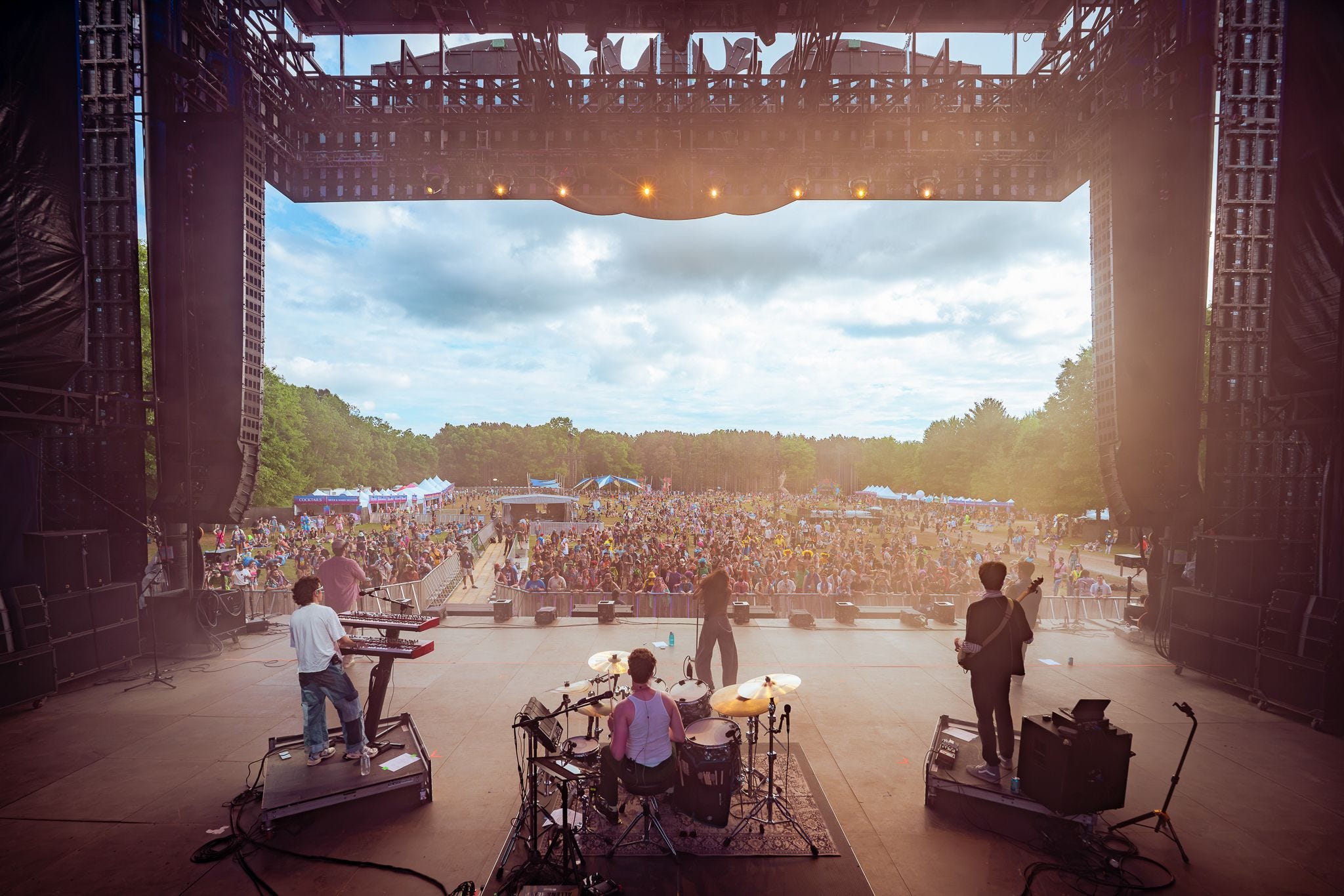
One of the easiest mistakes to make when writing about Electric Forest is assuming the music tells the entire story. The lineup is extraordinary every year, bringing together some of the biggest names in electronic music alongside jam bands, funk, hip-hop and artists who don’t fit neatly into any one genre. Those names are what sell tickets, fill playlists and spark conversations months before anyone ever sets foot in Rothbury. Yet somewhere between the first stage you visit and the last one you leave, another festival quietly reveals itself. It isn’t built by headliners or production crews alone. It’s built by painters, leather workers, sculptors, coffee makers, actors, jewelers and countless creators who never perform beneath a spotlight but leave just as lasting an impression.
With our interviews wrapped up for the afternoon, we did what Electric Forest has slowly taught us to do over the years. We stopped looking for the next destination and simply wandered. Early in the weekend there’s a tendency to move with purpose, constantly checking schedules and worrying about missing something. By Saturday, those instincts begin to fade. The best discoveries usually aren’t the ones circled on a map. They’re the ones you stumble into because you allowed yourself enough time to stop.
The vendor village rewarded that mindset almost immediately. Every booth seemed to offer another invitation to linger a little longer. Psychedelic reinterpretations of classic cartoons hung beside hand-tooled leatherwork. Handmade clothing swayed gently in the breeze while jewelry, sculptures and paintings transformed every corner into a gallery. One vendor displayed enough Chewbacca-inspired outfits to make it feel as though Kashyyyk itself had quietly opened a storefront beneath the pines. More than anything, though, what stood out wasn’t the merchandise. It was the artists themselves. Every creator seemed genuinely excited to explain where an idea came from, how something was made or what inspired an entire collection. Their booths weren’t simply businesses. They were extensions of their personalities.
One artist handed us something we’d never experienced before, a handcrafted copper kaleidoscope pendant. Instead of asking us to admire it from the safety of the display table, they encouraged us to borrow it and carry it into the Forest. “Go see what you find,” they said.
That small gesture completely changed the afternoon.
Looking through the pendant transformed familiar places into something entirely new. Sunlight fractured into shifting patterns that no camera filter could recreate. The towering white pines dissolved into ribbons of green and gold while installations we’d already photographed suddenly looked as though they belonged in another world. Eventually we found ourselves standing in front of one of my favorite pieces in all of Electric Forest, the Piano in the Woods. I’ve photographed that piano before, and every year I find myself drawn back to it, but viewing it through someone else’s artwork reminded me that sometimes the greatest gift an artist can offer isn’t creating a new subject. It’s teaching someone a new way to see an old one.
As we continued making our way down Main Street, we remembered one promise we still needed to keep. Before leaving for Michigan, we’d told our hydration sponsor, RaveRunner, that we’d grab photographs of their exclusive Electric Forest collaboration hydration bag while it was being sold inside the official merchandise booth. It sounded like one of the simplest assignments of the weekend. Walk over, snap a few photos and send them back.
Reality had been much less cooperative.
Since Thursday we’d stopped by the merchandise booth three different times. Each visit ended with the same optimistic answer. “Check back later.” “We’re waiting on another shipment.” “They should be restocking soon.” By Saturday afternoon we figured we’d give it one final attempt before admitting we had simply missed our opportunity.
Raphael, working behind the merchandise counter, greeted us with an apologetic smile before explaining what had happened. There wouldn’t be another restock because there wasn’t anything left to restock. The collaboration had sold out almost immediately. For RaveRunner, that was actually wonderful news. Their limited-edition Electric Forest bag had clearly resonated with attendees, disappearing into the crowd long before we managed to photograph one. After hearing why we kept returning, Raphael happily offered another solution. While there wasn’t a single hydration pack left hanging on the wall, he let us photograph the point-of-sale screen showing the RaveRunner collaboration in the merchandise system so we’d have something to bring back to our sponsor.
It wasn’t the photograph we’d originally promised to capture, but by then it had become a better story. Sometimes the clearest proof that people embraced something isn’t seeing it sitting on a shelf. It’s arriving just a little too late because everyone else got there first. We owe Raphael a sincere thank you for taking a few extra minutes to help us keep our word.
As the afternoon slowly gave way to evening, we found ourselves wandering back toward one of the places that had fascinated us since Thursday: the Time Travel Agency maze. We already knew there were still experiences hidden somewhere inside that we hadn’t discovered, and curiosity has always been one of the easiest ways to lose track of time at Electric Forest.
The maze welcomed us back like an old friend who still had one more secret to share.
Earlier in the weekend we’d visited the mechanic who “repaired” Hope’s moxie, stopped by the delightfully strange dentist’s office where guests walked away with complimentary toothbrushes and uncovered quiet spaces hidden behind walls that most people never realized opened. Every room carried its own personality, making the maze feel less like an attraction and more like an entire neighborhood tucked inside the Forest.
This time we found ourselves invited into the séance room.
Stepping through the doorway felt like crossing into another century. Candlelight flickered across weathered furniture while shelves overflowed with mysterious objects that looked as though they’d been collected over generations. The actor leading the experience never once stepped outside their role, inviting everyone inside to become participants rather than spectators. At one point, much to my own amusement, I was chosen to become the witch for the séance.
It was impossible not to laugh.
At the same time, it perfectly illustrated what makes these immersive experiences so memorable. The performers never wink at the audience to remind everyone it’s pretend. They trust complete strangers to lean into the story, and those strangers almost always do. Thousands of people willingly suspend disbelief together, if only for a few minutes, because everyone silently agrees that imagination deserves to be taken seriously.
That commitment has become one of Electric Forest’s greatest strengths. Whether you’re talking to a mysterious doctor, an eccentric mechanic, a woodland creature or a fortune teller, nobody breaks the illusion. The actors don’t simply perform for the audience. They invite the audience to perform alongside them. That’s a very different kind of entertainment, and one that stays with you long after you’ve left the room.
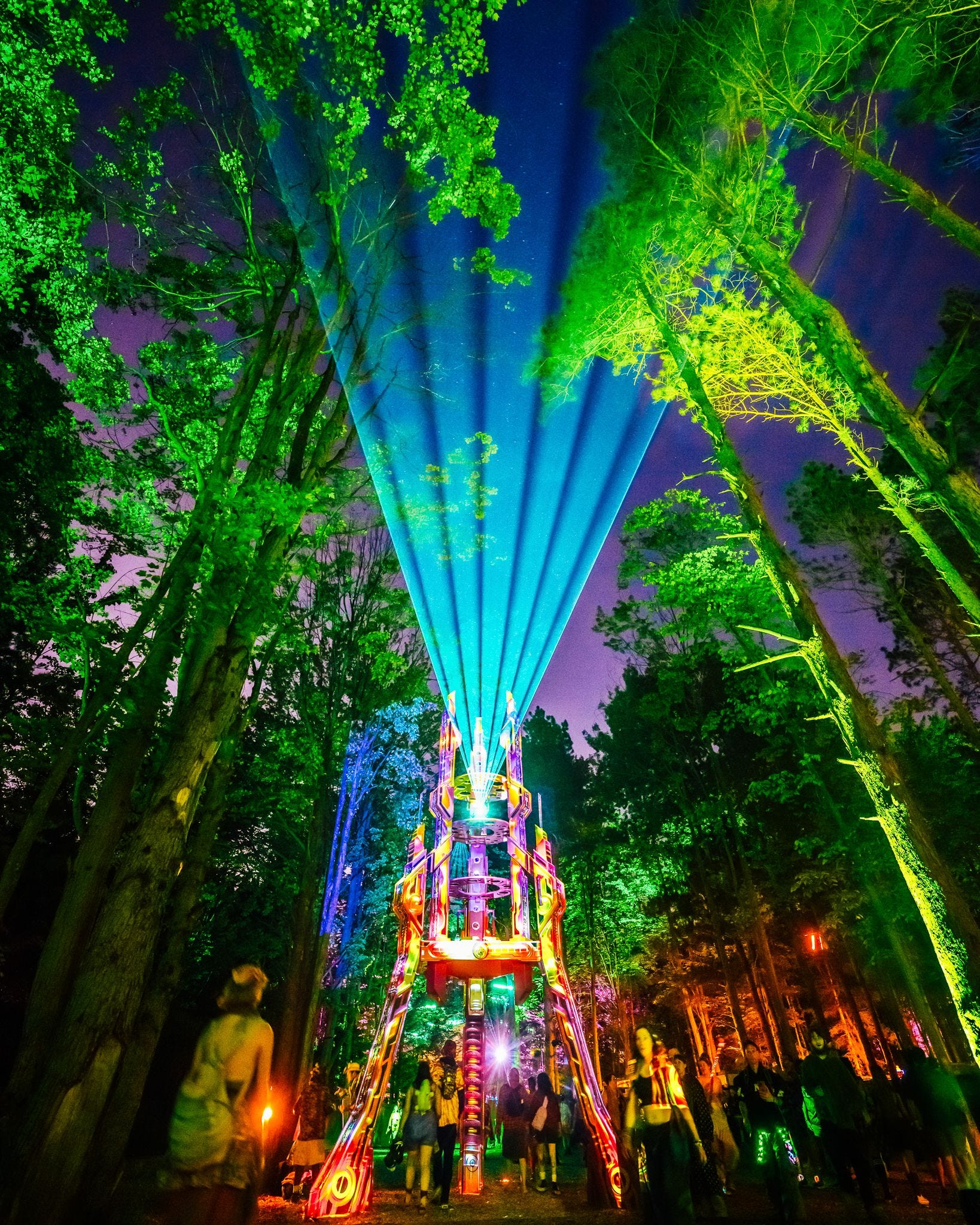
By the time we stepped back outside, daylight had almost completely disappeared beneath the canopy. Strings of lights now traced the pathways through Sherwood Forest, lanterns glowed from hidden corners and the distant pulse of bass echoed between the trees. The festival had transformed once again. The relaxed pace of the afternoon was giving way to the electricity of another Saturday night, and thousands of people were all beginning to move toward the same destination.
One of the biggest crowds of the weekend was already gathering.
It was finally time for DJ Diesel and Teddy Pain.
When the Forest starts dancing together
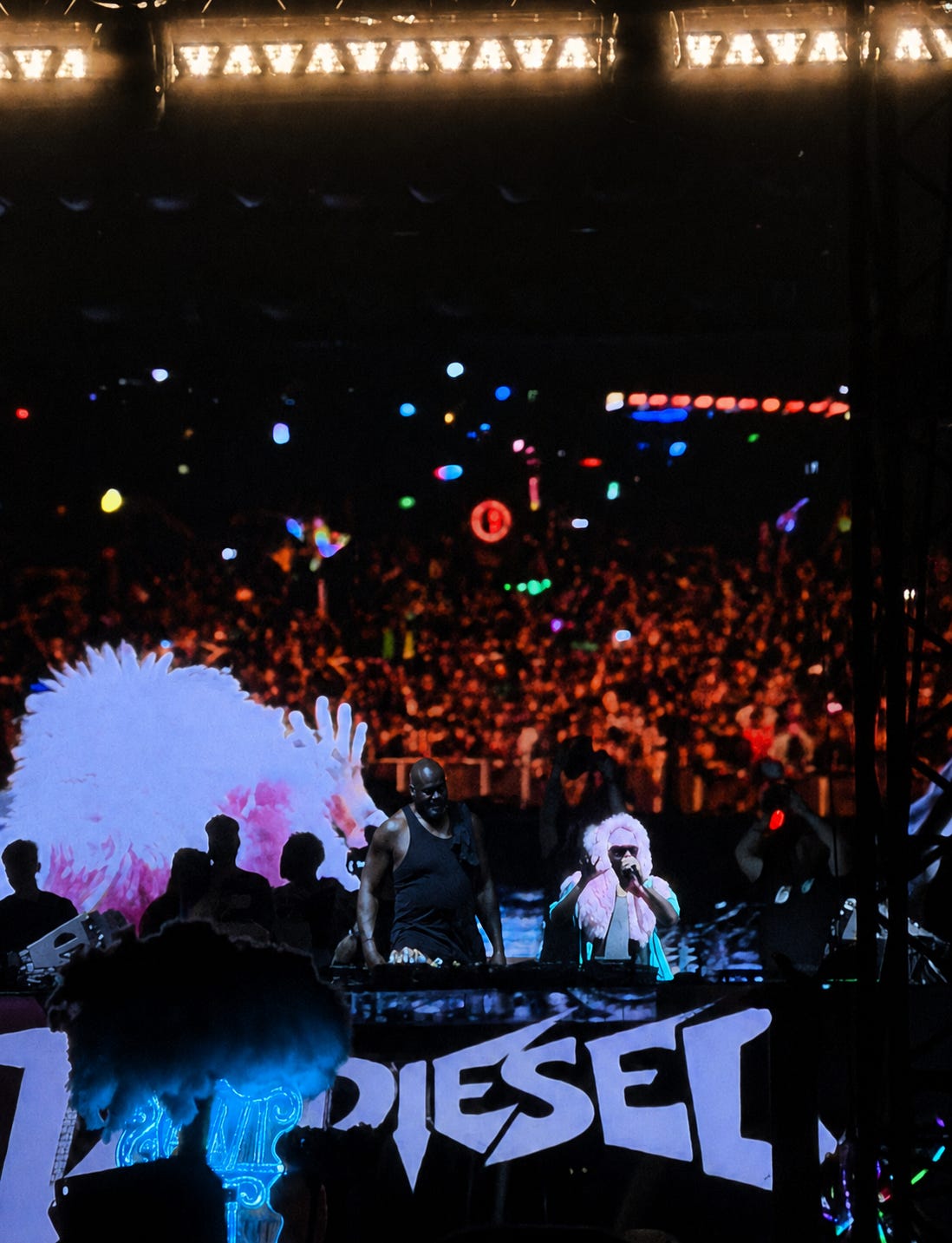
By the time we made our way toward Ranch Arena, the atmosphere had shifted again. That’s one of the remarkable things about Electric Forest. The same pathways you wandered peacefully that afternoon now pulsed with movement as streams of people flowed toward the night’s biggest performances. The conversations were louder, costumes glowed beneath LEDs instead of sunlight and every stage seemed to pull another current of people through the trees. Saturday night always feels like the point where the entire festival has found its rhythm. Everyone has settled into camp life, discovered their favorite corners of Sherwood and figured out which shoes were the wrong choice. By now, strangers have become neighbors and familiar faces start appearing everywhere you look.
The crowd gathering for DJ Diesel B2B Teddy Pain reflected exactly that feeling. It wasn’t simply large. It was the kind of audience that arrives early because nobody wants to miss the beginning. Groups squeezed together to make room for newcomers while conversations bounced between favorite Shaq stories, old T-Pain hits and guesses about what the two might have planned. Electric Forest crowds have a reputation for looking after one another, and moments like this remind you why. Tens of thousands of people can gather in one place without losing the sense that everyone is collectively looking out for the experience around them.
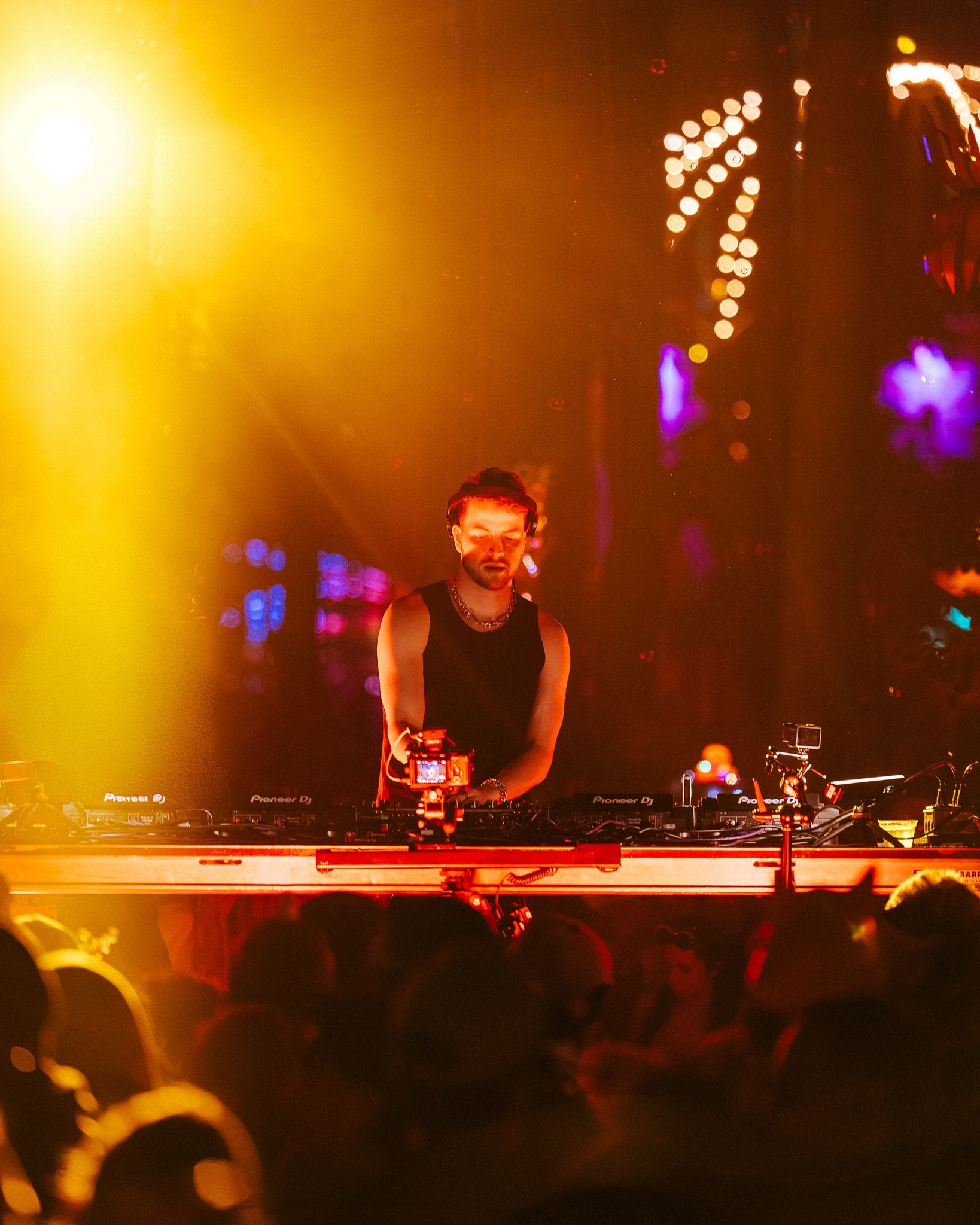
The collaboration itself worked because neither artist tried to become the other. DJ Diesel brought the crushing bass and larger-than-life presence that have become staples of his festival sets, while T-Pain balanced the night with his unmistakable charisma and catalog of songs that somehow still feel woven into popular culture years later. The set bounced between hip-hop, bass music, surprise edits and moments that felt equal parts concert and celebration. There was never much concern for staying inside one genre because Electric Forest has never been a festival that asks artists to color inside the lines.
Watching from the crowd, I found myself appreciating something beyond the music itself. We had ended up spending the set with one of our longtime festival friends and several people they had met over years of attending festivals together. Some friendships had started at Electric Forest. Others began somewhere entirely different before eventually crossing paths again beneath these same trees. That seems to happen here with surprising regularity. Festivals become reunion grounds where circles of friends slowly expand each year until nobody can quite remember who introduced whom in the first place.
Those are often the moments that stay with you longest.
Not necessarily the biggest bass drop.
Not the loudest cheer.
Just standing in the middle of a crowd, looking around and realizing everyone is sharing the same memory while it’s happening.
As the music continued late into the night, I couldn’t help thinking back to how the day had begun. That morning we sat inside the Trading Post talking with Sheriff Phoenix about how every object carries the story of the people who held it before. Throughout the afternoon we met artists sharing pieces of themselves through paintings, jewelry and handmade creations. The Time Travel Agency invited thousands of strangers to become characters inside a story instead of simply watching one unfold. Space Fruit reminded us that sometimes caring for a community looks like handing someone a smoothie, a healthy meal or simply giving them a quiet place to catch their breath before heading back into the crowd.
By the time Saturday reached its final hours, it became clear those weren’t separate stories at all.
They were all telling the same one.
Electric Forest has always been known for incredible music, elaborate production and unforgettable performances, but after three days beneath these trees, I found myself thinking less about stages and more about the people standing between them. The artists who loaned us a kaleidoscope pendant simply because they wanted us to see the Forest differently. Raphael taking a few extra minutes to help us document a sold-out RaveRunner collaboration. Phoenix remembering a trade from years earlier. The Space Fruit team building a company around making someone else’s vacation a little brighter. Every interaction quietly added another thread to a weekend that already felt impossibly full.
When people ask what makes Electric Forest different, they often expect an answer about production budgets or lineups.
Those things certainly help.
But after spending another year here, I think the real answer is much simpler.
The Forest has spent years creating a place where people are encouraged to contribute something instead of simply consume something. Some contribute music. Others contribute artwork. Some build elaborate scavenger hunts or hidden theatrical worlds. Some hand strangers handmade Pokémon. Others serve smoothies, trade antiques, lend kaleidoscopes or simply offer directions to someone who looks lost.
Everyone leaves something behind.
Afterglow

By the time we made our way back toward camp, the music had faded into the distance, but the conversations from the day were still finding places to settle. It’s funny how quickly a festival changes your definition of what feels valuable. That morning began with a room full of antiques whose worth was measured by the stories attached to them. By nightfall, we’d added a few stories of our own.
The NeverEnding Story necklace had found another chapter. A handmade kaleidoscope pendant had shown us familiar places through unfamiliar eyes. A sold-out RaveRunner collaboration bag reminded us that sometimes success leaves nothing behind but a good story. Space Fruit had once again proven that taking care of people can become its own kind of art, while the actors, artists and dreamers scattered throughout Sherwood continued quietly building a world where imagination is treated as something worth protecting.
Saturday felt less like chasing a lineup and more like collecting pieces of the people who make Electric Forest what it is. The music was incredible, but between the stages we found the caretakers, the storytellers, the creators and the volunteers whose fingerprints are on this place in ways most attendees never see. They don’t appear on posters, yet they help shape the memories people carry home every year.
Tomorrow would bring another sunrise, another wave of music and another chance for the Forest to surprise us. If the first three days had taught us anything, it was not to expect the next chapter to look anything like the last one. Around here, the best stories have a habit of waiting just beyond the next trail.

Please consider Donating to Sponsor an article even $1 helps!
